
2026 iGaming Trends: Why White Label Platforms Emerging Fast
Something shifted in iGaming this year. Not gradually. More like a switch got flipped. Brazil shot straight into the top three markets after its federal sports betting framework went through. New Zealand wants to issue 15 operator licenses. Thailand drafted gambling legislation. Markets nobody took seriously eighteen months ago are suddenly handing out licenses.
And the old playbook — spend two years building your own platform from scratch — that stopped making sense for most operators a while back.
We see it constantly at DSTGAMING. Operators reach out after burning through months and budgets on the custom route. The conversation usually starts: “We need to be live yesterday.” White label used to carry a stigma, like admitting you couldn’t build your own thing. Not anymore. Choosing white label in 2026 is the strategic move.
Market snapshot
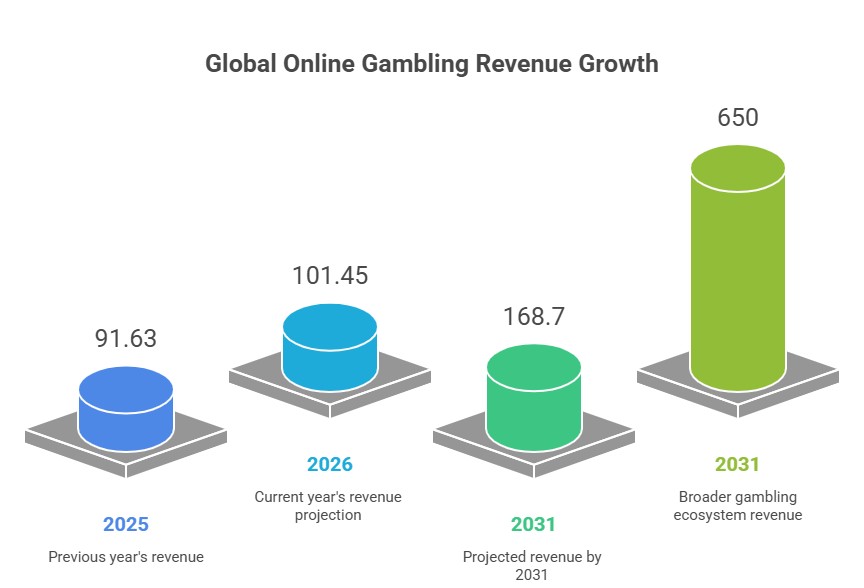
Global online gambling revenue sits around $101.45 billion in 2026. Up from $91.63 billion last year. The projection for 2031 is $168.7 billion at a 10.7% CAGR. Zoom out to the broader gambling ecosystem and revenue is heading past $650 billion.
Raw totals are one thing. What actually caught our attention:
Phones run everything. Over 53% of online gambling revenue flows through mobile devices now, growing at 13.6% yearly. We talked to an operator last quarter who said desktop was maybe 15% of their total traffic. Fifteen percent. The shift went faster than most people expected.
Then regulation. Brazil got its framework rolling and shot to the top. New Zealand wants those 15 licenses issued this year. North America still leads growth at 15.4% CAGR. Doors opening everywhere. They won’t stay open forever though.
What’s driving the white label boom
Getting to market — the part that kills most plans
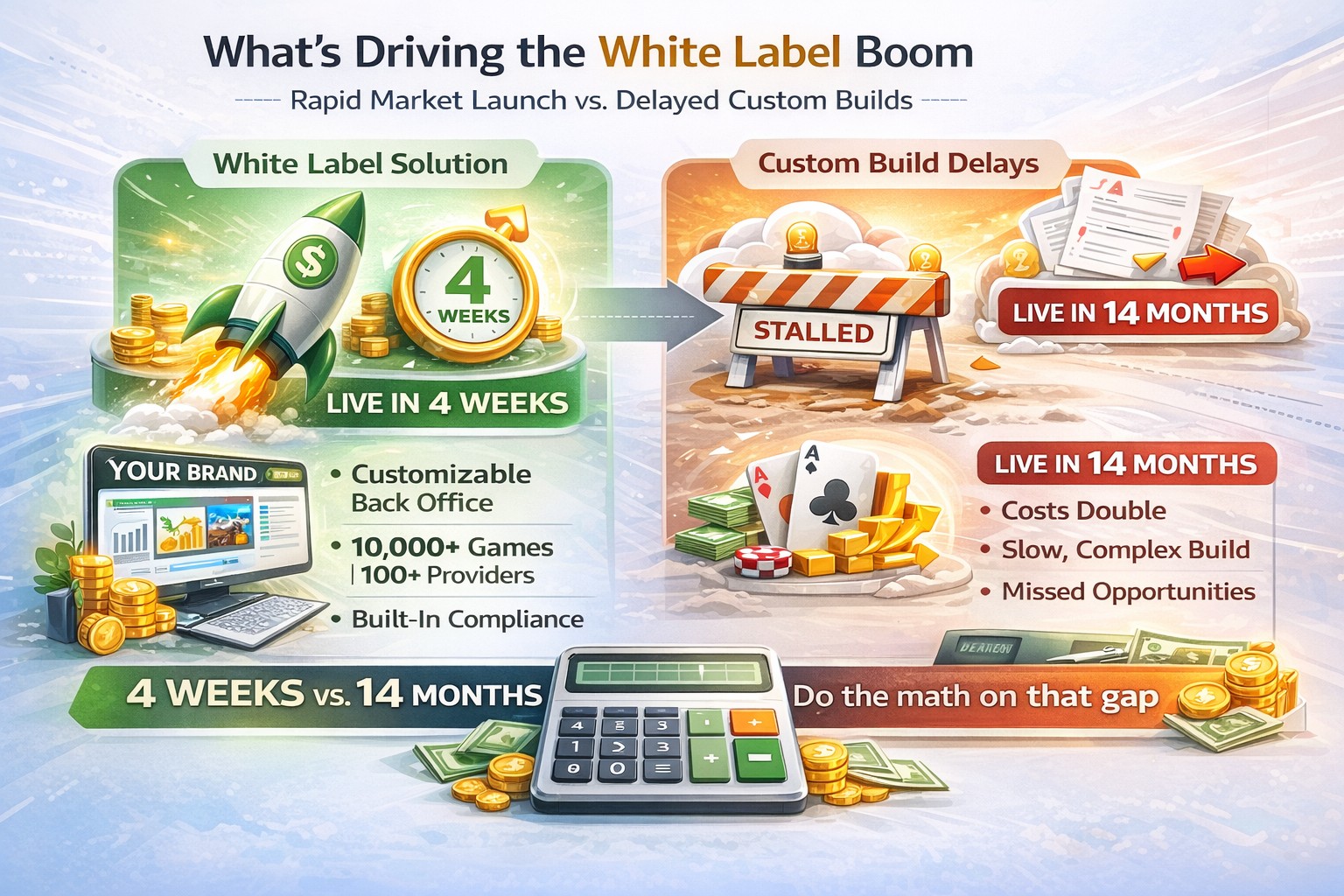
We’ll be blunt. We’ve watched operators miss entire market cycles because their custom build took too long. A country opens up, early movers grab affiliates and the player base, and by month fourteen — when the custom platform finally goes live — acquisition costs doubled. Not a hypothetical. We have seen it happen repeatedly.
Our white label online casino solution gets operators live in roughly four weeks. Fully branded. Customizable back office. Our casino game aggregator loaded with 10,000+ titles from over 100 providers. Payment solutions that work on day one. Compliance baked in.
Four weeks versus fourteen months. Do the math on that gap.
AI stopped being a slide in someone’s pitch deck
Two years ago “AI-powered” was something vendors slapped on marketing materials. Half couldn’t explain what the AI actually did. That era ended.
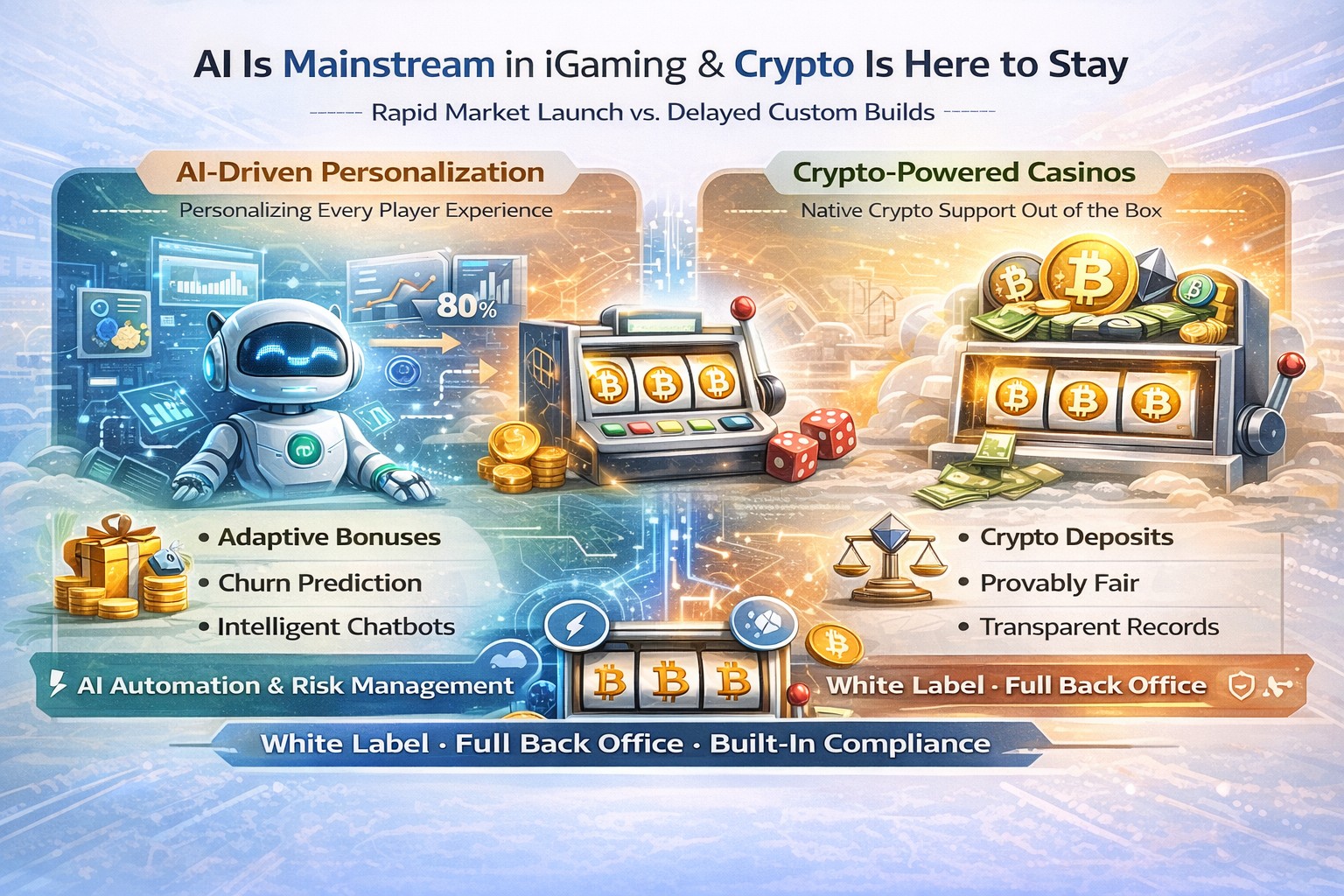
Now operators use machine learning for bonus personalization that adapts to individual player behavior. Chatbots resolve real issues instead of sending people in circles. Predictive models flag players likely to churn before they actually leave.
Building that in-house though? ML engineers, data infrastructure, months of model training. We decided to skip that problem for our operators. DSTGAMING embeds risk management and AI-driven personalization directly into the white label stack. Operators launch with these capabilities already working. No separate integration project.
We wrote about this convergence in our piece on the future of casino APIs — aggregation, security, and automation merging in ways that would’ve sounded far-fetched two years ago.
Crypto lost its novelty
Remember when accepting Bitcoin felt edgy? Press releases about it and everything? That was 2020. Players under 35 now just expect crypto options. Bitcoin, Ethereum, stablecoins. Table stakes.
Blockchain brings more than payment flexibility too. Provably fair gaming. Transparent transaction records. Decentralized identity verification. Not theoretical anymore.
We built a dedicated crypto casino solution for this exact reason. It layers native crypto support onto our full white label stack — same game library, same back office, same compliance tools. Operators targeting digitally native demographics can launch crypto-ready without cobbling together separate integrations.
Compliance would be funny if it weren’t so expensive
Here’s what operators deal with on the regulatory side. Brazil’s licensing? R$30 million for five years under Law No. 14,790/2023. New Zealand auctioning 15 licenses. Europe’s MiCA regulation dumping fresh compliance requirements on anyone accepting crypto. Every single jurisdiction with its own KYC rules, AML requirements, responsible gambling mandates.
Nobody got into iGaming because they love regulatory filings. We get that. But fines are brutal and reputational fallout is worse.
Our compliance framework at DSTGAMING is built, battle-tested, continuously maintained. Multi-language, multi-currency — standard. What used to be a six-month legal project becomes weeks. For operators targeting multiple markets at the same time? Our platform handles cross-border requirements without the usual piecemeal chaos.
Keeping players around
Player acquisition costs climbed again this year. Getting someone to sign up is easy. Any decent marketing team can drive registrations. The part that actually determines profitability is whether that player comes back next week. Next month.
Gamification changed the equation for operators who adopted it early. Loyalty tiers, tournaments, leaderboards, achievement systems. It turns a casino from somewhere you visit occasionally into something you engage with. We built our gamification solutions right into the white label. No separate development. No stitching together third-party tools that barely communicate.
Our overview of emerging iGaming solutions covers tokenized loyalty programs and social gaming features too — both seeing serious pickup right now.
Mobile is the minimum
Over half of all iGaming traffic comes from phones. Slow load, buttons overlapping — player’s gone. Probably to a competitor. Probably permanently.
We designed our platform mobile-first from the start. Clean rendering across phones, tablets, desktops. Same speed, same polish. Not a feature we highlight — it’s the bare minimum for operating in 2026.
Custom builds vs. white label
Some operators go custom. We respect the ambition. But side by side:
| Factor | Custom Build | White Label (DSTGAMING)
|
|---|---|---|
| Time to Market | 12–24 months | Around 4 weeks |
| Upfront Investment | Very high | Significantly lower |
| Game Integration | Manual, per provider | 10,000+ games ready |
| Compliance | Build it yourself | Already integrated |
| Payment Systems | Custom development | Multi-currency, working |
| Ongoing Maintenance | Your team handles it | 24/7 DSTGAMING support |
We wrote a full walkthrough on how to start a white label iGaming business. For online casino startups especially — white label turns what used to take years into weeks.
What we bring to the table
After years of doing this, we’ve learned the difference between what operators think they need on day one and what matters six months in. Technology is part of it. But here’s the full picture:
Our casino game aggregator gives access to 10,000+ titles from 100+ providers. Slots, live dealer, table games, crash games. Deployment options range from white label to turnkey to crypto casino, depending on the operator’s situation. Payment solutions cover cards, e-wallets, bank transfers, and crypto across currencies through a single integration. Operators wanting exclusive content can work with our casino game development team. Fraud detection and risk management run continuously. Our technical team is available around the clock.
We stay involved after launch. That’s the part most vendors skip. Also the part that determines whether an operator succeeds.
Where this is going
More countries will regulate — that trend has run five years straight with no sign of reversing. Technology keeps getting complex. Player expectations keep rising. Doing everything in-house keeps getting more expensive.
White label is growing faster than the broader iGaming market and the reasons are plain. Compliance costs more every year. Technical requirements get steeper. Most operators can’t justify full engineering and legal teams when a white label platform puts them on roughly the same playing field.
Modern white label platforms — modular, API-driven, deeply customizable — have reached a point where players can’t tell the difference between a white label site and a fully custom build. Industry insiders call this white label’s golden era. From where we sit, that sounds right.
Operators who position themselves now will be ready for 2027.
One last thought
This industry doesn’t wait. White label became the default for operators who refuse to spend a year building while competitors bank revenue. At DSTGAMING, that’s been our focus from the start — technology, compliance expertise, and ongoing partnership.
Curious whether it fits? Reach out for a free consultation. Concept to live casino in about four weeks.