
Crypto Casino: Launch, Compliance & Payments — The Complete 2026 Guide
The global online gambling market is experiencing a seismic shift. While traditional payment methods still dominate, cryptocurrency has emerged as the preferred choice for a growing segment of players who value privacy, speed, and lower transaction costs. If you’re considering launching a crypto casino or integrating cryptocurrency payments into your existing platform, you’re tapping into a market that’s projected to reach $250 billion by 2028.
But here’s the reality: launching a crypto casino isn’t just about accepting Bitcoin and hoping for the best. It requires navigating complex compliance frameworks, implementing robust payment infrastructure, and understanding the unique expectations of crypto-savvy players. This guide walks you through everything you need to know—from initial planning to going live—with real cost data, compliance insights, and actionable strategies.
Why Crypto Casinos Are Gaining Traction
Furthermore, the appeal of cryptocurrency in online gambling isn’t difficult to understand. Traditional payment methods come with inherent friction: bank processing delays, high fees (often 3-5% per transaction), geographical restrictions, and privacy concerns. Cryptocurrency solves many of these pain points while introducing new opportunities.
Speed is perhaps the most obvious advantage. While traditional withdrawals can take 3-7 business days, crypto withdrawals are typically processed within minutes to hours. This isn’t just a technical improvement—it fundamentally changes the player experience. When a player wins, they want access to their funds immediately, not next week.
Privacy matters to your players more than you might think. Many prefer not to have gambling transactions appear on their bank statements. Cryptocurrency offers pseudonymous transactions that don’t directly tie to personal banking information, though operators still need to implement KYC (Know Your Customer) procedures for compliance.
Lower fees create a win-win scenario. Traditional payment processors charge 2.5-5% per transaction, plus additional fees for chargebacks and currency conversion. Crypto transactions typically cost a fraction of this—often less than 1%—which means higher margins for operators and better bonuses for players.
Global accessibility removes barriers that plague traditional casinos. A player in Nigeria, Brazil, or India can deposit funds just as easily as someone in the UK or Canada, without worrying about whether their local bank supports international gambling transactions.
The Three Pillars of a Successful Crypto Casino
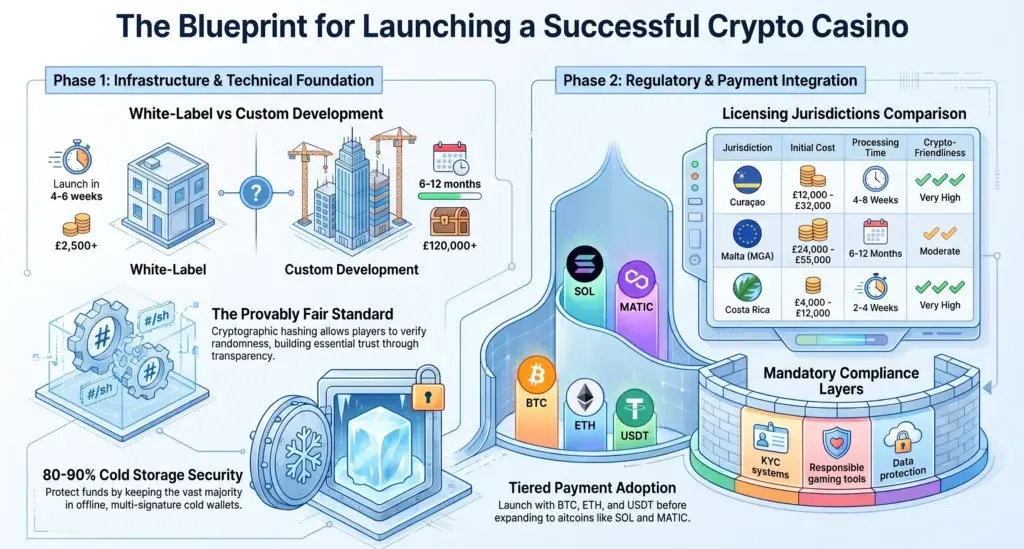
Besides, building a crypto casino requires excellence across three interconnected areas: technology, compliance, and user experience. Weakness in any one area can undermine the entire operation.
- Launch Strategy & Technical Infrastructure
Your technical foundation determines everything from player acquisition costs to operational efficiency. The key decision you’ll face early on is whether to build custom or use a white-label solution.
Custom Development gives you complete control but comes with significant investment. You’re looking at $150,000-$500,000 in initial development costs and 6-12 months of build time. This makes sense if you have unique game mechanics, specific regulatory requirements, or plan to operate at scale (10,000+ monthly active users).
White-Label Solutions offer a faster, more affordable path to market. Quality providers like DSTGAMING offer turnkey solutions starting around $3,000-$30,000 with launch timelines of 4-6 weeks. You get proven technology, established game libraries, and regulatory frameworks already in place.
The right choice depends on your budget, timeline, and long-term vision. Most operators launching their first crypto casino benefit from white-label solutions, then consider custom development as they scale and identify specific competitive advantages they want to build.
Essential Technical Components
Regardless of your approach, your crypto casino needs these core systems:
Blockchain Integration Layer: This handles wallet connectivity, transaction verification, and blockchain monitoring. You’ll need support for multiple cryptocurrencies—Bitcoin and Ethereum are mandatory, but players increasingly expect options like Litecoin, USDT, USDC, and emerging chains like Solana and Polygon.
Provably Fair Gaming Engine: This is what separates crypto casinos from traditional platforms. Provably fair systems use cryptographic hashing to prove that game outcomes are random and not manipulated. Players can verify fairness themselves, which builds trust and differentiates your brand.
Hot/Cold Wallet Infrastructure: Security isn’t negotiable. Your architecture should keep the majority of funds (80-90%) in cold storage with multi-signature requirements, while maintaining enough in hot wallets for instant withdrawals. A typical setup allocates 10-20% to hot wallets for operational liquidity.
Real-Time Transaction Monitoring: You need systems that track blockchain confirmations, detect suspicious patterns, and flag potential fraud. This protects both your business and your players.
- Compliance & Licensing Framework
If you’ve operated in traditional online gambling, crypto casino compliance will feel both familiar and different. The core principles remain—player protection, fair gaming, anti-money laundering—but cryptocurrency adds new layers of complexity.
Licensing Options: A Realistic Comparison
| License | Initial Cost | Annual Fee | Processing Time | Reputation | Crypto-Friendly | Best For |
| Curaçao eGaming | $15,000-$40,000 | $10,000-$25,000 | 4-8 weeks | Moderate | Very High | New operators, crypto-first platforms |
| Malta Gaming Authority | $30,000-$70,000 | $25,000-$50,000 | 6-12 months | Very High | Moderate | Established brands, European focus |
| Isle of Man | $40,000-$80,000 | $35,000-$60,000 | 8-16 months | High | High | Premium positioning, UK access |
| Gibraltar | $100,000-$150,000 | $85,000-$100,000 | 12-18 months | Very High | Moderate | Major operators, full compliance |
| Costa Rica | $5,000-$15,000 | $2,000-$8,000 | 2-4 weeks | Low | Very High | Minimal budget, lower oversight |
Curaçao has become the de facto choice for crypto casinos. The jurisdiction understands blockchain technology, processes applications quickly, and costs remain reasonable. The trade-off is reputation—while improving, Curaçao licenses don’t carry the prestige of Malta or Gibraltar.
Malta offers the gold standard in regulation but hasn’t fully embraced cryptocurrency. Expect rigorous due diligence, extensive documentation, and substantial capital requirements (typically €100,000+ in reserve). If you’re targeting serious European players and traditional casino audiences, this investment makes sense.
Emerging options like Estonia and Georgia are creating crypto-specific frameworks. These jurisdictions recognize that crypto casinos operate differently from traditional platforms and are designing regulations accordingly. Watch this space—we may see new preferred jurisdictions emerge in 2026-2027.
Compliance Beyond Licensing
Obtaining a license is just the beginning. Ongoing compliance requires:
KYC/AML Procedures: Even crypto casinos must verify player identity. The standard is tiered: basic verification for small transactions (under $2,000), enhanced verification for larger amounts, and source of funds documentation for significant deposits or withdrawals ($10,000+). Services like Sumsub, Onfido, and Jumio charge $1-5 per verification.
Responsible Gaming Tools: Deposit limits, self-exclusion options, reality checks, and cooling-off periods aren’t just ethical—they’re required by most licensing jurisdictions. Budget $10,000-$30,000 for robust responsible gaming infrastructure.
Data Protection: GDPR compliance is mandatory if you accept European players. This means secure data storage, clear privacy policies, data deletion capabilities, and potentially appointing a Data Protection Officer. Implementation costs run $15,000-$50,000 depending on your player base size.
Game Fairness Certification: Third-party testing labs like eCOGRA, iTech Labs, or GLI charge $5,000-$20,000 to certify your games are fair and RNG systems are secure. While provably fair games don’t always require traditional certification, having both strengthens your credibility.
- Payment Infrastructure & Cryptocurrency Integration
This is where crypto casinos shine—and where many stumble. Your payment infrastructure needs to be fast, secure, and flexible.
Cryptocurrency Selection Strategy
Don’t try to support every cryptocurrency from day one. Start with the foundation and expand based on player demand:
Tier 1 (Launch Essentials):
- Bitcoin (BTC) — Still 40-50% of crypto gambling volume
- Ethereum (ETH) — Smart contract capabilities, large user base
- USDT (Tether) — Stablecoins eliminate volatility concerns
- USDC — Alternative stablecoin, increasingly preferred by institutional players
Tier 2 (3-6 Months Post-Launch):
- Litecoin (LTC) — Faster transactions, lower fees than Bitcoin
- Bitcoin Cash (BCH) — Popular in certain markets
- Binance Coin (BNB) — Growing gambling adoption
- Dogecoin (DOGE) — Community-driven demand
Tier-3 (Growth Phase):
- Solana (SOL) — Extremely fast, low-cost transactions
- Polygon (MATIC) — Ethereum scaling solution
- Cardano (ADA) — Growing ecosystem
- Tron (TRX) — High transaction volume, Asian markets
Payment Processing: Build vs. Partner
Building In-House requires blockchain developers ($80,000-$150,000 annually per developer), security audits ($20,000-$50,000), and ongoing maintenance. This makes sense only if you’re processing $10M+ monthly volume or have unique technical requirements.
Payment Processors handle the complexity for 0.5-2% per transaction. Providers like CoinsPaid, NOWPayments, or Coinbase Commerce offer APIs that integrate in days, not months. For most operators, this is the smart choice—focus your resources on player acquisition and game selection, not blockchain infrastructure.
Hybrid Approach: Some platforms use processors for popular cryptocurrencies and direct integration for niche coins where they have technical expertise. This balances cost, control, and development resources.
Cost Breakdown: What Does It Really Take?
Let’s talk about real numbers. Here’s what launching a crypto casino actually costs:
Initial Launch Costs
| Component | Low-End (White-Label) | Mid-Range (Customized White-Label) | High-End (Custom Build) |
| Platform/Software | $30,000 | $80,000 | $200,000-$500,000 |
| Licensing | $15,000 | $40,000 | $70,000 |
| Game Integration | $10,000 | $35,000 | $100,000+ |
| Payment Processing Setup | $5,000 | $15,000 | $40,000 |
| Legal & Compliance | $10,000 | $25,000 | $50,000 |
| Design & Branding | $5,000 | $20,000 | $50,000 |
| Initial Marketing | $20,000 | $50,000 | $100,000 |
| Working Capital | $50,000 | $150,000 | $300,000 |
| TOTAL | $145,000 | $415,000 | $910,000-$1,210,000 |
Ongoing Monthly Costs
- License Renewal: $800-$8,000/month (amortized)
- Platform Fees: $2,000-$25,000/month (white-label) or $15,000-$50,000/month (custom maintenance)
- Game Provider Fees: $5,000-$30,000/month (revenue share or fixed)
- Payment Processing: 0.5-2% of transaction volume
- Customer Support: $3,000-$15,000/month (depending on 24/7 coverage)
- Marketing & Acquisition: $20,000-$200,000/month (highly variable)
- Server & Infrastructure: $2,000-$10,000/month
- Compliance & Legal: $2,000-$8,000/month
For a mid-sized operation processing $2-5M in monthly bets, expect $50,000-$100,000 in monthly operating costs, not including marketing.
Why Partner with DSTGAMING
Moreover, building a crypto casino from scratch is possible. But it’s expensive, time-consuming, and risky. We’ve spent years perfecting what you’re trying to build—and we’ve made every mistake so you don’t have to.
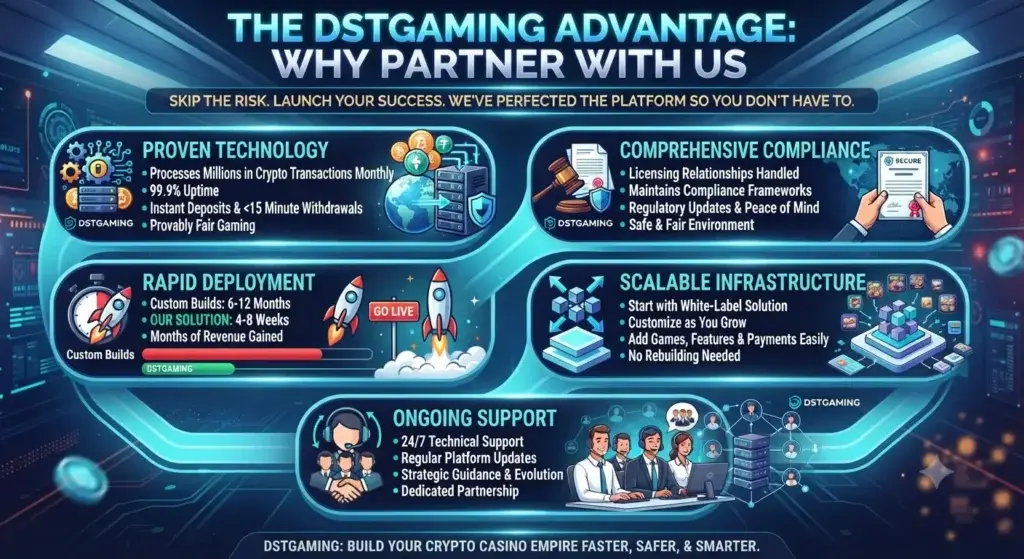
Proven Technology: Our platform processes millions in crypto transactions monthly with 99.9% uptime. Your players get instant deposits, withdrawals under 15 minutes, and provably fair gaming they can verify themselves.
Comprehensive Compliance: We handle licensing relationships, maintain compliance frameworks, and keep you updated on regulatory changes. You get peace of mind; your players get a safe, fair environment.
Rapid Deployment: While custom builds take 6-12 months, we can have you live in 4-8 weeks. That’s months of revenue you don’t leave on the table.
Scalable Infrastructure: Start with our white-label solution, then customize as you grow. Add custom games, unique features, or specialized payment options without rebuilding from scratch.
Ongoing Support: Launch is just the beginning. We provide 24/7 technical support, regular platform updates, and strategic guidance as your business evolves.
Best Practices for Crypto Casino Operations
Launching successfully is one thing; thriving long-term requires operational excellence:
Player Acquisition in Crypto Markets
Crypto players are different from traditional casino audiences. They value:
- Privacy: Your marketing should emphasize no-KYC deposits (for amounts below regulatory thresholds), anonymous play, and discreet transactions.
- Speed: Highlight instant deposits and sub-hour withdrawals in all messaging. Traditional “3-5 business days” is unacceptable to this audience.
- Transparency: Provably fair gaming isn’t optional—it’s expected. Make game verification simple and visible.
- Community: Crypto players are often active in communities (Reddit, Telegram, Discord). Build genuine community presence rather than just advertising.
Liquidity Management
Managing crypto liquidity is crucial and often overlooked:
Volatility Hedging: If a player deposits 1 BTC when it’s worth $95,000 but withdraws when it’s worth $88,000, you face a $7,000 loss if you held that BTC. Options:
- Instant conversion to stablecoins (eliminates volatility but adds conversion costs)
- Hedging strategies using derivatives (complex but effective at scale)
- Mixed approach: hold 30-40% in crypto, convert the rest
Withdrawal Liquidity: Players expect instant crypto withdrawals. Maintain hot wallet balances sufficient for 3-5 days of typical withdrawal volume. For a $1M monthly volume casino, keep $50,000-$100,000 in hot wallets.
Treasury Management: Treat your crypto like the volatile asset it is. Don’t bet your entire bankroll on Bitcoin going up. Diversify across stablecoins, major cryptos, and even fiat reserves.
Security Protocols
Crypto transactions are irreversible, which makes security paramount:
Multi-Signature Wallets: Require 3-of-5 signatures for cold wallet transactions. No single person should be able to access your reserves.
Withdrawal Limits: Implement tiered limits (e.g., $5,000 instant, $5,000-$25,000 with delay, $25,000+ with manual review). This prevents catastrophic losses from compromised accounts.
Regular Audits: Third-party security audits should happen at least annually, preferably quarterly. Budget $15,000-$40,000 per audit.
Employee Training: Social engineering attacks are more common than technical exploits. Train your team to recognize phishing, verify requests, and follow security protocols religiously.
Advanced Strategies: Differentiating Your Crypto Casino
The crypto casino market is increasingly competitive. Here’s how leading operators stand out:
Native Token Ecosystems
Some successful crypto casinos launch their own tokens, creating loyalty programs and reduced house edges for token holders. This:
- Builds community and brand loyalty
- Creates additional revenue through token sales
- Enables unique reward mechanisms
- Requires significant legal review (securities regulations vary by jurisdiction)
Implementation costs run $50,000-$200,000 including legal review, smart contract development, and token distribution infrastructure.
VIP Programs with Crypto Incentives
Traditional VIP programs focus on cashback and bonuses. Crypto casinos can offer:
- Exclusive NFT drops for high rollers
- Governance tokens for platform decisions
- Staking rewards on deposited funds
- Access to exclusive games or tournaments
Sports Betting Integration
Combining casino games with crypto sports betting creates a comprehensive platform. Moreover, this requires additional licensing (sports betting licenses) but significantly increases player lifetime value. Players who bet on both casino and sports have 2-3x higher retention rates.
Common Pitfalls and How to Avoid Them
We’ve seen hundreds of crypto casino launches. Here are the mistakes that kill platforms:
Insufficient Liquidity: Launching with $50,000 when you need $200,000 means you can’t pay winners promptly. This destroys reputation instantly. Rule of thumb: maintain bankroll equal to 20-30x your maximum win amount.
Over-Complicating the MVP: Don’t launch with 2,000 games and 15 cryptocurrencies. Start with 200 quality games and 4-5 major cryptos. Nail the core experience, then expand.
Ignoring Mobile: 65-70% of crypto casino traffic comes from mobile devices. If your mobile experience is an afterthought, you’ve lost most of your potential players before they register.
Underestimating Customer Support: Crypto transactions can be confusing. Players get nervous when funds don’t appear instantly (even if it’s normal blockchain confirmation time). You need knowledgeable support available 24/7. Budget accordingly.
Poor Bonus Structure: Crypto players are sophisticated. They calculate expected value and share information in communities. If your wagering requirements are predatory (50x+), players will identify this and avoid your platform. Fair bonuses (30-40x) build trust and long-term value.
The Future of Crypto Casinos: What’s Coming
The crypto casino industry is evolving rapidly. Here’s what we’re watching:
Layer 2 Scaling: Ethereum Layer 2 solutions (Arbitrum, Optimism, Base) offer near-instant transactions with minimal fees. Expect these to become standard in 2026-2027.
Regulatory Clarity: More jurisdictions are developing crypto-specific frameworks rather than forcing cryptocurrency into traditional gambling regulations. This will lower compliance costs and increase legitimacy.
DeFi Integration: Decentralized finance protocols enable innovative features like decentralized house banking, yield-generating deposits, and trustless game mechanics. Early movers will gain competitive advantages.
AI-Powered Personalization: Machine learning will enable hyper-personalized game recommendations, dynamic bonus offers, and fraud detection far beyond current capabilities.
Is Now the Right Time?
If you’re still reading, you’re serious about launching a crypto casino. Here’s how to think about timing:
You should launch now if:
- You have $150,000-$500,000 in capital available
- You understand online gambling fundamentals
- You can commit to 3+ year timeline (this isn’t a quick flip)
- You have marketing capabilities or partnerships
- You’re comfortable with cryptocurrency volatility
You should wait if:
- Your total budget is under $100,000
- You’ve never operated in iGaming before
- You’re treating this as a side project
- You lack technical resources or partnerships
- You’re expecting immediate profitability (typically breaks even month 6-12)
The crypto casino market is growing, but it’s also maturing. The operators who succeed combine strong technology, rigorous compliance, smart marketing, and genuine commitment to player experience.
With a white-label solution like DSTGAMING, you can live in 4-6 weeks. This includes platform customization, license application, payment integration, and game library setup. Custom builds take 6-12 months. The timeline depends primarily on licensing jurisdiction (Curaçao is fastest at 4-8 weeks; Malta/Gibraltar take 6-18 months) and your decision-making speed.
Realistically, you need $100,000-$150,000 minimum for a credible launch with a white-label solution. This covers platform fees ($30,000-$50,000), licensing ($15,000-$40,000), initial marketing ($20,000-$30,000), and critical working capital ($50,000+). Attempting to launch with less typically results in undercapitalization and platform failure within the first 3-6 months.
No. Most operators use payment processors that handle conversion. Players deposit crypto, you receive fiat or stablecoins (depending on your preference), and withdrawals are paid in crypto. This eliminates volatility risk but costs 0.5-2% per transaction. Larger operators often hold major cryptos (BTC, ETH) to reduce fees and benefit from long-term appreciation.
Three main strategies: (1) Instant conversion to stablecoins or fiat (eliminates risk, adds cost), (2) Hedging with derivatives (complex but effective at scale), (3) Natural hedging through balanced positions (works if deposit/withdrawal volumes are similar in timing and amount). Most new operators choose instant conversion for simplicity and risk reduction.
Provably fair uses cryptographic hashing to allow players to verify game outcomes weren’t manipulated. Players receive a seed before the game, results are generated, then players can hash the seeds themselves to confirm the outcome matches. Traditional RNG relies on third-party certification and trust. Crypto players strongly prefer provably fair systems—it’s a competitive expectation, not a nice-to-have.
Yes, and many operators do. This requires separate payment infrastructure for fiat (credit cards, e-wallets, bank transfers) which adds complexity and cost. Fiat processing fees are higher (2.5-5% vs 0.5-2% for crypto), and you’ll face more chargebacks and fraud. However, accepting both maximizes your addressable market. Consider starting crypto-only, then adding fiat once you’re established and have cash flow for the additional infrastructure.
Traditional advertising channels (Google Ads, Facebook) have severe restrictions on gambling advertising. Successful crypto casinos rely on: (1) Affiliate partnerships (typically 25-50% revenue share), (2) Influencer partnerships in crypto communities, (3) Content marketing and SEO, (4) Community building (Telegram, Discord, Reddit), (5) Targeted native advertising on crypto news sites. Budget at least 30-40% of revenue for player acquisition in year one.
License suspension or revocation is catastrophic. You must immediately stop accepting new players, may be required to return player funds, and face potential legal action. Preventing this requires rigorous compliance: regular audits, responsible gaming enforcement, prompt regulatory reporting, and maintaining required capital reserves. Choose licensing jurisdictions carefully and budget for ongoing compliance costs ($3,000-$10,000 monthly).
Crypto transactions occur in minutes to hours depending on blockchain congestion and confirmation requirements. Best practice: process withdrawals within 15-30 minutes for amounts under $5,000 (after initial KYC), 2-6 hours for larger amounts requiring additional verification. Players expect sub-hour withdrawals—anything slower puts you at a competitive disadvantage. Build your systems for speed.
This varies enormously based on game selection, bonuses, and player acquisition source. Industry averages: $800-$2,500 LTV for sports bettors, $400-$1,200 for casino players, $1,200-$3,500 for combined casino/sports players. Your acquisition cost should be 20-40% of expected LTV. If you’re paying $300 to acquire a player worth $600, your unit economics work. At $300 to acquire a $350 player, you’re in trouble.
Ready to Launch Your Crypto Casino?
The crypto casino market presents genuine opportunities for operators who approach it seriously. You need proper capitalization, robust technology, real compliance, and commitment to player experience. Shortcuts in any of these areas typically result in platform failure.
DSTGAMING has powered successful crypto casino launches across five continents. We provide the technology, compliance framework, and ongoing support you need to compete effectively in this market.
What you get with DSTGAMING:
- White-label platform ready in 4-6 weeks
- Multi-cryptocurrency payment integration
- Licensing support and compliance framework
- 500+ provably fair games
- 24/7 technical and operational support
- Scalable infrastructure that grows with your business
Next steps:
- Schedule a platform demo to see our technology in action
- Download our detailed pricing guide for transparent cost breakdown
- Review our case studies to see how other operators have succeeded
The operators who launch in 2026 will establish market position before increased competition arrives. While launching a crypto casino requires significant investment, the potential returns for well-executed platforms are substantial.
Contact our team today to discuss your specific requirements, timeline, and how DSTGAMING can help you build a successful crypto casino.