
What Separates a Trusted Online Casino Brand from One Players Abandon
A B2B Operator’s Blueprint
Here’s something worth sitting with for a moment.
Right now, as you read this, potential players are typing questions. They ask, “How do I know if an online casino is legit?” They also ask, “What makes an online casino trustworthy?” into Google before they decide whether to deposit on your platform.
They’re not doing this out of paranoia. They’re doing it because the online casino space has a genuine trust problem — built up over years of rogue operators, withheld withdrawals, rigged RTPs, and aggressive marketing that disappears the moment a player tries to cash out. A significant portion of players have personally experienced a bad operator or know someone who has.
The irony is that most of this article’s audience — operators reading a B2B iGaming resource — are building legitimate, licensed businesses. You’re not the problem. But you inherit the trust deficit left by those who were.
Understanding exactly what players are looking for when they evaluate a casino’s trustworthiness isn’t just a player experience issue. It is directly upstream of your conversion rate, your deposit-to-withdrawal ratio, your chargeback exposure, your affiliate relationships, and your long-term player lifetime value.
This article works through the questions players ask most frequently about casino trustworthiness — and translates each one into actionable operator intelligence. Some of it will validate decisions you’ve already made. Some of it will surface gaps worth addressing. All of it connects back to how DSTGAMING builds trust infrastructure into the platforms it powers.
The Trust Gap Is Your Biggest Acquisition Problem — Even If You’re Doing Everything Right
Before we get into specifics, let’s put a number on the problem.
Studies across the iGaming industry often show high drop-off rates during registration and first deposit. These rates are highest among first-time visitors. The most common reasons players abandon a registration flow midway are not about bonus offers or game selection. They relate to trust signals. These include an unfamiliar brand and no visible licensing information. They also include unclear withdrawal terms or a payment process that feels uncertain.
This happens to legitimate operators every day. Players who could have been great long-term customers leave before they deposit. The product is not bad. The trust signals are not clear, fast, or credible enough.
The operators who solve this problem well don’t just build a good casino. They build a casino that communicates its trustworthiness at every touchpoint — from the footer license badge to the withdrawal confirmation email. That communication is what this article is about.
How Do I Spot a Fake Online Casino?
What Players Are Actually Evaluating When They Land on Your Platform
When players search this question, they’re rarely trying to identify an obvious scam. They’re trying to distinguish between legitimate operators and those who will make withdrawal difficult, manipulate game outcomes, or disappear with their funds. The checklist they’re mentally running through tells you exactly what trust signals matter.
The licensing badge is the first thing sophisticated players check — and the first thing you can fail
Players have learned to look for license information, and more importantly, they’ve learned to verify it. A license badge in the footer means nothing if it links to a dead regulator page or displays a license number that doesn’t return results when checked. Experienced players routinely open the MGA, UKGC, or Curaçao GCB verification portals and enter the operator’s license number directly.
What this means for operators: your license display needs to be more than decorative. It should include a direct, working link to the verification page on the regulator’s website. If you hold multiple licenses for different markets, display the most relevant one for each player’s jurisdiction. The verification link should load quickly and return your entity name clearly.
Platforms launched on DSTGAMING infrastructure carry licensing documentation as a core component of the platform build — not an afterthought. Whether you’re operating under Curaçao, MGA, or another framework, the licensing display and verification pathway is built into your site architecture from day one.
Withdrawal terms are where fake casinos reveal themselves — and where legitimate operators lose players unnecessarily
The single most common complaint pattern across player review sites, Reddit iGaming communities, and affiliate review platforms is withdrawal-related. Delayed processing, unexpected verification requests on large wins, vague maximum withdrawal limits buried in bonus terms — these are the signature practices of operators who don’t intend to pay.
Players have become fluent in reading withdrawal terms. They look for specific numbers — maximum weekly withdrawal limits, processing timeframes, which payment methods are available for withdrawal (not just deposit), and whether bonus wagering requirements affect withdrawal eligibility. Vague language, stacked conditions, or terms that change between the promotional page and the account section are red flags sophisticated players recognize immediately.
For legitimate operators, this creates a clear opportunity: radical clarity in your withdrawal terms is itself a trust differentiator. Specific numbers, simple conditions, and withdrawal confirmations that arrive promptly and accurately signal that you’re an operator who intends to pay.
SSL, domain age, and professional presentation are tier-one filters
Players checking for fake casinos routinely inspect the browser padlock, check the domain registration age on WHOIS lookup tools, and assess the overall polish of the website. A site with spelling errors in the bonus terms, low-resolution game thumbnails, and a domain registered two weeks ago reads as high risk regardless of what the license badge says.
None of this should be news to a legitimate operator — but it’s worth noting that “professional presentation” is evaluated on mobile first for the vast majority of players. A site that looks polished on desktop but has broken layouts, slow load times, or clunky navigation on mobile doesn’t just lose UX points; it loses trust points. Because trusted, professional operators invest in their mobile experience.
Payment provider logos are trust signals, not just payment options
When players see Visa, Mastercard, Skrill, Neteller, and recognisable local payment brands displayed prominently, they register these as trust proxies. Major payment providers conduct due diligence on the merchants they work with. Their presence signals that a third party with standards has approved this operator.
This is one reason why operators with only obscure cryptocurrency payment methods or unfamiliar e-wallet providers face higher abandonment rates during payment method selection — not because players don’t use crypto, but because the absence of recognizable alternatives raises questions about why the mainstream options aren’t there.
What Is the Most Trustworthy Online Casino?
The Four Pillars Players Are Evaluating
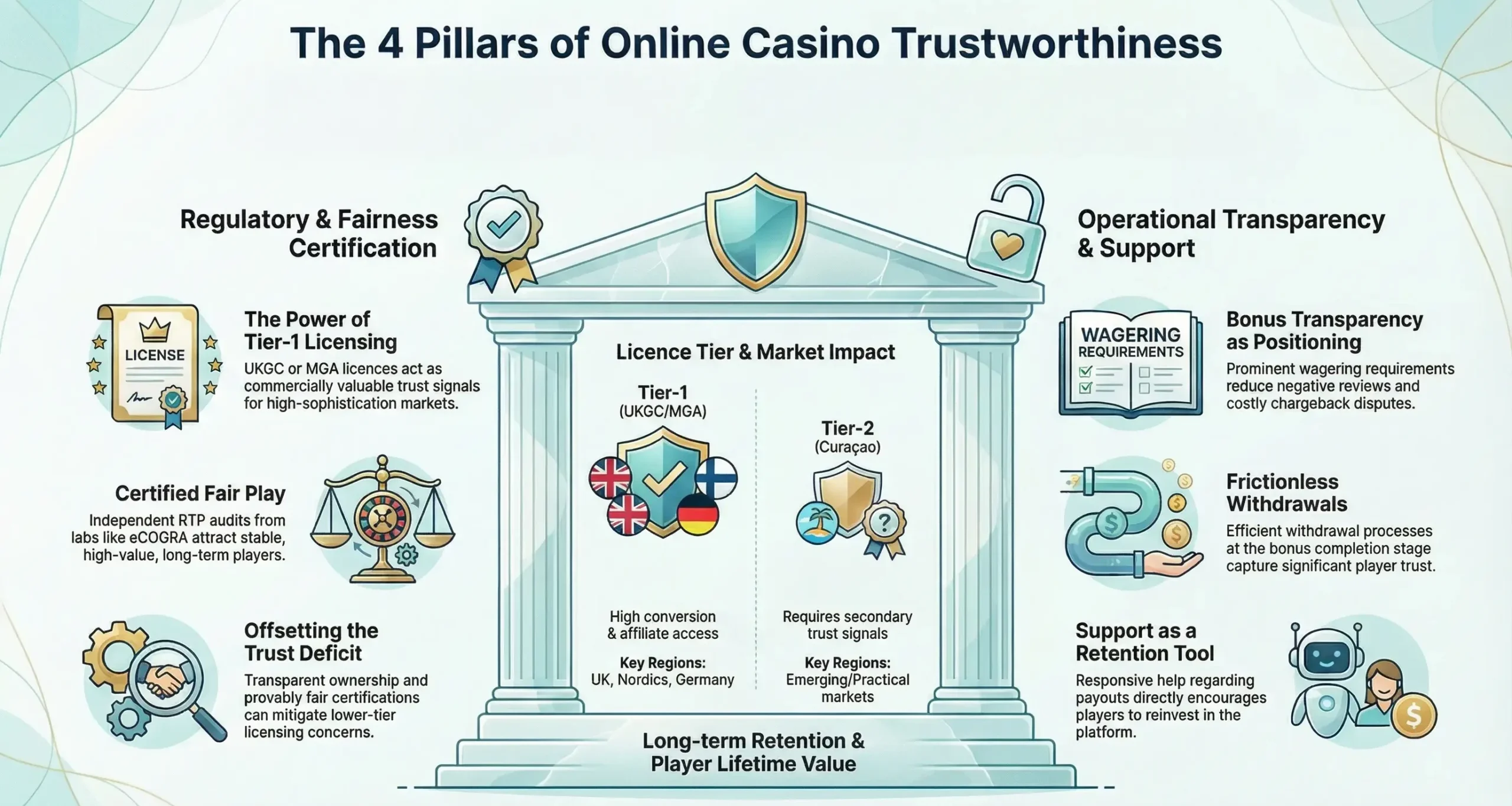
When players research which casino to trust, they’re effectively running a multi-factor assessment. Understanding these factors helps operators prioritise where to invest in trust infrastructure.
Pillar 1: Regulatory Credibility
Not all licenses are equal in the player’s mind, and the affiliate and review site ecosystem has educated players accordingly. A UKGC or MGA license signals a meaningfully higher standard than a Curaçao sublicense — not because Curaçao is illegitimate, but because players have absorbed the narrative that Tier-1 licenses involve more rigorous operator vetting.
For operators, this has direct acquisition implications. In markets where player sophistication is high — UK, Germany, Nordics, and increasingly Australia and Canada — the licensing jurisdiction materially affects your affiliate tier access, your comparison site placement, and your player conversion rate. Operators who have invested in MGA or UKGC licensing are not just buying regulatory compliance; they are buying a commercially valuable trust signal.
For operators entering markets where Curaçao remains the practical licensing route, the trust deficit can be partially offset through other credibility signals — third-party RTP audits, provably fair certification, transparent ownership disclosure, and active player community presence.
Pillar 2: Game Fairness Certification
Players increasingly understand the difference between a casino that claims to be fair and one that demonstrates it. Third-party RTP auditing from recognized testing laboratories — eCOGRA, iTech Labs, GLI, BMM Testlabs — provides independent verification that game outcomes match their stated return percentages.
From an operator standpoint, this is an investment with clear return. Casinos with eCOGRA certifications and displayed RTP data attract a specific player segment — informed, value-conscious players who are also among the most stable and long-term valuable in terms of lifetime value. They’re not chasing sign-up bonuses; they’re looking for a fair game they can return to.
DSTGAMING’s platform integrates with certified game providers whose RTP data is audited and documentable. Operators who want to display RTP data for player confidence have the underlying certification infrastructure to support that claim.
Pillar 3: Transparent Bonus Terms
The bonus terms gap — where operators advertise a headline offer and bury the conditions in small print — is one of the most documented trust-eroding patterns in online gambling. Players who feel misled by bonus terms don’t just leave; they leave negative reviews, dispute charges, and generate chargeback costs.
The most trusted operators in the market have moved toward what might be called “bonus transparency as positioning” — advertising the wagering requirement prominently, making it easy to track progress, and building withdrawal processes that don’t create friction at the bonus completion stage. This costs nothing in real terms (the wagering requirement is the same either way) but captures significant trust value.
Pillar 4: Responsive, Verified Support
People really like it when they can get help away from a casino they trust. The people who help them are usually really good, at their job. When someone asks about getting their money out they get an answer. If everything goes smoothly with the help people are more likely to put money in over time. This is really important when they are asking about getting their money out.
So what does this mean for the people who run these casinos? It means that helping people is not something they should try to spend money on. It is actually a thing to spend money on because it helps keep people playing. When someone asks about getting their money out and they get an honest answer they are more likely to put more money in again.
What Is the Golden Rule of Gambling?
Turned Into an Operator Framework
The player-facing version of this question is usually answered with advice like “never bet more than you can afford to lose.” For operators, the equivalent principle is more strategic — and more commercially interesting.
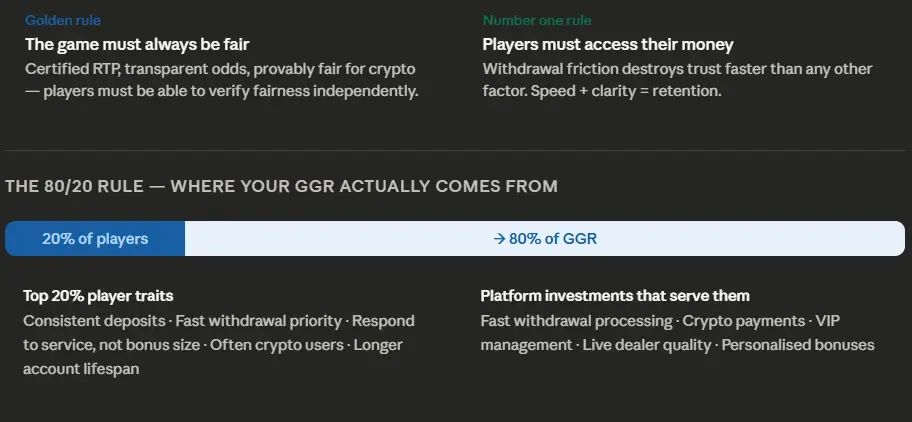
The golden rule for iGaming operators is: the player must always feel that the game is fair and that they can access their money.
Everything else in your platform — game selection, bonus structure, loyalty programme, visual design — is secondary to this foundational principle. Operators who break it, even once with a high-value player, trigger reviews, chargebacks, and affiliate feedback. These are far more damaging than any short-term gain from the breach.
Practically, this golden rule translates into three operational commitments:
- Transparent RTP: Players should be able to find RTP data for any game they play. This doesn’t mean showing it by default on every spin — it means making it accessible and accurate when a player looks for it.
- Withdrawal without friction: The moment a player decides to withdraw should feel as smooth as the moment they decided to deposit. Delays, unexpected document requests (that weren’t telegraphed during KYC), or maximum limits that surprise players are golden rule violations.
- Consistent communication: If a withdrawal is being processed, tell the player. If it’s delayed, tell the player why. The absence of communication is itself a trust signal — and it’s a negative one.
What Is the Number One Rule of Gambling?
And Why It Creates Your Best Player Segment
The important rule for players is really simple: make a budget and stick to it. Only use money you can afford to lose when you gamble.
For people who run casinos this is not about following the rules for responsible gambling. It is actually a description of the players who are the most valuable to them.
Players who gamble with money they can afford to lose set limits on how much they deposit and think of casino games as a thing to do rather than a way to make money are the best players. They do not try to win back money they lost. They do not cause problems with payments. They do not stop playing after they lose a lot of money because they know they cannot afford it. They play regularly. Come back to play again.
The people who run casinos and understand this make tools to help with gambling that are actually helpful to players. Not just to follow the rules. For example they remind players to set limits on how much they deposit when they first start playing. They give players reminders to “protect your budget” of saying “you are gambling too much”. They make it easy for players to take a break from playing if they want to. How they present these tools matters.
DSTGAMING’s white label platform includes built-in responsible gambling tooling — deposit limits, loss limits, session timers, and self-exclusion workflows — as standard features. Operators don’t need to retrofit these; they launch with them. Operators who use these tools well can see clear benefits. They should present responsible gambling tools as player-friendly. They should not present them as regulator-driven. This can improve retention among top players.
What Is the 80/20 Rule in Gambling?
The Operator’s Most Important Data Insight
The 80/20 rule (the Pareto Principle) appears in gambling in a specific and well-documented form: roughly 80% of your revenue comes from approximately 20% of your players.
For most operators, the reality is even more concentrated. The top 10-15% of players by deposit volume often generate 70-80% of GGR. This is not unique to iGaming — it mirrors patterns in retail, SaaS, financial services, and most subscription businesses. But in iGaming, the implications are particularly significant because the characteristics of that top segment are predictable, actionable, and directly influenced by platform decisions.
Who Is in Your 20%?
The highest-value player segment in a typical iGaming operation shares several characteristics. They are consistent — they deposit regularly at consistent levels rather than making large single deposits and disappearing. They respond to service quality rather than bonus size — their loyalty correlates more strongly with fast withdrawals, responsive support, and fair game experiences than with the size of the welcome bonus. They are often crypto users or high-digital-fluency players. And they tend to have longer account lifespans than acquisition-driven players who arrived for the bonus.
Understanding this segment with specificity — what games they play, when they play, what triggered their first deposit, what their support interaction history looks like — is the foundation of defensible GGR in a competitive market.
The Platform Implication
The 80/20 insight has a direct implication for platform investment decisions. Features that disproportionately benefit your top 20% — fast withdrawal processing, VIP account management, live dealer game quality, crypto payment options, personalized bonus structures — generate returns that are non-linear relative to their cost. A $50,000 investment in improving withdrawal speed will generate more lifetime GGR than a $50,000 investment in marketing to new acquisition channels, because the existing high-value players stay longer and deposit more.
DSTGAMING’s platform architecture reflects this. Withdrawal processing infrastructure, live dealer game integration, crypto payment capability, and VIP tier management are built into the platform layer — not available only at premium tiers. Operators launching on DSTGAMING start with the infrastructure that serves their highest-value players well, from day one.
The Acquisition Trap to Avoid
The 80/20 rule also has an important inverse implication. Operators who build their acquisition strategy primarily around large welcome bonuses attract a player segment that is heavily weighted toward the 80% — bonus hunters who deposit to meet wagering requirements, collect their bonus value, and move on. These players generate costs (bonus payments, processing fees, support volume) while contributing disproportionately little to long-term GGR.
This does not mean that welcome bonuses are an idea. It means that the company should think carefully about what kind of bonuses they want to offer. They should design bonuses to attract the customers they want to keep. They should not aim to advertise the biggest bonus on other websites. Companies that offer clear bonuses with easy to understand rules attract a better kind of customer in markets where experienced players are the goal. These customers are more valuable to the company, than the ones who just look for the bonus.
Building Trust at the Platform Level
How DSTGAMING Operationalizes All of This
The trust signs we talked about in this article. Like showing licenses, fast withdrawals, fair games, responsible gambling tools and many payment options. Are not things that operators can just add to a platform that is already done. They are choices that need to be included from the very start.
Here’s how DSTGAMING approaches this at the platform level:
- Licensing and compliance infrastructure: DSTGAMING’s platform supports licensing display, verification link integration, and compliance documentation for all major jurisdictions. Operators don’t build this from scratch — they configure it for their specific license.
- Payment stack breadth: DSTGAMING’s platform integrates fiat payment processors, crypto payment rails (BTC, ETH, USDT, LTC, TRX), and local payment methods relevant to target markets. The breadth of the payment stack is a trust signal that’s built into the platform, not assembled piecemeal post-launch.
- Certified game library: DSTGAMING’s game integrations are sourced from providers with third-party RTP certification. Operators can display accurate RTP data because the underlying certification exists.
- Withdrawal processing architecture: Fast withdrawal is not just a policy — it’s an infrastructure question. DSTGAMING’s payment processing architecture is built to support same-day or next-day withdrawal processing, which directly impacts the player experience metric most correlated with trust and retention.
- Responsible gambling tooling: Deposit limits, loss limits, session timers, reality checks, and self-exclusion workflows are built into DSTGAMING’s white label platform as standard features — not compliance add-ons.
- Support infrastructure: DSTGAMING’s turnkey and white label packages include support infrastructure options — live chat integration, ticket management, and escalation workflows — so operators launch with support capability rather than building it post-launch.
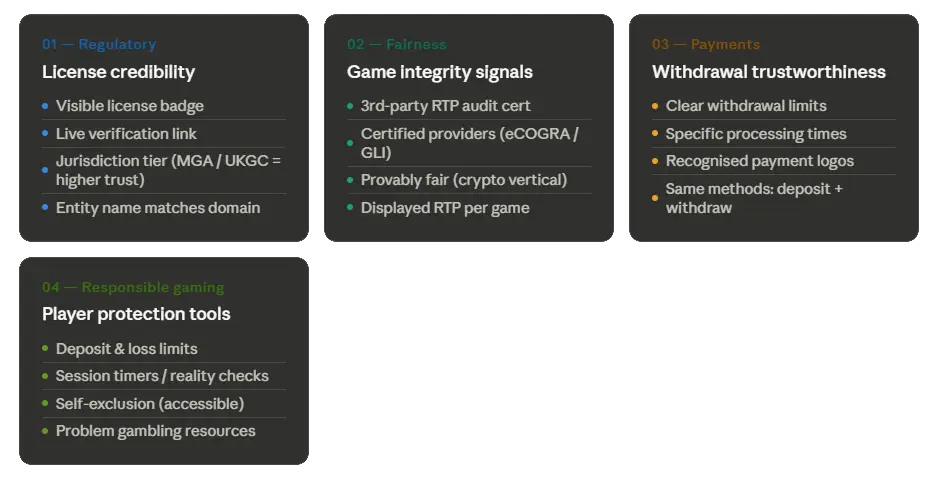
The operator trust framework — 4 pillars players evaluate
The three operator golden rules
The Practical Checklist: What Your Platform Should Be Able to Demonstrate Today
Before closing, here’s the operator self-audit this article is really building toward. These are the questions a due-diligent player — or an affiliate review site — would ask about your platform. If you can answer yes to all of them, you’re ahead of most of the market. If you can’t, each gap is a conversion and retention risk worth quantifying.
- On licensing: Does your license badge link to a live, working verification page on the regulator’s site? Does the entity name on that page match what players see on your platform?
- On withdrawal: Can you state your withdrawal processing time in specific hours — not “3-5 business days”? Are all the payment methods available for deposit also available for withdrawal? Are your maximum withdrawal limits clearly stated before a player makes their first deposit?
- On game fairness: Can you point players to third-party certification for your game providers’ RTP claims? For your crypto vertical, do you offer provably fair mechanics for any game types?
- On responsible gambling: Are deposit and loss limits accessible within two clicks from a player’s account? Is your self-exclusion process easy to initiate? Are your responsible gambling resources displayed without being buried?
- On support: What is your average first-response time on live chat? Can a player get a withdrawal question resolved without being escalated three times?
- On payment breadth: Do you offer at least two or three major recognized payment brands in addition to any crypto options? Do your payment provider logos link to verified merchant pages?
Building a Casino Players Trust Starts Before They Sign Up
Trust isn’t a feature you add to a finished casino. It’s the architecture the casino is built on. Every choice, like licensing, payment providers, withdrawals, safer gambling tools, and support speed, builds or breaks trust. Players feel this trust before they play a game.
The operators who will own the best player segments in the markets opening over the next three years — Brazil, the UAE, and the re-regulated versions of existing markets — will be those who built trust infrastructure into their platform from the foundation, not those who retrofitted compliance onto a product built for speed.
DSTGAMING’s white label and turnkey casino solutions are built with this principle as the foundation. Licensing infrastructure, payment stack breadth, certified game library, responsible gambling tooling, crypto payment support, and withdrawal processing architecture are not optional add-ons — they are the platform.
If you’re evaluating B2B casino platform providers, the question isn’t just “what features do you offer?” It’s “what does your platform communicate to a player who’s trying to decide whether to trust us?”
With DSTGAMING, the answer is already built in.