
Why Turnkey Platforms Are Key to Online Casino Success
Why Turnkey Casino Solution Has Become Critical for Online Casino Growth
The online casino market remains full of opportunity, but success is no longer defined by ambition alone. Under stricter global regulations, operators must move fast without sacrificing stability. Without a robust foundation, resources often drain before a site even goes live.
This is why a turnkey casino solution has become the essential shortcut for modern operators. It is a production-ready, all-in-one platform that eliminates the need for ground-up development. By offering one technical base, these platforms include game content. They also include payment systems and back-office tools. This allow them go live within a month.
What Is a Turnkey Casino Solution?

A turnkey casino solution is a ready-built online casino platform where the technology is fully prepared, but ownership and operational control belong entirely to the operator.
Picture purchasing a freshly constructed home. Once the builder finishes the frame – foundation included, along with wiring and water lines – it becomes move-in ready. Similarly, within gambling platforms, essential infrastructure exists beforehand: operational software, preloaded game content, transaction systems, plus control panels for oversight. There is no requirement to create each piece independently or handle an extensive group of engineers. Built-in capabilities allow immediate operation without ground-up construction.
After the construction of the house finishes, choices about furnishings and operations fall solely on the owner. A turnkey casino allows adjustments to appearance, brand elements, and layout – shaped around specific goals. Ownership matters: the system itself, along with stored information, rests in the hands of the operator, never the provider. Control stays local when it comes to user records; earnings also stay intact, avoiding heavy splits typical in prebuilt setups.
Still, adopting a complete system means taking on more duties. Although the tools are prepared for use, oversight of licenses, legal requirements, assistance to users, promotion, and routine management falls to those running it.
Ultimately, full-service casino setups fit those who have resources plus expertise aiming at a unique, lasting presence. These systems prioritize autonomy and expansion potential, instead of ease. Control defines their purpose – longevity shapes their design.
Turnkey vs White Label: Understanding the Core Differences
In practice, the most common source of confusion for operators is not technology capability, but the trade-off between control, risk, and long-term value. At a high level, the distinction is straightforward: white label models prioritize convenience, while turnkey models prioritize independence.
Core comparison: at a glance
| Dimension | White Label |
Turnkey |
| Ownership | Platform, code, and data are owned by the provider | Platform and player data are owned by the operator |
| Time-to-market | Very fast, often live within weeks | Slower, requires configuration and integration |
| Upfront cost | Low initial investment | Higher setup and licensing costs |
| Revenue model | Revenue share from GGR | Higher revenue retention, typically fixed fees |
| Licensing & Compliance | Operates under the provider’s licence | Operator obtains and manages licences |
| Customization | Limited, template-based | High flexibility across UI/UX and features |
| Operational Responsibility | Largely handled by the provider | Fully managed by the operator |
Why Turnkey Solves the Biggest Operator Pain Points
Turnkey models address operator pain points not by simplifying the business itself, but by balancing technical readiness with commercial autonomy. They remove some of the most failure-prone elements of early execution while preserving the control required to compete in regulated and mature markets.
Technical complexity: escaping integration overload
Often, the true cost of platform development is not in coding basics but in handling ongoing integrations. From games to payment processing, each component needs smooth interaction across systems. Infrastructure demands, paired with security requirements, increase pressure on internal teams. Without external support, challenges grow – costs rise, timelines stretch, stability weakens. Complexity, once underestimated, becomes a steady drain on resources and reliability.
Turnkey platforms reduce this risk by offering a fully developed and pre-integrated environment. Game libraries, payment interfaces, and backend systems are already connected and stress-tested, eliminating the need for large internal teams to maintain hundreds of APIs or troubleshoot compatibility issues. Standardized architecture and automation further limit fragmentation, helping operators avoid the accumulation of technical debt that frequently undermines projects before they reach scale.
Regulatory and compliance burden: enabling, not bypassing, compliance
KYC and AML are not features that can be added later. In regulated markets, compliance failures can trigger immediate consequences, including frozen bank accounts, loss of PSP access, or licence suspension.
While turnkey operators typically remain responsible for licensing, turnkey systems address how compliance is executed. Identity verification workflows, transaction monitoring, and reporting tools are embedded into the platform’s core logic. This supports consistent audits, clearer data trails, and the flexibility to adjust compliance processes across jurisdictions without rebuilding systems from scratch.
Market credibility: stability builds trust
Player trust is shaped by experience. Downtime, failed payments, or settlement errors damage credibility far faster than marketing can repair it. Turnkey platforms benefit from proven stability, having been deployed and refined across multiple live environments.
Beyond reliability, turnkey solutions allow operators to create polished, distinctive user experiences rather than relying on uniform templates. Combined with full data control, this consistency reinforces confidence in a crowded market.
In short, turnkey solutions commercialize technology development while professionalizing operations, allowing operators to focus on execution instead of infrastructure survival.
How A Four-Week Launch Becomes Achievable
A four-week launch timeline is not achieved through shortcuts or reduced standards. It is the result of standardisation and pre-integration, where the most time-consuming elements of platform development are completed before an operator enters the process. When these conditions are in place, speed becomes a by-product of preparation rather than a marketing promise.
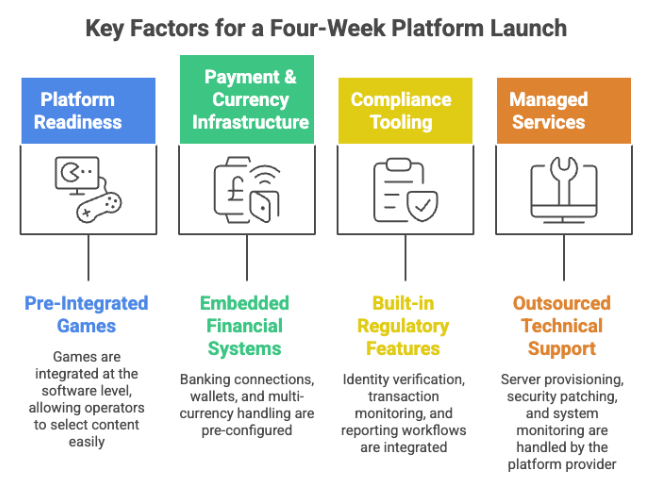
The first factor is platform readiness. Games are already integrated at the software level, allowing operators to select content without negotiating and connecting individual game engines. This removes one of the largest sources of delay in early-stage launches.
The second factor is payment and currency infrastructure. Banking connections, wallets, and multi-currency handling are embedded into the platform architecture from the outset. Because these systems are pre-configured, operators can focus on commercial onboarding rather than technical implementation.
The third factor is compliance tooling. Identity verification, transaction monitoring, and reporting workflows are built into the platform’s core logic. Where licensing arrangements are already in place or aligned with the platform’s supported jurisdictions, regulatory bottlenecks that typically slow deployment can be significantly reduced.
Finally, operating frameworks absorb routine technology tasks. Through managed provision of servers, continuous security updates occur without internal oversight. Monitoring functions proceed independently under structured support models. Technical upkeep continues seamlessly, reducing reliance on resident specialists at deployment stages.
When combined, these elements let a turnkey online casino go from set-up to live operation in less time. While actual launch timing ultimately depends on licensing approval, banking setup, and commercial readiness, the technical path to market is no longer the limiting factor.
Proven technology with minimal technical burden
Measurable performance under real operating conditions
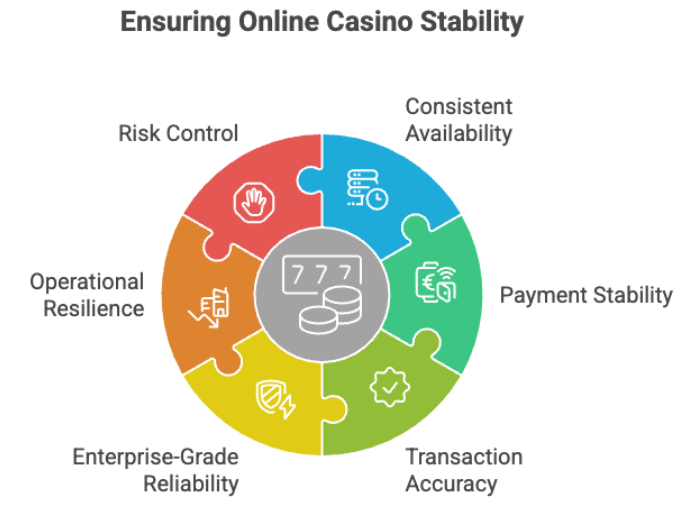
For online casino operators, “proven technology” is defined less by novelty and more by sustained performance under real operating conditions. Platforms supporting multiple live casinos have to demonstrate consistent availability, payment stability, and transaction accuracy at scale.
Established turnkey platforms are typically engineered for enterprise-grade reliability, with uptime commonly benchmarked at around 99.9% across live environments. In active deployments, these systems process millions of transactions over time, including gameplay activity, wallet movements, and payment settlements across multiple currencies and jurisdictions. Their value lies not in peak capacity, but in predictable performance during periods of high player activity.
Operational resilience is equally critical. Managed infrastructure, continuous monitoring, and regular system updates allow issues to be identified and resolved before they affect players. Server provisioning, security patching, and platform maintenance are managed within the operating framework. This removes the need for in-house development teams to manage daily technical operations.
By relying on platforms that have already been stress-tested in live markets, operators reduce exposure to downtime-related revenue loss, payment disputes, and reputational damage. In this context, performance metrics act less as growth drivers and more as risk controls. They support steady scaling and build regulatory confidence over the long term.
Licensing & Multi-Jurisdiction Readiness
Stability in internet-based gaming comes through compliance with established legal systems. Where a platform registers shapes its operational path – locations like Curacao, Malta, or the UK offer distinct advantages. Entering quickly across borders tends to link with Curacao licensing. In contrast, oversight from Malta or the UK brings stricter requirements, yet opens doors to financial institutions and trusted service networks. Fit matters more than ranking one option above another.Decisions depend on your audience focus, risk tolerance, and growth goals.
This is why platform compatibility across multiple jurisdictions matters. Operators rarely remain confined to a single market. A system that can adapt to different licensing regimes allows expansion without rebuilding core infrastructure each time regulations change or new opportunities emerge.
Modern platforms increasingly support risk-based compliance, where controls scale according to jurisdictional requirements, player profiles, and transaction behavior. This approach prioritizes proportional oversight rather than rigid, one-size-fits-all rules. In doing so, it helps operators remain compliant, bankable, and sustainable as regulatory expectations continue to evolve across markets.
Scalability & Real-World Performance
Scalability determines whether a platform can grow with the business, not just launch it. Modern platforms are built with auto-scaling infrastructure, allowing capacity to expand as player activity and transaction volumes increase, without requiring system redesign or disruptive upgrades. This ensures that growth does not introduce instability.
In practical terms, performance is measured through reliability rather than novelty. Consistent uptime, the ability to handle rising transaction volumes, and stable operational workflows are the indicators that matter most. When growth does not trigger technical rework or service degradation, management can focus on expansion strategy rather than system resilience.
Who turnkey models are designed for—and who they are not
Turnkey casino solutions are not universal by design. Success relies on alignment between an operator’s goals, available assets, and tolerance for uncertainty. Ease of use brings no guarantee – without coherence, smooth systems still break down. It is not the framework but the match that counts when abilities meet context. How things turn out hinges on this connection, never just design.
Because turnkey solutions suit beginners, those focused on promotion, and companies wanting quick launch timelines, they reduce worries about coding challenges or connecting complex tools. With stability already in place at the start, focus moves to securing approvals, shaping visual identity, whereas another team concentrates on drawing interest instead of building systems entirely new.
They also suit established businesses entering new jurisdictions or verticals, where speed, regulatory alignment, and operational consistency are critical, reducing friction without rebuilding core systems.
By contrast, turnkey may not fit operators pursuing unique internal systems as a competitive advantage, as full ownership brings higher costs, longer timelines, and heavier management demands.
Essential lies in seeing such balances clearly. Though turnkey eases tech setup, accountability for results and rules stays fixed. Where this approach works – or does not – shapes choices rooted in purpose, never convenience.
A practical test is whether the business can launch and operate without an internal engineering function. Teams are generally suited to a turnkey model if they need a defined launch timeline, operate under a recognized licensing framework, and seek long-term control over player data, payment strategy, and compliance execution.
Real-World Impact: Turnkey Success by the Numbers
The transition from a conceptual brand to a profitable market player is often measured in months, not years, when utilizing a turnkey framework. Based on prevailing industry experience and performance data from successful turnkey launches, the following benchmarks represent the standard for optimized operations:
- Accelerated ROI: In the current market, operators utilizing comprehensive turnkey solutions frequently reach their break-even point within the first 6 to 8 months. This efficiency is primarily driven by the significant reduction in initial capital expenditure and the elimination of custom development costs.
- Enhanced Retention: Industry data suggests that platforms launching with pre-integrated 24/7 player support and advanced loyalty modules typically see a 35% higher player retention rate in the first quarter compared to startups attempting to build these complex systems from scratch.
- Technical Reliability: High-tier turnkey providers are expected to maintain a 99.9% uptime guarantee. This level of reliability is critical during high-traffic events; for instance, mid-sized operators have been known to process over $2.5 million in transactions during a single peak sporting season without experiencing technical failure or downtime.
- Market Entry Agility: By bypassing the standard 12-month development cycle, industry experience shows that a partner can move from contract to “live” status in a regulated jurisdiction like Curacao in as little as 27 days, allowing for a strategic “early-mover” advantage ahead of major seasonal market events.
Final Thoughts
Online casinos have shifted focus from technical specifications to execution speed. Tighter regulation and higher user expectations leave little room for error, exposing gaps once tolerated during rapid expansion.Though turnkey casino systems simplify launch procedures, day-to-day management hurdles remain present. Predeveloped components shift attention from infrastructure tasks toward adherence oversight, player recruitment, and support operations. Performance relies more on steady implementation, legal alignment, and interaction standards than on software capabilities alone. Whether long-term expansion proves viable rests upon how well the business design functions amid actual economic pressures.
Ready to skip the technical hurdles and launch your brand in weeks? Contact DSTGaming today for a demo of our all-in-one turnkey casino platform and see how we can accelerate your path to market.