
White Label Casino Solutions Explained: Benefits, Costs, and Strategic Trade-Offs

Navigating the iGaming Market: Is the White Label Model Right for Your Brand?
For most casino entrepreneurs or emerging brands, the real challenge often lies not in understanding the gambling industry itself, but in having the resources to manage three critical systems simultaneously: technical, legal, and financial.
This is the context in which White Label casino solutions have gained significant market favor. Out there, handing off server setup, game integration, payments, and everyday tech upkeep lets companies focus on how they show up and spread the word. Since the foundation has already proven it holds up under pressure, those just starting skip the danger of broken builds or crashing systems – while also spending less money upfront.
In other words, the White Label model allows businesses to enter the market with controlled costs and timelines, enabling them to validate demand and commercial viability before deciding whether to scale further.
What Is a White Label Solution
A white label setup refers to an existing business framework often used within internet-based gambling operations. One organization may license a complete gaming environment from another source, then run it using its individual branding. With this approach, businesses gain faster access to the sector by avoiding internal development of infrastructure or initiating compliance processes independently.
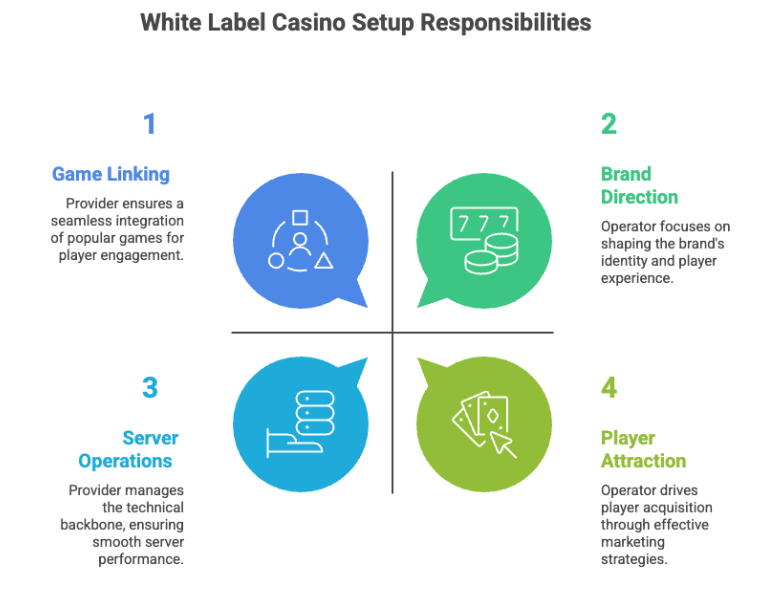
Under a white label structure, responsibilities are clearly divided between the provider and the operator. Infrastructure handling sits with the platform provider – development, server operations, game integration, payment processing, licensing, adherence to rules. Brand direction, promotion, attracting players, keeping users engaged – that work belongs to the operator. Through this split, firms lacking deep technical or legal knowledge can enter a tightly controlled gaming sector under valid oversight. One side builds foundations. The other shapes presence.
A typical white label casino setup includes a gaming license alongside popular games. Included within are processing options for payments, paired with administrative control features. Regulatory components like identity verification and anti-money laundering checks form part of the structure. These packages gain favor due to fast deployment times. Entry costs stay modest when compared to building independently. Risk levels tend to remain controlled under this model. Operators focused on outreach and image creation often find alignment here. Suitability arises especially for those emphasizing promotion over technical infrastructure.
How the White Label Casino Business Model Works
How White Label Casinos Operate
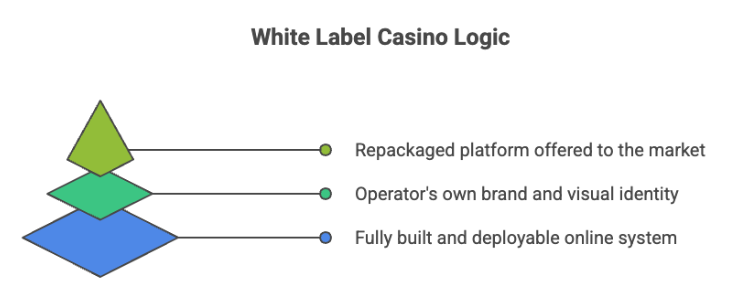
The core logic of a white label casino can be summarized as “leasing infrastructure while focusing on brand operations.” Platform providers supply a fully built and immediately deployable online system that includes a gaming license, game content, payment channels, and compliance mechanisms. Operators then apply their own brand, domain name, and visual identity on top of this foundation, repackaging the platform and offering it to the market under their own name.
Division of Responsibilities Between the Platform Provider and the Operator
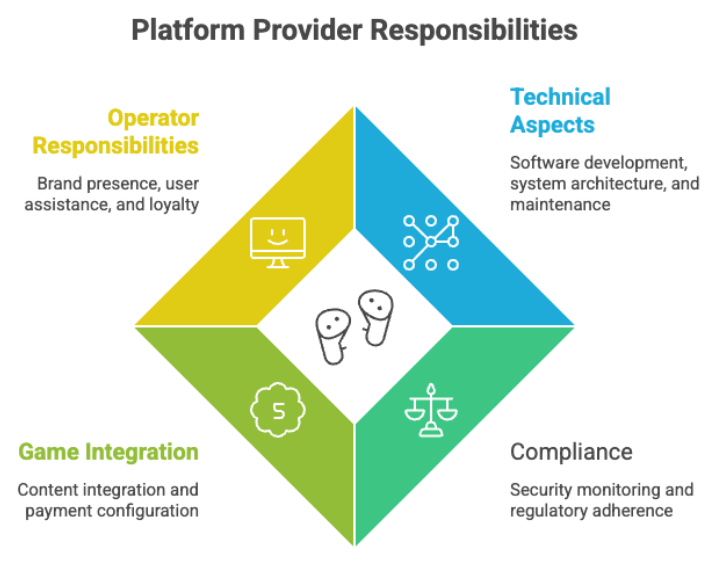
The platform provider assumes full responsibility for all technical and compliance-related aspects. This includes software development, system architecture, game content integration, payment configuration, security monitoring, and ongoing updates and maintenance. As providers are typically already integrated with multiple game suppliers, operators do not need to negotiate individual licenses, significantly reducing both time and administrative costs.
Yet the operator handles tasks linked to public engagement. Among these are shaping brand presence, applying outreach methods like search visibility tools, online community interaction, and partner promotions, offering assistance to users, while also refining enjoyment and loyalty over time. Seen from a user’s point of view, the system runs on its own web address, appearing identical in design and function to an individual gambling site.
Launch Process and Timeline
The launch process for a white label casino is relatively streamlined. Once a supplier is chosen, setup begins with licensing, financial arrangements, and then adding games – this flows into branding adjustments and launching promotional activities. Completion usually takes between four and six weeks, far less time compared to developing an original system entirely.
Revenue Sources and Profit-Sharing Structure
A white label casino earns mainly through gross gaming revenue (GGR), calculated by subtracting total winnings from bets placed. In most arrangements, suppliers use a revenue-share (RevShare) model.Under this model, the provider receives an agreed percentage of Net Gaming Revenue (NGR). NGR is calculated after deducting bonuses, payment processing charges, and applicable platform fees. Such arrangements often allocate between one-fifth and one-half of NGR, with settlements typically occurring on a weekly or monthly basis.
Cost Structure
The main cost components include an initial setup fee, ongoing monthly software and operational fees, compliance-related expenses, and marketing and player incentive costs. As online casinos do not require physical premises, the overall operating leverage is relatively high, and mature platforms are often able to maintain comparatively stable EBITDA margins.
Speed and Cost Advantages: Why Time-to-Market Determines Success
In the iGaming industry, time-to-market often determines whether a new platform survives even before the product itself is fully evaluated. The core advantage of white label solutions lies in their structural edge in both speed and cost.
The first major difference is the speed of launch. Four to six weeks usually cover the timeline for launching under a white label arrangement. Already in place are central components: gaming inventories, payment processing, administrative dashboards, and foundational code structures. Branding elements, screen layouts, and regional targeting remain tasks left for the operator. Take DSTGAMING-style frameworks – these carry ready-made compliance layers alongside operational blueprints, cutting entry delays sharply. Building an entire digital gambling environment without such support stretches into many months; sometimes beyond twenty-four. Software creation, outside system links, regulatory submissions, and validation cycles demand attention at once, piling up calendar demands. Time spent multiplies when starting empty-handed.
Starting at a much smaller scale defines the contrast in financial commitment. From the beginning, pre-built solutions require less capital, usually between 50,000 and 200,000 U.S. dollars. A custom system, on the contrary, moves past half a million fast – sometimes stretching into millions. Cost patterns shift sharply depending on the path taken. The fundamental distinction is that white label solutions convert large upfront technology capital expenditure into more predictable operating expenses. Operators do not need to build their own servers, purchase proprietary code, or integrate extensive game content libraries.
Equally important is the transfer of technical and staffing costs. With a white label setup, upkeep of the system falls to the provider, along with security patches, fraud oversight, and compliance aid included. Operators therefore skip assembling big in-house departments for technology, law, or quality checks, shifting focus toward promotion and identity development instead. Long-term expenses drop as a result, while day-to-day vulnerabilities decrease at the same time. Fixed overheads shrink, yet resilience improves under such models.
Most critically, speed has a direct impact on cash flow and market opportunity. While self-built platforms may still be in development, white label operators are already gaining players. They generate revenue and confirm market demand. In a very competitive environment, it helps to enter new markets quickly. Getting an early foothold often improves return on investment. At its core, the white label solution trades minimal risk for the most valuable asset: time. It helps businesses move from concept to cash flow much faster.
Ready-Made Infrastructure and Customization Options
Another core strength of white label solutions lies in their ready-to-use infrastructure. This goes far beyond a simple front-end template. A complete backend structure exists here, combining game collection with transaction handling through unified office operations alongside customer data systems. One part connects to another without separation, forming a single operational unit where functions like payments flow into administrative tasks while user records remain linked throughout.
Immediate access to diverse games and payments becomes possible under this structure. Data-guided tools handle campaign oversight, incentives, and user engagement. New participants face fewer technical hurdles at launch. Operational uncertainty in the initial phases sees a notable reduction.
At the same time, “white label” does not mean a lack of flexibility. Modern white label solutions offer a substantial degree of customization at the front-end and operational level, covering brand visuals, interface layout, game selection, and promotional strategies. True differentiation does not come from the underlying technology itself, but from brand positioning and the ability to acquire, engage, and retain players.
Licensing, Compliance, and Operational Responsibilities
For any online casino operation, holding an official gaming license alongside a solid compliance system is essential. Under white label models, services usually function using pre-approved authorisation, enabling businesses to work beneath the licensor’s oversight while receiving integrated systems that support identity verification, anti-money laundering checks, player protection measures, and financial tracking processes.
Shortening the launch period becomes possible through this method, while bypassing expensive and time-heavy licensing procedures carried out alone. Still, using a white label arrangement fails to shift full accountability toward the supplier. Responsibility for marketing adherence on the user-facing side stays with operators, along with maintaining service quality and public perception of the brand. Across regions, rules expected by authorities differ in notable ways.
Because of this outcome, it becomes essential to outline the rules within the intended market prior to choosing a white label option – this approach reduces future legal and functional exposure. Only after clarity is achieved can potential missteps be minimized through informed decisions.
Risks and Limitations of the White Label Model
Though launching faster appeals, the white label path carries constraints worth noting – compliance demands, competitive overlap, and restricted growth flexibility stand out. A close look at the downsides becomes necessary prior to adoption.
Regulatory and policy risks
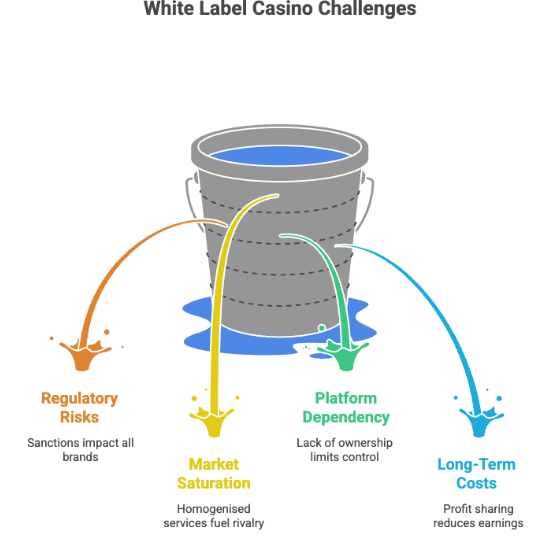
Operating beneath a provider’s overarching license defines how white label casinos function. When regulatory bodies sanction the host company through penalties, suspensions, or withdrawal of authorization, every brand using that permit faces enforced closure. Should compliance shortcomings occur within the central operation, ripple effects reach each dependent entity without exception. Many such arrangements rely on international or offshore licensing frameworks by default. Access to tightly controlled regions – like the United Kingdom or Germany – becomes problematic under these conditions. Growth potential suffers significantly when entry into strict jurisdictions remains blocked. Long-term expansion may stall where legal alignment proves unattainable.
Market saturation and homogenized competition
Despite different logos, services frequently feel alike due to shared platforms and software sources. Where markets are long established, such similarity fuels intense rivalry in pricing and incentives, steadily shrinking profit space.
High dependency on the platform provider
Ownership of essential systems remains absent under white label setups. Progress on updates depends heavily upon external suppliers. When performance falters, shifts to alternative platforms may demand significant resources. Termination of collaboration introduces operational uncertainty. Integration timelines are controlled externally, limiting internal control. Transition difficulties often arise without warning.
Long-term cost and strategic considerations
Despite modest initial costs, continued profit sharing along with recurring charges may slowly reduce earnings over time as operations grow. When long-term growth or wide scaling is the goal, white label setups are often a short-term step, not a long-term plan.
Choosing the Right White Label Casino Solution Partner
Overall, white label casino solutions are not a speculative shortcut, but a business choice that trades flexibility for efficiency. They enable operators to overcome technical, regulatory, and capital barriers, quickly test market demand, and establish early cash flow. At the same time, the model carries inherent risks related to regulatory dependence, homogenized competition, and long-term cost pressure, making it unsuitable for every stage of growth.
Against this backdrop, solution providers such as DSTGAMING often suit operators seeking sustainable, controlled growth.
They bring years of industry experience and strong knowledge of compliance processes. They also provide comprehensive technical and operational support.
Conclusion
White label casino setups do not offer quick wins; instead, they represent a strategic trade – efficiency replacing adaptability. Operators gain access through reduced technical hurdles, lighter compliance loads, and fewer upfront funds. Entry becomes faster, demand can be measured without delay, and revenue may start sooner than expected. Yet reliance on external regulation creates vulnerability, while similar offerings across providers fuel indistinct rivalry. Over the years, expenses might rise quietly, eroding margins. Not every expansion phase benefits under such constraints.
What matters most begins with clarity of purpose. Objectives must shape decisions, not assumptions. A provider’s fit depends less on features, more on consistency over time. Regulatory insight becomes critical when compliance pressures rise. Technical stability cannot be tested after commitment. Long-term backing reveals itself only through sustained presence. Market position shifts constantly – partnership choices should not require constant reassessment. Understanding precedes selection each time.
Interested? Schedule a free consultation with DSTGAMING casino platform experts.