
AI-Powered Player Retention: The Future of iGaming
It was always inevitable that iGaming would one day rely on Artificial Intelligence for player retention. We already use AI for everything from game development to marketing campaigns, and AI-powered player retention was always the next step. With the right framework, AI analyse player behaviour in real time and helps operators spot early signs of disengagement. Player retention has always been a key part of the iGaming industry. It also remains one of the most cost-effective ways to grow a business.
The value of retention becomes clear when you compare the costs. Keeping 10 existing players often costs less than acquiring one new player. Therefore, many operators prioritize retention to improve long-term profitability.
Operators used to rely on extensive marketing campaigns and affiliate partnerships to acquire players. Still, rising costs, tighter regulation, and increasing competition have made it harder to rely solely on new-player growth. The operators that perform best today are often those that keep existing players engaged, and DSTGAMING’s progressive AI-powered player retention framework reflects this shift toward smarter, more adaptive engagement.
Importantly, retention has always been a strategic tool since it costs less to engage an existing player than to target and attract a new customer.
Is Retention Still a Competitive Advantage?
Player retention has always been a key part of the iGaming industry. It also remains one of the most cost-effective ways to grow a business.
The value of retention becomes clear when you compare the costs. Keeping 10 existing players often costs less than acquiring one new player. Therefore, many operators prioritize retention to improve long-term profitability.
Between the rising advertising costs across digital channels and the intense competition for premium affiliate traffic, the cost of acquiring new players has gone through the roof. Regulatory restrictions in several jurisdictions, which are narrowing traditional marketing opportunities, are also emphasizing the value of retaining existing customers.
The concept of customer lifetime value reinforces this shift. A player who remains engaged for months or years contributes far more than the value of their initial deposit. Operators generate revenue from the consistent activities of these players and compete in new markets without losing sleep over expenses. We have observed that even slight improvements in retention rates can yield significant gains in profitability, as the value of each loyal player compounds over time.
Player retention may be the true competitive advantage in a world of overwhelming iGaming platforms offering equally attractive benefits. The growing variety of online gaming platforms, unending game selections, payment options, and customer support structures that culminate in an excellent user experience make it necessary for casinos and sportsbooks to retain their existing players as much as they pursue new users.
We argue that player loyalty in a world of gaming options comes from consistently relevant experiences, not the promise of one-time incentives.
The point here is that truly competitive operators are those who understand why players stay, why they leave, and how to strengthen engagement throughout the customer journey.
How relevant are Traditional Retention Strategies Today?
In the past, operators retained players with proven strategies. These included weekly emails, deposit bonuses, cashback, loyalty points, player communities, and VIP programs.
Today, these methods still deliver results. However, player expectations continue to evolve. Many players now want more personalized experiences. Therefore, operators must combine traditional retention strategies with tailored engagement to stay competitive.
A common challenge with traditional retention campaigns was their reliance on broad assumptions. Operators often grouped their players into categories based on deposit amount, account age, or even location. The game would also make identical offers to players across these broad categories, regardless of personal preferences. This approach made campaign management simpler, but ignored the unique motivations and behavioural patterns that influence individual engagement.
Generic promotions may generate temporary activity, but they rarely establish meaningful loyalty. Players who receive repeated bonus offers without regard to their personal preferences are unlikely to recognize the value of such an experience. In some cases, indiscriminate promotional strategies encourage bonus hunting and other detached bonus-driven behaviour rather than long-term engagement.
Traditional retention models also tend to be reactive, based on reduced player activity or suspended engagement. At that stage, it is often considerably more difficult to rebuild player engagement than to maintain it.
DSTGAMING’s player management framework leverages its AI setup to develop more intelligent, data-driven approaches that go beyond static segmentation and reactive campaign management.
DSTGAMING’s player management framework uses unified player data, behavioural analytics, campaign automation, and real-time engagement tools. By combining the best of traditional retention strategies and AI, we go beyond static segmentation, enabling operators to respond dynamically to individual players’ interactions with the platform.

How Artificial Intelligence is Changing Player Retention
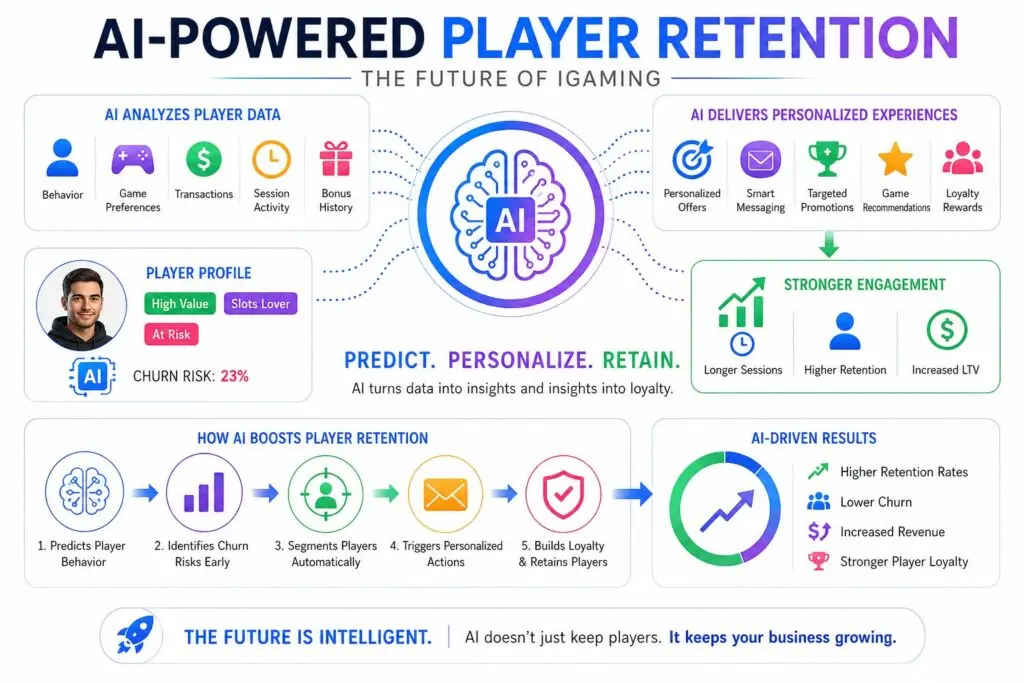
Using Artificial intelligence in player retention is not an end to the time-tested strategies used by platforms. If anything, AI improves player retention by introducing fresh perspectives on player behaviour. Operators can now rely on AI to process a wide range of behavioural data and identify patterns that would be impossible to detect through manual analysis alone.
Every player’s interactions build their behavioural profile. These factors include deposit frequency, game preferences, and average session duration. They also cover wagering habits, withdrawal activity, login times, and device preferences. In addition, operators analyze geographical trends, responses to previous promotions, and navigation habits. Together, these insights reveal how each player interacts with the platform.
AI-powered player retention analyses use user interaction records to identify relationships between seemingly isolated behaviours and future outcomes. Instead of simply reporting what has happened, it also estimates what is likely to happen based on existing patterns. This predictive capability transforms retention from an attempt to measure player interactions into ta forward-looking strategy.
This age of machine learning also implies that new AI models will be developed using new learning frameworks over time. The more behavioral data AI receives, the more accurate its predictions become. As a result, it can deliver more relevant recommendations and timely interventions.
Moreover, AI continues to learn from new player behavior. Therefore, operators can update retention strategies based on current preferences instead of relying on outdated data.
Ultimately, what we get is an advanced adaptive system capable of responding to individual behaviour in real time without relying heavily on predefined marketing schedules.
Early Churn Detection Using Predictive Analytics
Before AI was used in iGaming data, player disengagement seemed to happen suddenly, or out of the blue. But the available data suggests that there might be an unobserved buildup leading to the disengagement.
The first signs of player disengagement often appear in player behavior, not in overall results. At first, these changes may seem minor. However, they can build up over time.
For example, players may spend less time gaming or place smaller wagers. They may also play their favorite games less often or change their betting strategies for weeks. Individually, these changes may seem insignificant. Together, however, they can signal a higher risk of player churn.
Once an operator understands that churn is a risk, the next step is to establish why it is a challenge. It’s also critical to take action at the right time based on those insights. DSTGAMING’s platform allows operators to personalize offers, recommend relevant games, offer loyalty rewards that align with players’ behaviour, provide support, and communicate with players before they become ‘stale’, which helps boost retention rates.
Personalised Marketing
Personalization has grown beyond inserting a player’s first name into an email. These days, AI helps operators personalize most stages of the player experience, starting with recommendations based on individual behaviour.
AI selects promotions according to demonstrated preferences and targets communications in line with historical engagement patterns, even outside fixed schedules. But incentives will vary depending on the player’s spend power. Some players enjoy free spin promotions, while others opt for cashback promotions. Some of the passions behind a third player are the exclusive tournaments, and another is the early release of new games. AI can identify these behavioural distinctions and automate adjustments to retention frameworks.
DSTGAMING’s player engagement tools enable operators to interpret these cues and develop customized campaigns and game recommendations tailored to each player’s tastes and preferences, rather than relying on a generic marketing approach.
Responsible Gaming
Player retention has always been considered a distinct aspect of responsible gaming. After all, retention focuses on increasing engagement, while responsible gaming emphasizes player protection. We even observed that player engagement in many regions, such as Sweden and the UK, was affected when regulators implemented strict policies to manage problem gambling. Interestingly, the growing adoption of AI also reveals a connection between player retention and responsible gaming. Recent advances in behavioural analytics demonstrate that these goals are more aligned than they appear, since sustainable engagement depends on players’ well-being.
AI can help manage problem gambling by recognizing certain patterns that are correlated with high levels of gambling risk, such as frequenting the site or playing for extended periods of time. Early detection means operators can take the steps needed to prevent the damaging behaviour from worsening.
These insights help DSTGAMING’s responsible gaming system monitor behavioural indicators, help operators adhere to gambling laws, and encourage a more sustainable and healthy gambling experience without losing the fun and enjoyment provided by their games.

Challenges in Implementing AI-Driven Retention
AI-driven player retention offers many benefits that may never be realized without the framework and high-quality data to measure customer engagement expectations and make necessary recommendations. However, even with the right tools and structure, AI implementation is likely to face a growing range of challenges.
Data Quality and System Integration
AI is largely limited by the quality of data it receives and the structure around its integration. When the available data are drawn from fragmented records across CRM, payments, game platforms, and support tools, it is difficult for the machine to parse and review them to build a complete view of player behaviour. Inconsistent tagging, missing fields, and delayed updates can distort predictions and weaken campaign performance. DSTGAMING’s ecosystem employs clean data pipelines to provide a stronger foundation for AI-driven decision-making and successful platform integration.
Privacy, Consent, and Regulatory Pressure
There are privacy issues with the use of retention models, as behavioural tracking is detailed. The operator is tasked with transparency in data collection and management of consent, and with the processing of data in accordance with local legislation. Personalization can pose a compliance risk, even in highly regulated markets, and can create problems if not properly documented and reviewed. But with the use of AI, there must be clear policies and audit trails that align with local regulations for responsible use.
Bias without Model Oversight
Machine learning may include some biases if its training data reflects narrow player segments or incomplete historical campaign patterns. Such bias may lead to unfair targeting or even missed opportunities for players and operators alike. Such biased data can only be prevented by using constant, regular model testing and human review to see the reasoning behind the AI’s recommendations. AI without regulation can go on a short-term hunt for engagement, missing out on fairness/trust.
The Future of iGaming Retention
The next wave of ‘intelligent systems’ will shape the future of iGaming, and how operators can integrate them into their user experience framework will determine the success or failure of their operations. Another important part of future success will be maintaining user engagement, and AI can help predict customers’ needs, adapt to shifting user behaviour, and foster long-term relationships. The ones who win in the future with AI are those who invest in building players’ trust and in understanding them better through AI.