Why iGaming Operators Need Gamification Services
Here is a question we put to almost every operator who talks to DSTGAMING for the first time: what happens to a player on day nine? This is where innovative Gamification Services can make a real difference in engaging players beyond the first week.
Day one is easy. There’s a welcome bonus, a shiny lobby, a first deposit. Day two and three usually still go fine. But by day nine most players have taken what the bonus gave them, tried the same three slots they always play, and drifted off to whichever brand sent the loudest email that morning. The acquisition budget was spent. The lifetime value never showed up.
That gap between the first deposit and a real habit is the reason gamification services exist. It’s also why we build gamification into the platform itself rather than bolting it on as a promotion tool. This piece explains what gamification actually changes in the way people play, which mechanics an operator should start with, where the money comes back, and how to do all of it without upsetting your compliance team.

Your Games No Longer Make You Different
Twenty years ago an operator could compete on catalogue. Not anymore. A mid-sized brand in Europe, LatAm or Asia licenses the same slots, the same live tables and the same crash games as the brand in the next browser tab. Payment options have converged as well. So has the sign-up flow.
What hasn’t converged is everything around the games: whether a player can see progress, whether their activity gets noticed, whether they feel they’re building something on your site or simply spending money on it. That’s the layer gamification works on, and it’s the only layer left where a platform can genuinely look and feel different.
The pressure behind this is not theoretical. Acquisition costs across regulated markets have climbed year after year, and the UK Gambling Commission’s industry statistics show how casually players hold accounts with several brands at once. Keep a player one month longer and that’s one month you don’t have to buy them back.
We went through the wider operating model in our guide to iGaming retention strategies that build value. Gamification is the visible part of that model, the part the player actually touches.
What Gamification Does to Behaviour
People hear “gamification” and picture badges. Fair enough, badly done gamification is exactly that: a sticker chart nobody looks at. Done properly, it changes four things.
It makes progress visible. A level bar, a mission tracker or a seasonal pass tells the player their sessions add up to something. Without it, every login starts from zero, and zero is not a reason to come back.
It nudges people to explore. Ask for three spins on a title that launched last week and you’ve just moved a player out of their two comfort games and into the rest of your lobby. That sounds small. It isn’t. A player who knows twenty of your games has twenty reasons to return; a player who knows two has two.
It turns bonuses into rewards. The free spins that arrive because someone finished a challenge feel earned. The same free spins arriving in a mass email feel like a discount, and they attract exactly the bonus hunters you’d rather not pay. Earned rewards also tend to see less abuse, simply because they’re tied to real activity rather than to registering an account.
And it gives competitive players something to compete for. A tournament leaderboard with two hours to go and your name in fourth place is a motivator no promotion can copy.
None of this is guesswork. The self-determination research by Ryan, Rigby and Przybylski, still the most cited explanation of why people keep playing games, comes down to three needs: autonomy, competence and relatedness. Missions, levels and leaderboards map onto those needs almost one to one.
Six Mechanics, and the Job Each One Does
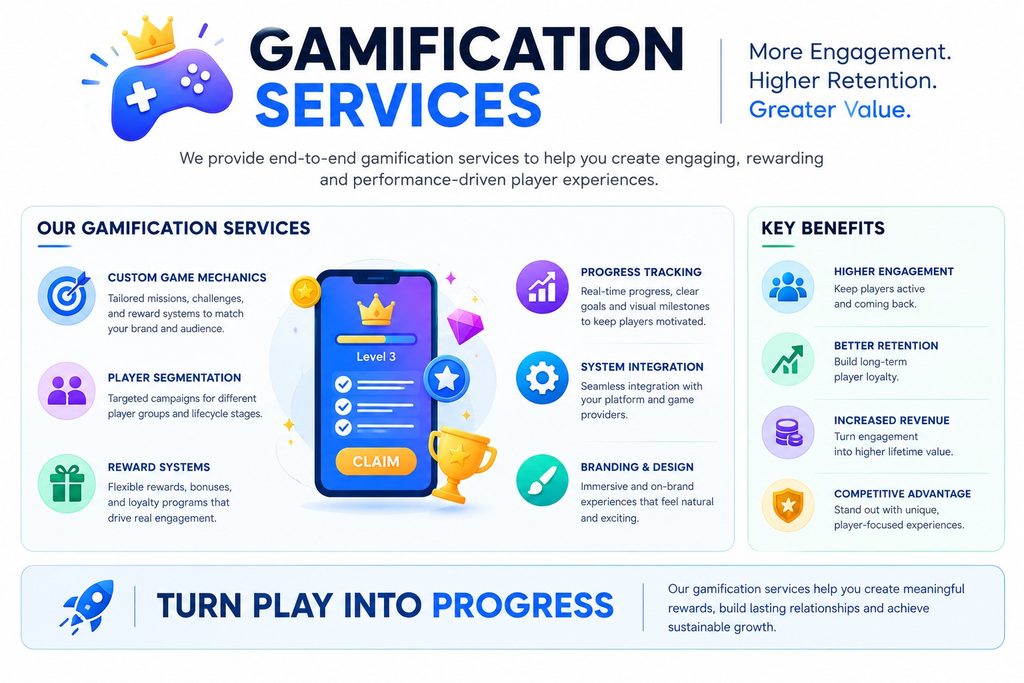
Our gamification solutions are modules inside the platform CRM. You can switch on one and add the rest later. Each one answers a different question a player is silently asking, and each one moves a different number.
| Mechanic | What it does for the player | Retention job | First number to watch |
|---|---|---|---|
| Loyalty system | Points, levels and milestones that build over the whole relationship | Answers “why here and not the other site?” | Ninety-day retention |
| Missions | Short challenges with a clear reward: try a provider, hit a target, log in three days running | Shapes behaviour and pushes exploration | Distinct games tried |
| Tournaments | Time-boxed competition with a prize pool and live leaderboard | Creates peaks around launches and fixtures | Reactivation rate |
| Jackpots | Prizes that grow across the platform or network | Adds anticipation to ordinary play | Session length |
| Mini games | A daily wheel or scratch card that rewards showing up | Turns the visit into a habit | Session days per month |
| Reward system | Converts activity into bonus funds, free spins, cashback or prizes | Makes every other mechanic tangible | Bonus cost per retained player |
Do you need all six on day one? No. Most operators we work with get the best first-quarter return from loyalty plus missions, then add tournaments once the active base is big enough for a leaderboard to mean something.
Where the Return Shows Up
Judge gamification services on operating numbers, never on how pretty the interface is. Session frequency tells you how many days per month the average active player logs in; daily mini games and streak missions move it directly. Catalogue depth tells you how many different games a player has tried, and in our data it’s one of the strongest predictors of who’s still around after three months.
Bonus cost per retained player usually falls, because earned rewards go to activity rather than to everyone. Put the gamified reward spend next to the mass promotions it replaced and compare. Ninety-day retention, the share of first-time depositors still playing three months on, is the number that tells you whether your acquisition spend is an investment or just a bill. And reactivation rate shows how many lapsed players come back when a tournament or seasonal event goes live, which gives you a reason to contact a dormant player that isn’t “here’s another bonus”.
Because the modules live in the CRM, every one of these numbers is available per segment. You’ll see that a mission works beautifully for high-value players and does nothing for casual ones, and you can change the target or the reward without rebuilding anything.
Gamification and Responsible Gambling Aren’t Enemies
This is the objection we hear most from compliance teams, so let’s deal with it head on. Can gamification encourage excessive play? A badly designed programme can. A well-designed one does the opposite, for a reason that surprises people: the gamification engine is the one system on your platform that already tracks activity in fine detail.
That detail gives you safeguards. Missions can be capped so a challenge never requires more than a set stake or session length. Loyalty progression pauses automatically when a player sets a limit, takes a time-out or trips a risk indicator. Rewards can be routed to non-monetary forms, tournament entries or prize draws for example, for segments where bonus funds aren’t appropriate. And every reward decision is logged, which is precisely what a regulator wants to see when they ask.
The Malta Gaming Authority’s player protection guidance, which plenty of operators outside Malta use as a benchmark, is a sensible reference when you write your reward rules. Our own rule of thumb: get the responsible gambling team into the first design workshop, not into the review meeting afterwards.
Why This Is More Urgent in 2026
We recently wrote up the casino gamification trends operators need in 2026. Three of them raise the stakes.
Event-based platforms have made real-time reactions practical. A mission can respond to a deposit, a near miss or a game launch within seconds instead of in tomorrow’s email batch. Personalisation has dropped from segment level to player level, so the same mission framework can show different targets and rewards to different people based on their own history, without separate campaigns.
And then there’s who is actually signing up these days. Battle passes, daily quests, seasonal events: that’s the world they came from, so of course they look for the same things in a casino. Show them a welcome bonus and a promotions page and nothing else, and you’ll look about ten years out of date.
A Rollout Plan That Works
The operators who get the most out of gamification services tend to follow the same rough order. They decide first which behaviour they want to change, and they make it precise: not “engagement”, but “raise the share of players who try a new provider each month” or “lift day-seven logins”. A precise target makes the right mechanic obvious.
They start with loyalty programs and missions. Both can work from day one, even with a small active player base. They also generate useful data quickly.
First, reward economics should be defined before launch. The team sets a maximum reward cost per player each month. They also establish clear reward limits. This approach prevents difficult changes later. Reducing rewards after launch can create more friction with players.
Next, the team works with compliance specialists to define responsible gaming rules. These rules are then configured, tested, and documented. Only after this process should players access missions.
For the first tournament, choose a relevant event or occasion. This could include a game launch, major fixture, or holiday weekend. As a result, the tournament gains a clear theme. The marketing team also gets a stronger campaign angle.
Finally, review performance each month. Remove missions that deliver little value. At the same time, expand the ones that show strong results.
On the DSTGAMING platform this whole sequence fits in weeks, because the modules already talk to the wallet, the game aggregator and the CRM. Operators building on their own stack should budget a good deal longer just for the plumbing.

Why Not Build It In-House?
From the outside gamification looks simple. Rules, counters, rewards. From the inside a production system has to handle wallet integration, real-time events from every game provider you carry, fraud and abuse controls, reward valuation across currencies, regulatory logging and a front end that works on every device. Building that once is a big project. Maintaining it while providers, regulations and player expectations keep shifting is a permanent one.
That’s the difference between a gamification project and gamification services. With DSTGAMING the engine is maintained, updated and extended as part of the platform, so your people spend their time designing missions and tournaments that suit your brand instead of debugging event pipelines at midnight.
Give Players a Reason to Be There on Day Nine
Acquisition is expensive, players hop between brands without a second thought, and your game catalogue no longer sets you apart. What does set you apart is the experience wrapped around the games: progress people can see, rewards they feel they’ve earned, and events that give them a reason to come back this week rather than eventually.
That’s what gamification services deliver, and it’s why DSTGAMING built loyalty, missions, tournaments, jackpots, mini games and rewards straight into the platform. If you’re already on our white label online casino solution or our turnkey online casino solution, the engine is already there waiting to be switched on. If you’re not, our gamification solutions page shows how the modules fit into an existing operation.
Talk to DSTGAMING about gamification services. We’ll map your player lifecycle with you, pick the mechanics that fit your market, and build a programme your product, marketing and compliance teams can run with confidence.