
Casino API: The Complete 2026 Operator Guide
A Casino API is the technological backbone that connects game providers, payment gateways, and user management systems into a single functional unit. It eliminates the need for fragmented point-to-point connections, allowing modern iGaming platforms to scale efficiently and securely. This guide details how API architecture drives operational speed, security, and market flexibility for B2B operators.
| Feature | Specification |
|---|---|
| Integration Time | 2 – 6 Weeks (Standard) |
| Protocol Support | REST & WebSocket |
| Security Standard | OAuth2 / JWT / TLS 1.3 |
| Scalability Model | Horizontal / Microservices |
What is a Casino API?
A Casino API (Application Programming Interface) sets the definitive rules for how different software components communicate within an online casino. It functions as a universal translator, ensuring that game engines, payment modules, and user databases speak the same language. Without this central hub, operators would struggle to manage the complex web of connections required for modern gambling.
At DSTGAMING, the API serves as the most critical link between game providers and risk management systems. It centralizes communication and drastically reduces the technical debt associated with ad-hoc integrations. Developers can focus on building player-facing features rather than troubleshooting low-level plumbing issues.
For any operator launching a White Label Online Casino, this consistency is vital. It ensures the platform remains scalable, maintainable, and responsive as new features are added. A well-designed API creates a unified environment where data flows seamlessly between all parties.
Game Integration & Session Management
The API supports both REST and WebSocket protocols to handle different gaming needs. REST is ideal for standard actions like checking balances or configuring games, while WebSockets are essential for live dealer games where latency must be minimal. The API also maintains continuous session states, allowing players to resume games instantly if a connection drops.
Payment and Wallet Operations
All financial interactions route through secure API endpoints that support both fiat and cryptocurrency. The API handles the complex routing to different payment gateways and updates the unified wallet balance in real-time. This ensures that players see one consistent balance across all verticals, from slots to live tables.
How Does a Casino API Work?
The API framework manages several core tasks simultaneously to ensure a smooth player experience. It handles game integration, session management, and financial transactions through a set of defined endpoints. This architecture separates the front-end user interface from the complex back-end logic.
Benefits You Get with Casino API
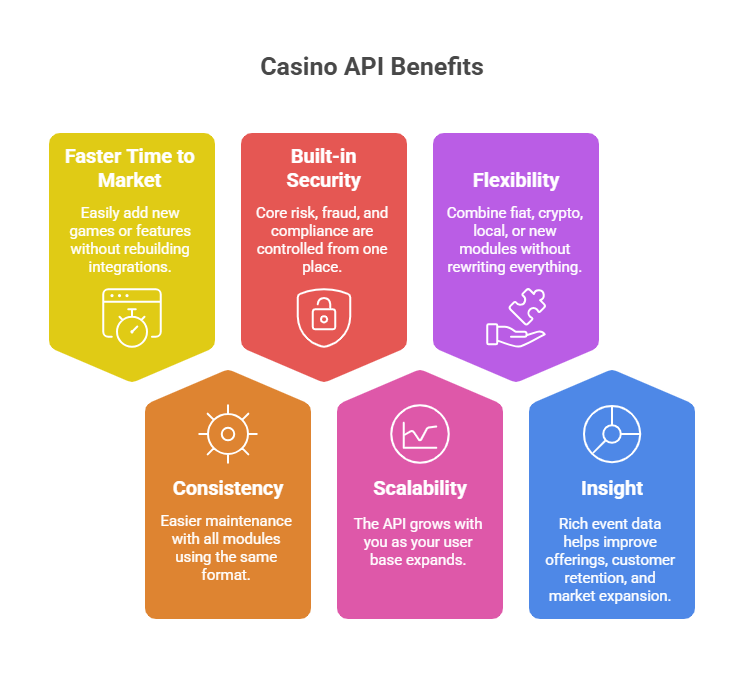
From DSTGAMING, our API offers the following benefits:
- Faster time to market: You don’t have to rebuild integrations. It’s easy to add new games or features.
- Consistency: It’s easier to keep up with maintenance when all modules use the same format.
- Security built in: Core risk, fraud, and compliance are all controlled from one place.
- Scalability: The API grows with you as the number of users you have grows.
- Flexibility: You don’t have to rewrite everything, as you can combine fiat, crypto, local, or new modules.
- Insight: Rich event data helps you improve your offerings, strategies for keeping customers, and expansion in the market.
Aggregator API vs. Direct Integration: Full Comparison
Operators must decide between connecting directly to game studios or using an aggregator API. While direct integration offers deep control, it lacks the efficiency required for rapid scaling. Modern iGaming platforms typically prefer the aggregator model for its speed and simplicity.
| Criteria | Aggregator API ★ Recommended | Direct Integration |
|---|---|---|
| Integration Speed | Weeks | Months per provider |
| Maintenance | Centralized / Low | Fragmented / High |
| Game Variety | Instant access to 10,000+ games | Limited to contracted studios |
| Cost Efficiency | Shared resources | Dedicated dev team required |
Key Architectural Considerations
Building or selecting a Casino API requires attention to specific architectural pillars. At DSTGAMING, we emphasize these areas to ensure robustness and security for our partners.
Security and Authentication
Every request must be validated using strong token schemes like JWT and OAuth2 to prevent unauthorized access. All communication is encrypted via TLS/SSL to safeguard sensitive player data. Without these security APIs, platforms risk data breaches and regulatory non-compliance.
Latency and Reliability
High latency destroys trust and frustrates players. We use edge servers, caching, and direct provider connections to minimize delays in balance updates or game results. The system also employs fallback logic and circuit breakers to maintain uptime even if a specific provider fails.
Versioning and Compatibility
APIs evolve, but changes should not break existing client implementations. DSTGAMING maintains versioned endpoints to ensure backward compatibility. This allows operators time to migrate to new versions without disrupting their live services.
Step-by-Step: How to Launch with Casino API
Integrating a Casino API follows a structured path to ensure a stable launch. Here is the standard process DSTGAMING recommends to its partners.
- Define Requirements: Identify target markets, required game providers, and specific payment methods.
- Select Architecture: Choose between REST or WebSocket integration based on your game focus.
- Connect Endpoints: Map your front-end wallet and user system to the API’s standard schema.
- Configure Risk Rules: Set betting limits, fraud triggers, and compliance parameters within the API layer.
- Testing & Certification: Conduct rigorous QA on game rounds, settlements, and reporting.
- Go Live: Launch the platform and monitor real-time analytics for stability.
How much does Casino API integration cost?
Costs vary based on the depth of integration and the provider’s pricing model. However, API integration is generally more cost-effective than building proprietary connections. Below is an estimate based on current market rates for B2B operators.
| Cost Category | Low Estimate | High Estimate |
|---|---|---|
| Setup / Onboarding | €5,000 | €15,000 |
| Monthly Maintenance | €1,000/mo | €3,000/mo |
| GGR Revenue Share | 5% | 15% |
Case Study: Rapid Market Expansion in Latin America
Context: An established operator wanted to expand into the Latin American market but faced fragmented local payment preferences. They needed to integrate multiple local gateways without rewriting their entire backend logic.
What They Did: They utilized DSTGAMING’s Casino API payment adapter. Instead of coding new wallet logic for every local bank and e-wallet, they mapped these new gateways to the existing unified API schema. The front-end remained unchanged, while the back-end handled the routing.
Results:
- Integration Speed: 3 weeks to cover 5 new payment methods.
- Development Cost: 60% lower than direct integration estimates.
- Player Retention: Increased by 25% due to seamless local payment options.
“The API adapter approach allowed us to roll out local payment methods in weeks, not months. Our players got the convenience they needed, and our dev team stayed focused on core product features.” — CTO, LATGaming Partners (Source: Internal performance report, Q1 2026)
Benefits of a Unified Casino API
A robust Casino API provides tangible operational advantages beyond simple connectivity. It acts as a strategic asset that drives efficiency and growth.
- Faster Time to Market: Add new games or features without rebuilding core integrations.
- Centralized Security: Control risk, fraud, and compliance checks from a single gateway.
- Operational Consistency: All modules use the same data format, reducing maintenance overhead.
- Market Flexibility: Swap or add payment providers and game studios with minimal code changes.
Challenges and Solutions in API Implementation
No system is without challenges, but experienced providers mitigate risks effectively. DSTGAMING addresses common API hurdles with specific architectural strategies.
Integration Complexity
Every game provider has unique quirks and data structures. DSTGAMING builds specific adapters that normalize this data into a unified schema. This shields the operator from the complexity of individual provider APIs.
Security Threats
APIs are primary targets for fraud and DDoS attacks. We implement rigorous rate limiting, anomaly detection, and code audits to protect endpoints. These measures ensure that only valid requests are processed.
Version Drift
Older modules may rely on legacy endpoints while new features require updated versions. We support multiple API versions simultaneously to allow for gradual migration. This prevents sudden breakages during updates.
The Future of Casino API Technology
The technology behind iGaming platforms is constantly evolving. DSTGAMING monitors several key trends to keep our API ahead of the curve.
GraphQL and Smart Querying
While REST remains the standard, GraphQL allows clients to request exactly the data they need. This reduces overfetching and improves performance for mobile applications with limited bandwidth.
AI and Predictive Personalization
APIs are beginning to integrate with AI engines to offer real-time game recommendations. As the API feeds event data to these models, the platform can dynamically adjust content to suit player preferences.
Blockchain and Provably Fair Gaming
Some providers are moving logic onto the blockchain for transparency. API bridges allow operators to integrate these on-chain games alongside traditional off-chain titles seamlessly.
Frequently Asked Questions
What is the difference between REST and WebSocket in Casino APIs?
REST is used for stateless requests like checking balances or launching games, suitable for slots and table games. WebSockets provide a persistent connection necessary for real-time data, such as live dealer video streams and chat functions.
How long does Casino API integration take?
A standard integration typically takes between 2 to 6 weeks. This timeline depends on the complexity of the operator’s front-end and the number of third-party providers being connected. Simple wallet integrations can be completed even faster.
Is a Casino API secure for financial transactions?
Yes, modern Casino APIs utilize advanced security protocols including OAuth2, JWT, and TLS encryption. These layers ensure that sensitive financial data and player information are encrypted and protected against unauthorized access.
Ready to Build Your iGaming Platform?
Get a unified Casino API that scales with your business. Connect to 100+ providers and secure your market position today.
Conclusion
The Casino API is the undisputed backbone of modern iGaming platforms. It enables operators to add games, manage payments, and enforce security with speed and precision. Without it, scaling a gambling operation would be prohibitively complex and expensive. Investing in a robust, modular API architecture is the key to long-term success in the competitive iGaming landscape.
Next Step: Assess your current platform’s flexibility and see if a unified API architecture can drive your next phase of growth.