
Casino Gamification Trends Operators Need in 2026

A generous welcome bonus can still attract a first deposit. It rarely gives players a reason to return on day seven, or day thirty. The casino gamification trends gaining ground in 2026 address that harder commercial challenge: turning a catalogue of games, offers and payment options into an experience with visible progress, relevant reasons to play and rewards that feel earned.
For operators, gamification is no longer a decorative layer of badges and generic leaderboards. It is a retention system that sits across the player lifecycle. Done well, it can create more repeat sessions, improve campaign relevance and give a casino brand a clearer identity in a market where game libraries increasingly look alike. Done badly, it adds friction, encourages poor-quality bonus behaviour and creates avoidable responsible gambling and compliance risks.
Why casino gamification trends are changing
The shift is partly commercial. Acquisition costs remain high, while players can compare offers and switch brands in minutes. Operators therefore need a stronger value exchange after registration. Rather than asking players to respond to one broad promotion, the most effective programmes provide a series of smaller, understandable incentives tied to activity, discovery and loyalty.
Technology is also changing what is practical. Event-based platforms can react when a player completes a challenge, tries a new provider, reaches a loyalty milestone or returns after a period of inactivity. When this data is connected through APIs to the casino platform, game aggregator, CRM and bonus engine, campaigns can be timely without becoming a manual operational burden.
That does not mean every mechanic belongs in every market. Jurisdictional rules, player expectations, available payment methods and a brand’s risk appetite all affect the right design. An operator targeting crypto-native users may value on-chain reward transparency and multi-currency flexibility. A newly licensed brand in a tightly regulated market may need simpler mechanics, prominent terms and more conservative reward limits.
Progress systems are replacing one-off promotions
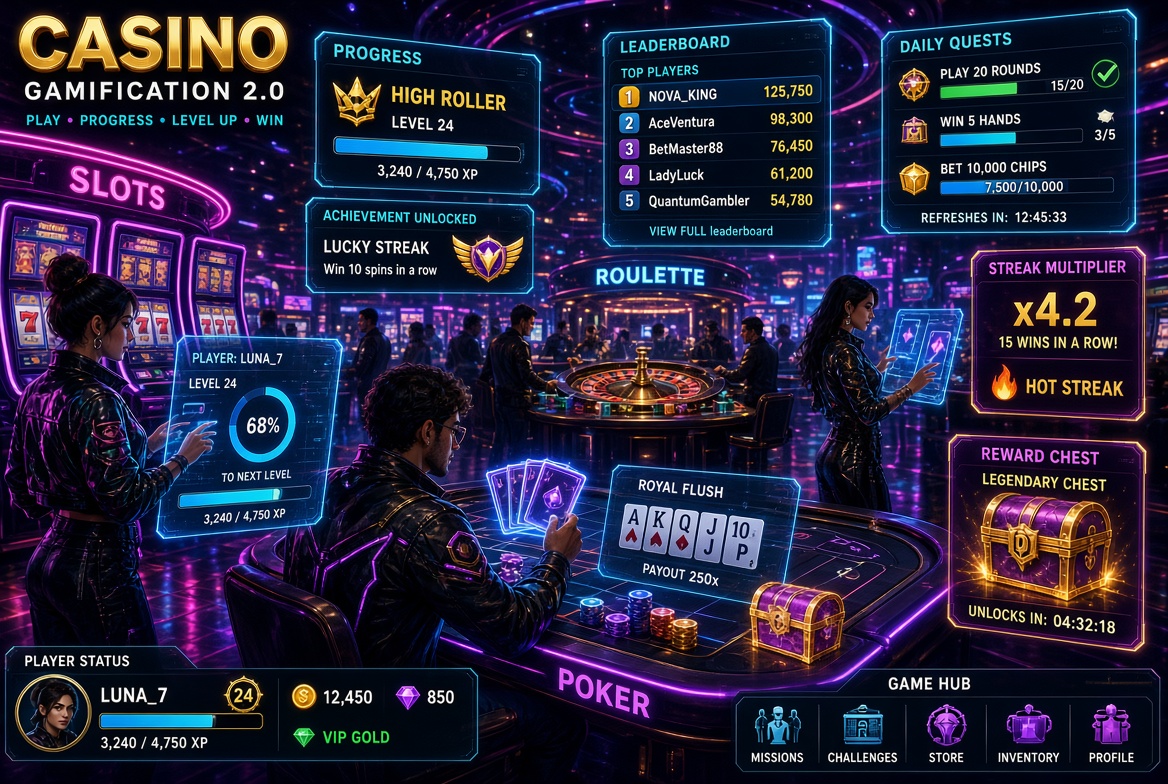
The strongest trend is the move from isolated bonuses towards persistent progression. Players can see where they are, what they can do next and what they will receive for completing a task. This gives routine casino activity a sense of direction without requiring a complex game-like interface.
Missions should have a clear purpose
Daily, weekly and seasonal missions are becoming more sophisticated. A mission might ask a player to explore selected slots, complete a set number of rounds within defined limits, or take part in a themed campaign. The objective should be simple enough to understand at a glance, while the reward must be proportionate to both the effort required and the operator’s commercial goals.
The key is to avoid missions that feel like disguised wagering requirements. If a challenge is too difficult, unclear or repetitive, it will not create loyalty. It will create frustration. Operators should vary missions by game category, player stage and campaign theme, then test the completion rate alongside the value generated after completion.
Loyalty tiers need benefits, not just labels
Tiered programmes remain effective when advancement provides meaningful benefits: earlier access to promotions, tailored tournaments, improved reward choice or a higher standard of service. A tier name alone will not retain a player. Neither will a programme that promotes rapid, high-intensity play as the only route forward.
A balanced model recognises sustained, responsible engagement. It can also use non-monetary benefits, such as exclusive content or personalised event access, to differentiate the brand without continually increasing bonus cost. For an operator, the tier engine should be configurable by market, currency and player segment rather than hard-coded into the platform.
Personalisation is becoming more disciplined
Personalisation has moved beyond inserting a first name into a message. Operators are increasingly using behavioural signals to decide which mission, reward or tournament a player is most likely to value. A player who enjoys live casino should not receive a slot-focused challenge by default. A low-frequency player may respond better to a simple return incentive than a seven-day quest.
However, personalisation requires restraint. More data does not automatically produce better engagement. Models can overfit to short-term activity, repeat irrelevant offers or create inappropriate incentives for players showing signs of risky behaviour. The right approach combines segmentation with clear suppression rules, affordability and risk signals, deposit controls and responsible gambling exclusions.
This is where platform architecture matters. Player profile data, game events, wallet activity, bonuses and risk management tools need to communicate reliably. If reward eligibility is calculated in one system but displayed incorrectly in another, trust disappears quickly. Real-time campaign capability must be matched by accurate balances, transparent terms and an auditable reward history.
Tournaments are shifting from volume to community
Tournaments remain a powerful engagement mechanic, particularly around new game launches, major sporting moments and seasonal campaigns. Yet the standard race-to-the-top leaderboard has limitations. It can favour a small number of high-stakes players and leave most participants feeling that there is no realistic chance of recognition.
More operators are therefore using segmented leaderboards, prize drops, team formats and milestone-based tournament rewards. These formats give a wider range of players an achievable reason to participate. They also allow the brand to create a campaign atmosphere around selected games, providers or themes without depending on a single large prize pool.
Social-style features should be handled carefully in real-money gaming. Community can mean shared progress, opt-in team challenges or visible event participation, not necessarily public chat or player-to-player interaction. Privacy, moderation and local regulations should shape the feature set from the start.
Reward choice matters more than reward size
A fixed free-spin reward is easy to deploy, but it is not always the most relevant incentive. Players increasingly expect some degree of choice: free spins on a preferred category, a tournament ticket, loyalty points, a cashback-style reward or a reward suited to their chosen currency.
Choice can improve perceived value while helping operators control cost. For example, a reward catalogue can present options with equivalent expected value but different appeal for different segments. This works particularly well for multi-market and crypto casino operations, where player preferences may vary by currency, content availability and local payment behaviour.
The trade-off is operational complexity. Every option needs clear eligibility logic, correct wallet handling and terms that are easy to locate. A reward catalogue is only an advantage if it is reliable across desktop, mobile and all supported currencies.
Build gamification into the operating stack
Casino gamification trends reward operators that treat engagement as a connected platform capability rather than an occasional marketing exercise. Before selecting mechanics, define the business outcome. Is the priority early-life retention, cross-selling into live casino, reactivation, game-provider promotion or differentiation for VIP players? Each goal requires different events, rules and measurement.
A practical implementation starts with clean event tracking. The platform should record relevant actions such as registration, deposit, game launch, qualifying wager, mission completion, reward claim and withdrawal request. These events must flow securely to the gamification and CRM layers, while fraud controls identify bonus abuse, multi-accounting and suspicious reward patterns.
Configurability is equally important. Commercial teams need to launch and adjust campaigns without requesting a development release for every prize value or rule change. At the same time, permissions, approval workflows and immutable logs protect against accidental errors. For growing operators, modular API integration makes it possible to add a gamification system without replacing the wider casino stack.
DSTGAMING’s operator-first approach is built around that requirement: connecting game aggregation, payments, risk management and configurable player-engagement tools so brands can move from campaign idea to controlled execution faster.
Measure quality, not just participation
A campaign with a high opt-in rate is not automatically successful. Operators should assess whether participants return more often, remain active for longer and generate sustainable value after rewards are issued. Compare cohorts against an appropriate control group where possible, and review results by player segment, market, device, currency and acquisition source.
Watch the cost side with equal care. Track bonus cost, reward redemption, incremental net gaming revenue, abuse rates, withdrawal patterns and customer-support contacts. A mission that produces strong wagering volume but also creates disputes or attracts bonus hunters may be damaging long-term profitability.
Responsible gambling metrics must sit in the same reporting view. Gamification should not target excluded players, override account limits or intensify engagement when risk signals are present. Clear opt-outs, understandable progress rules and sensible frequency caps are not merely compliance features. They protect player trust, which is far more difficult to rebuild than a short-term conversion rate.
The operators that stand out will not be those with the loudest wheel animation or the largest leaderboard. They will be the ones that make every challenge useful, every reward credible and every campaign easy for players to understand – then keep improving the experience with evidence rather than guesswork.