
Crypto iGaming in 2026: Market Trends Every Operator should Watch
There is more hard data on crypto gambling than there was a year ago, and less agreement about what it means. Published estimates of the market’s size differ by a factor of eight. The coin mix has moved. Regional demand has stopped moving in one direction. And at least one regulator has decided that crypto is not a cashier setting but a lifecycle it intends to inspect.
If you are weighing entry, those four things land on the same decision: which market, which assets, how much compliance headcount, and whether to build a platform or rent one. Here is what is worth watching, and what each trend does not tell you.
The market is getting easier to measure
Start with the number you can check yourself. A Gambling Insider investigation published on 27th July 2026 tracked 29 hot wallets belonging to 12 casinos across Ethereum, BNB Chain and Tron. Those wallets received $22.7 billion in deposits during 2025. Applying a GGR-to-deposit ratio of 0.25 to 0.50 puts estimated gross gaming revenue between $5.7 billion and $11.4 billion.
Now set that against the $81.4 billion figure for 2024 attributed to Yield Sec and first reported by the Financial Times in April 2025. The gap is uncomfortable. Yield Sec later told Gambling Insider that its number covered all forms of crypto gambling, and that 59% of it, around $48 billion, belonged to crypto casinos. Tanzanite, working on-chain by a different route, put 2024 crypto gambling GGR at $10 billion to $11 billion.
None of these numbers is wrong. They cover different years, different products, different networks and different payment routes, which is exactly why they should never appear on the same slide without their definitions attached. The $81.4 billion figure has circulated in investor decks as a crypto casino number for over a year. It was not one, and the clarification travelled nowhere near as far as the original.
Read the on-chain work for what it excludes, too. No Bitcoin. No Litecoin. Most of Solana missing. Nothing routed through a payment processor, and nothing in a wallet the researchers could not attribute to an operator. That is a large share of real activity sitting outside the $22.7 billion.
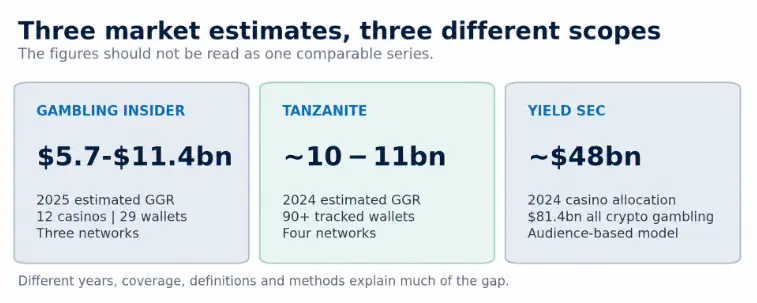
Figure 1. Published estimates vary because their years, definitions, coverage and methods differ.
What has genuinely changed is repeatability. Anyone can rerun those wallet queries next quarter and watch the number move, which was not true two years ago. Treat the result as a floor rather than a market size, and keep the questions that on-chain data cannot answer on a separate page: licensing, payment access, acquisition cost, and whether your target market is legal to serve. Our crypto casino launch guide covers those in detail.
Crypto adoption is not moving in a straight line
There is no credible global adoption rate for crypto gambling. The nearest thing to a reliable signal comes from platforms large enough to compare crypto and fiat behaviour inside their own client base.
SOFTSWISS reported on 5th March 2025 that its 2024 analysis drew on more than 500 brands. The value of crypto bets rose 18.7% year on year. The number of crypto bets fell 12.8%. Average crypto bet size increased 1.4 times, partly on Bitcoin’s higher exchange rate. Meanwhile fiat bet value grew 40.1%, and crypto’s share of total bet value dropped 2.5 percentage points.
That combination deserves a second look, because it is the opposite of what a growth headline would suggest. Rising value on falling volume is not adoption. It is the same players, or fewer of them, wagering larger amounts denominated in an asset that appreciated. Anyone assessing demand needs bet value, bet count, active users, deposits and GGR kept apart, because the first one alone will mislead you.
Coin choice is the more actionable finding. SOFTSWISS named Bitcoin, Ethereum, Litecoin, Tether and Dogecoin as the top five in its dataset. Altcoins rose from 26.8% of crypto bets in 2023 to almost half in 2024. Bitcoin’s share fell by more than 17 percentage points while Tether gained 7.3, Litecoin 6.5 and Ethereum 3.4.
Careful with the word altcoin here. It includes plenty of assets that are not stablecoins, so the data does not show stablecoins taking over crypto gambling. What it does show is that a Bitcoin-only cashier no longer matches how players are betting. Before adding an asset, get answers on four things:
- Which coins and networks your target players actually hold
- Fees and confirmation times on each network at realistic transaction sizes
- Liquidity and, for stablecoins, de-pegging exposure
- How each asset reconciles against player balances and your reporting
Regional demand is diverging
Chainalysis reported on 2nd September 2025 that Asia-Pacific on-chain value received grew 69% year on year in the 12 months to June 2025, from $1.4 trillion to $2.36 trillion. Latin America grew 63%. Sub-Saharan Africa grew 52%. Those figures cover retail and institutional activity together and do not isolate gambling.
By early 2026 the picture had cooled. TRM Labs reported on 23rd April 2026 that global retail crypto activity fell 11% year on year to $979 billion. Its methodology differs from Chainalysis, so the two are not points on one line. Put side by side, they describe demand that responds to local currency conditions, local rules and local payment gaps rather than to a global crypto cycle.

Figure 2. Chainalysis and TRM Labs use different methods. The indicators show divergence, not a single trend line or casino-revenue forecast.
High crypto adoption supports a payment hypothesis. It does not establish a market. A country can have enthusiastic retail crypto use and a gambling framework that makes your product illegal, or an advertising regime that makes it unacquirable, or a tax position that makes it unprofitable. Regional rankings are a place to start a shortlist, not a place to finish one, and country-level legal work is unavoidable.
Regulation is moving into the whole transaction lifecycle
This is the trend with dates attached, which makes it the most immediately actionable of the five.
In June 2026 the Curaçao Gaming Authority published an 11-page crypto policy guideline for online gaming operators. It applies to B2C licensees and it covers deposits, wagering, withdrawals and treasury activity. The framing matters: crypto is treated as an end-to-end process the licensee must be able to evidence, not a payment method it may switch on.
Some prohibitions took effect immediately, covering sanctioned wallets, mixers, prohibited crypto assets, wallets linked to personnel or ultimate beneficial owners, and operators acting as an exchange, payment provider or virtual asset service provider. Privacy coins are not banned by name across the board. Instead, licensees have to apply risk-based controls to any asset that could obstruct transaction monitoring, blockchain analysis or source-of-funds checks, which puts the judgement on the operator.
The rest is phased:
- September 2026: upload a crypto policy and adoption plan to the CGA portal
- December 2026: complete crypto risk assessments, VASP due diligence, wallet-ownership controls, transaction-monitoring procedures and staff training

Figure 3. Main implementation stages in the CGA crypto policy guideline, June 2026.
The guideline is also explicit on a point operators get wrong in procurement: using a third-party VASP or payment provider does not reduce the licensee’s own obligations for AML controls, transaction monitoring, player protection or incident reporting. Outsource the work if it makes sense. The accountability stays where the licence is.
So the question to ask about any jurisdiction is no longer whether crypto payments are allowed. It is what the licence holder has to be able to produce, and when.
Pre-integrated infrastructure matters more for entry speed
The first four trends all add systems. A crypto casino needs a front end, game aggregation, payments, identity checks, risk controls and reporting, and each of those is a supplier, a contract, an integration and a test cycle. Building them separately buys control at the cost of time and coordination overhead that first-time operators consistently underestimate.
A white-label model packages several of those functions in an environment that already works. That suits a first launch, a single-market test, or a team that would rather spend its attention on licensing and market fit than on platform engineering.
DSTGAMING describes its white label crypto casino offering as a ready-made platform with a customizable back office and website template. The current product page lists KYC management, reporting, payment options, system logs, game aggregation and risk-management tools. A separate crypto page lists BTC, ETH and USDT support with an integrated crypto payment system.
Take that as a starting point for questions rather than a compliance answer, including from us. No feature list establishes that every blockchain control a regulator wants is present in every package. Confirm supported coins and networks, custody arrangements, transaction screening, blockchain analytics, wallet segregation, reconciliation, source-of-funds workflows, data access and exit terms in writing. Establish whose licence applies and which markets the arrangement can lawfully serve. If a provider is vague about how you would leave, be careful about how you arrive.
Speed here comes from having fewer integrations to build. It does not come from skipping authorization or due diligence, and licensing, payment onboarding, localization and testing will still set most of your launch date.
What this means when you are choosing a platform
Start with the jurisdiction and the operating model, then work backwards to features. A feature count compared across three vendors tells you very little; the same list mapped against one regulator’s evidence requirements tells you almost everything.
Map your accepted assets, networks, custody arrangements and withdrawal flows against the licence holder’s KYC, AML, sanctions, reporting and player-protection duties. Then sort every control into three buckets: inside the platform, dependent on an external provider, or still manual. The third bucket is where costs hide, and it is usually larger than the sales conversation implied.
Commercial terms deserve the same attention as architecture. Data access, payment relationships, service levels, localization, change requests and exit support are all contract questions, and the fastest technical option is worth nothing if it cannot serve your target market or leaves you unable to evidence your own decisions.
Where that leaves an operator in 2026
The honest summary is that there is no single growth story to buy into. Activity is easier to observe than it was, and the published estimates still disagree by billions. Crypto bet value and player counts moved in opposite directions in the most detailed dataset available. Coin choice keeps broadening, regional demand has split, and at least one regulator now wants controls documented across the whole digital-asset lifecycle with deadlines from September 2026 onward.
What that favours is infrastructure that connects payments, games, identity checks, reporting and risk tooling without pretending to absorb the operator’s licensing and compliance responsibility.
If that is the position you are in, see how DSTGAMING’s white-label crypto casino platform shortens the technical route to market, and ask us which payment, wallet-monitoring and reporting integrations are available for the jurisdiction you have in mind.