
Having Trouble Integrating Games? Casino Game Aggregator Fixes It
We get a version of the same call at least twice a week at DSTGAMING. An operator, sometimes experienced, sometimes launching their first platform, reaches out with the same frustration. They signed deals with five or six game providers. Maybe more. Each one has its own API. Its own documentation style. Its own testing requirements. And now their dev team is buried in integration work that was supposed to take two months but is creeping past six.
Sound familiar? We hear it constantly. Game integration wrecks more launch timelines than licensing, payment processing, and branding put together. We have watched it sink projects dozens of times.
The fix is straightforward, though. A game aggregator handles all of it through a single connection point. One API. Thousands of games. No provider-by-provider integration marathon.
Here is how it actually works, and why operators who figure this out early save themselves months of pain.
The Integration Problem Nobody Warns You About
We will walk through what direct integration looks like when you are actually in the middle of it.
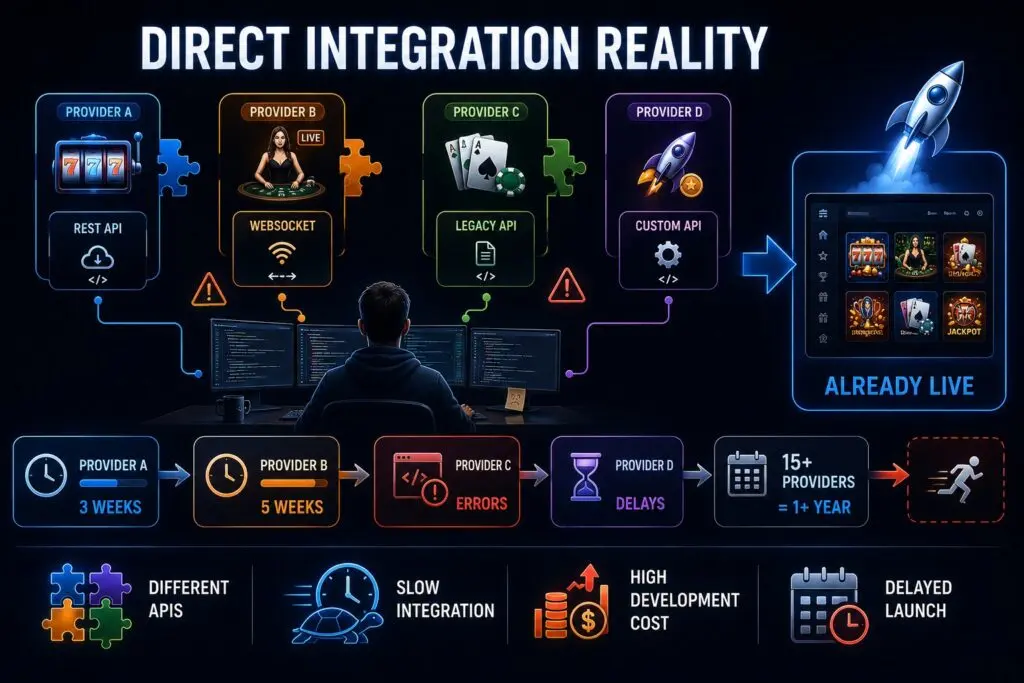
Picture this. You signed contracts with four providers. Slots from one, live dealer from another, table games from a third, crash games from the last. Each of them ships you an API package. And every single one works differently. One talks REST. Another insists on WebSocket connections. The third? Their docs? Last updated sometime during COVID, from the looks of it.
Your dev team starts building. They get Provider A working in three weeks. Not bad. Provider B takes five weeks because their sandbox environment keeps timing out and support takes 48 hours to respond. Provider C? Their API throws errors that aren’t in the documentation. Your lead developer is now spending half their time troubleshooting instead of building features.
Multiply that across every provider you want to offer. The online gambling market sits at $120.35 billion in 2026 and players expect variety. A platform with 200 games feels thin. Players want thousands of options. That means integrating with dozens of providers if you go direct.
We tracked the numbers across operators we have worked with. Direct integration with a single provider averages 4 to 8 weeks. Some take longer when documentation is poor or the provider’s technical team is slow. Scale that to 15 providers and you are looking at a year of pure integration work. Maybe more.
That is a year your competitors are already live and acquiring players.
What a Game Aggregator Actually Does
A game aggregator plants itself between your platform and every provider out there. You build one API connection on your end. That is it. The aggregator deals with every provider’s quirks behind the scenes.
We explain it to operators like this: imagine hiring someone who already has relationships with every game studio on the planet. You tell that person what you need. They go get it. You never sit in a meeting with Provider C’s support team again.
At DSTGAMING, our casino game aggregator connects operators to over 10,000 games from 100+ providers through exactly one integration. Slots, live dealer, table games, crash games, virtual sports, the full catalog. When a new provider launches a popular title, we add it. Operators get access automatically without writing a single line of code.
The technical side works like this. Your platform sends a standardized API call to our aggregator. We translate that into whatever format the specific provider requires, handle the session management, process the round results, and send everything back in a clean, consistent format. Your team builds one integration and never touches provider-specific code again.
The Real Cost of Going Direct
Money talks. So let’s talk about what direct integration actually costs.
Developer time is the obvious one. Senior backend developers in the iGaming space command serious rates. Every week spent debugging a provider’s quirky API is a week not spent on features that generate revenue. We spoke with an operator last quarter who estimated their direct integration costs at over $180,000 across eight providers. That covered developer salaries, QA testing, and the delays that pushed their launch back by five months.
But the hidden costs hurt worse. Every provider requires ongoing maintenance. APIs update. Endpoints change. Certification requirements shift. One operator we onboarded had three provider integrations break simultaneously after a routine update on the provider’s side. Their platform lost access to about 40% of their game library for eleven days. Eleven days of players opening the lobby and seeing empty categories.
Then there is the opportunity cost. While your team is fixing integration issues, they are not building the features that keep players engaged. As a result, operators miss several growth opportunities. They cannot improve loyalty programs, upgrade the user experience, or launch new markets.
With an aggregator, maintenance is someone else’s problem. At DSTGAMING, our technical team handles every provider update, API change, and certification renewal. Operators focus on running their business.
Speed to Market Changes Everything
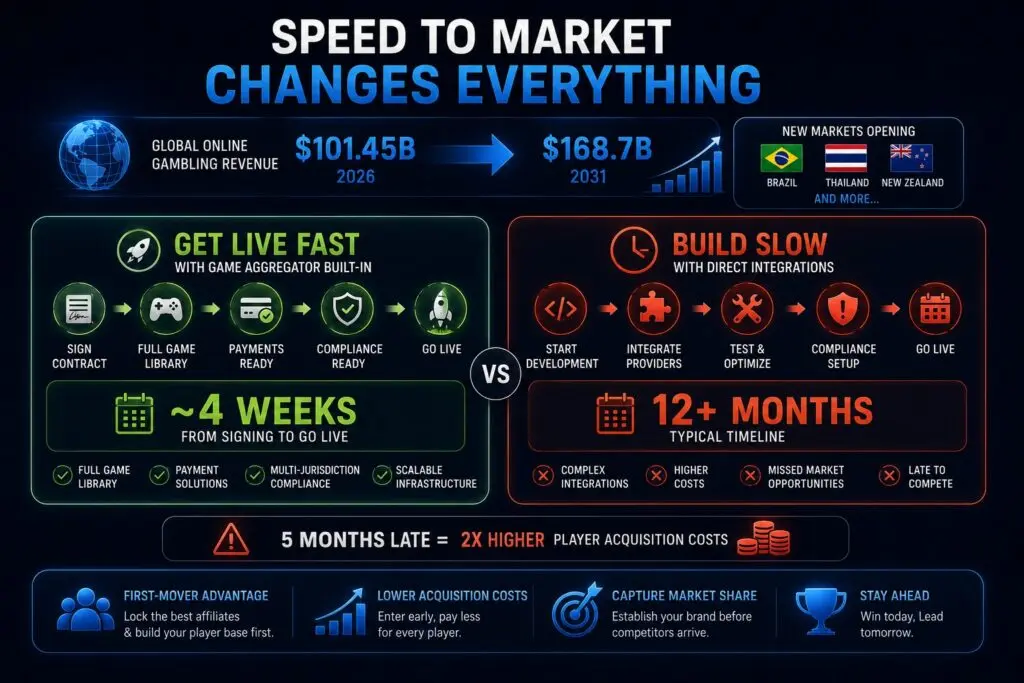
The iGaming industry moves fast. Global online gambling revenue reached $101.45 billion in 2026, projected to hit $168.7 billion by 2031. New markets keep opening. Brazil, Thailand, New Zealand, all creating licensing frameworks that didn’t exist two years ago.
Timing matters. We have seen operators miss entire market windows because their platform wasn’t ready. The operators who got in first locked down the best affiliates and started building their player base while everyone else was still coding. Show up five months late and you are paying twice as much for every new player. We have seen the numbers. It is not pretty.
Our white label online casino solution with the game aggregator built in gets operators live in about four weeks. Full game library. Payment solutions working on day one. Compliance infrastructure ready for multiple jurisdictions.
Four weeks from signing to going live. Compare that to the twelve-plus months a custom build with direct integrations typically requires.
Quality Control You Don’t Have to Think About
Not all games perform equally well. For example, some titles offer higher return-to-player (RTP) rates. Others provide better mobile optimization. In addition, some providers deliver reliable uptime, while others do not.
When you integrate directly, evaluating each provider’s quality falls on your team. Load testing. Fairness verification. Mobile compatibility checks. Performance monitoring across different devices and connection speeds.
An aggregator handles that filtering. We test every game before it enters our library. Performance metrics, mobile responsiveness, fair play certification, all verified before an operator’s players see the title. Games that don’t meet our standards don’t make the cut.
We covered this in detail in our analysis of emerging iGaming solutions. Quality control at the aggregator level means operators start with a curated library instead of gambling on provider reliability.
Beyond Games: The Full Stack Advantage
Game integration is usually the trigger that brings operators to us. But once they see the full picture, the conversation expands quickly.
Our aggregator connects to the broader DSTGAMING ecosystem. Gamification solutions that drive retention through tournaments, leaderboards, and loyalty tiers, all feeding data from the same game sessions. Crypto casino support for operators targeting digitally native audiences. Casino game development for operators who want exclusive titles nobody else offers.
Everything talks to everything. That is the benefit of an integrated stack versus stitching together five different vendors who barely communicate with each other.
We wrote a full walkthrough of the future of casino APIs, covering how aggregation, security, and AI automation are converging into single-platform solutions. The trend is clear. Operators who try to manage everything separately will keep falling behind operators who chose integration from the start.
Direct Integration vs. Game Aggregator: Side by Side
| Factor | Direct Integration | Game Aggregator (DSTGAMING) |
|---|---|---|
| Integration Time | 4-8 weeks per provider | One integration, all providers |
| Game Access | Limited to contracted providers | 10,000+ titles, 100+ providers |
| Maintenance | Your team handles every update | Aggregator team manages it |
| New Games | Requires new integration work | Available automatically |
| Cost | High dev hours per provider | Single fee, predictable |
| Time to Market | 6-18 months | Around 4 weeks (with white label) |
What We Keep Hearing From Operators
After years of doing this, certain patterns repeat. Operators who come to us after trying direct integration almost always say the same things. “We didn’t realize how much maintenance each provider would need.” “Our dev team spent months on integration instead of features.” “We missed our target launch date by half a year.”
The operators who start with an aggregator? Different story entirely. They launch faster, iterate on their product sooner, and reach profitability quicker because their engineering resources go toward growth instead of plumbing.
Why DSTGAMING Built the Aggregator This Way
We get asked sometimes why we didn’t just build a basic game feed and call it a day. The answer is simple: basic feeds break. They can fail when providers update their APIs without notice. They can also fail when new jurisdictions require specific game certifications. As traffic grows, they may struggle to support more concurrent players.
Our casino game aggregator was designed to handle all of that from the ground up. Load balancing across providers. Automatic failover when a provider’s servers go down. Real-time monitoring that catches issues before players notice them. We built it because we got tired of watching operators lose revenue to problems that should have been solved at the infrastructure level.
The operators running on our aggregator today process millions of game rounds monthly. The system handles it because it was built to handle it. Not bolted together as an afterthought.
Getting Started
If you are building a casino platform right now, or running one and drowning in integration work, a game aggregator is the practical fix. Not a shortcut. Not a compromise. The smarter architecture.
At DSTGAMING, we have built our casino game aggregator specifically for operators who want maximum game variety without the integration nightmare. 10,000+ titles. 100+ providers. One API. Ongoing maintenance handled.
Curious whether it fits your situation? Reach out to us for a free consultation. We will walk you through the whole setup, from first conversation to live platform with a full game library.