
Blockchain in iGaming: What Actually Survived the NFT Wave
A 2026 Operator’s Reality Check
Separating the technology that works from the hype that didn’t — and what it means for your platform today.
Let’s be honest about what happened.
Between 2021 and early 2023, the iGaming industry got swept up in one of the most aggressively hyped technology narratives in recent memory. NFT casinos. Metaverse gaming floors. Play-to-earn economies. Virtual chips as blockchain assets. Operators were being pitched the vision of a fully decentralized, avatar-driven casino universe where players owned everything, earned from everything, and the distinction between the physical and digital world dissolved entirely.
Some operators invested in it. Most waited. A few built their entire brand positioning around it.
Then the NFT market collapsed. The metaverse platforms that were supposed to house these virtual casino floors saw player counts crater. Axie Infinity — the poster child of the play-to-earn model — went from a $9 billion valuation to near-irrelevance within eighteen months. Decentraland’s much-publicized virtual world was revealed to have fewer than a thousand daily active users at its peak media coverage. The gap between the marketing narrative and the actual player behavior was vast.
As of 2026, the conversation has changed significantly. The speculative layer of blockchain gaming has been largely written off. But that doesn’t mean blockchain has no role in iGaming — it means the role it actually plays is becoming clearer. And for B2B operators, that clarity is valuable.
This article does three things: it honestly examines what failed and why, identifies what has genuinely survived and is being deployed in production environments, and explains how DSTGAMING positions its blockchain capabilities to serve operators who want real infrastructure rather than technology theatre.
What Failed — And Why It Matters That We Say So
Understanding why the NFT gaming wave collapsed is not a postmortem exercise — it’s due diligence for any operator evaluating blockchain technology today. The failure patterns are instructive.
The Play-to-Earn Model Was Economically Incoherent
The core promise of play-to-earn was simple: players earn tokens or NFTs with real monetary value by playing games. The problem was the economic architecture.
Play-to-earn economies required a constant influx of new players to sustain token values. Existing players earned tokens; new players bought them. When player growth slowed — as it always eventually does — token values fell, earnings collapsed, and the incentive for existing players to continue evaporated. The whole structure was circular, relying on an assumption of perpetual user growth that no digital product can actually sustain.
For iGaming operators, this lesson translates directly: any player retention or loyalty model built primarily around speculative token value rather than genuine entertainment value is structurally fragile. Players who are there for yield, not fun, leave the moment the yield disappears.
NFT Ownership Created Friction Without Adding Perceived Value for Most Players
The theoretical proposition was elegant: players truly own their in-game assets — skins, avatars, items — and can trade them freely on secondary markets. The practical reality was that most casino players don’t want to manage a crypto wallet, pay gas fees on Ethereum, navigate an NFT marketplace, or think about tax implications on their digital winnings. They want to deposit, play, and withdraw. The added complexity of blockchain asset ownership solved a problem that the mainstream player base didn’t particularly have.
This isn’t a condemnation of blockchain — it’s a product-market fit lesson. The feature set that resonates with a crypto-native demographic is meaningfully different from what the broader iGaming player base values.
Metaverse Casino Environments Were a UX Dead End — For Now
Virtual 3D casino floors with avatars and simulated environments attracted substantial investment and media coverage. They also attracted very few players. The UX friction of accessing metaverse environments — specialist hardware for VR, slow load times, clunky navigation — was far too high relative to what players actually wanted. A player who can open a mobile browser and be playing blackjack in thirty seconds is not going to download a VR client, configure an avatar, and navigate a 3D lobby first.
The metaverse casino concept is not permanently dead, but it is nowhere near mainstream deployment viability for operators who need to focus on player conversion and retention today. Treating it as a near-term operational priority remains a mistake.
The Hype Cycle Created Reputational Risk
Perhaps most damaging for the iGaming industry specifically: the association between NFT gambling projects and speculative token schemes raised legitimate regulatory scrutiny. Several projects that launched with loud NFT and play-to-earn messaging attracted attention from regulators who questioned whether the token mechanics constituted unlicensed financial instruments. For operators in regulated markets, the reputational adjacency to these projects was a liability, not an asset.
What Actually Survived — Blockchain Use Cases With Real Deployment
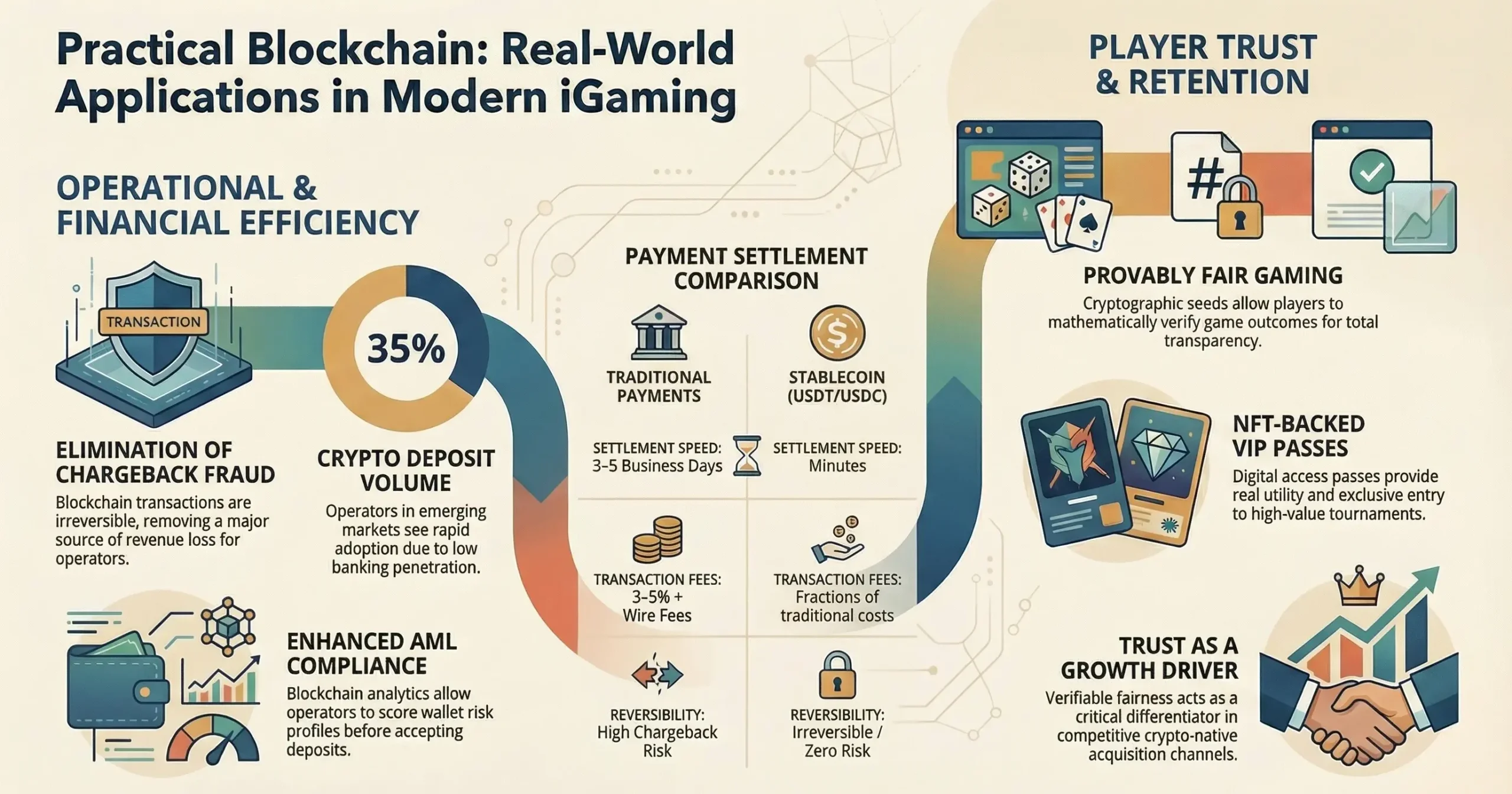
Once the speculative layer is stripped away, a smaller but genuinely functional set of blockchain applications remains — and several of them are being actively deployed in production iGaming environments right now.
Provably Fair Gaming — The Most Defensible Use Case
Provably fair is the blockchain application with the clearest value proposition for iGaming and the longest track record of real deployment. The concept is straightforward: game outcomes are generated using cryptographic algorithms that players can independently verify after each round, confirming that neither the player nor the operator could have manipulated the result.
Here’s how it works in practice. Before a round begins, the casino generates a server seed — a random value — and commits to it by sharing a hashed version with the player. The player provides their own client seed. The game outcome is determined by combining these seeds through a public algorithm. After the round, the server seed is revealed, and the player can run the same algorithm themselves to verify that the outcome was genuinely determined by those inputs.
The result is a system where fairness is mathematically verifiable rather than based on trust or third-party auditing alone. For a player who has ever wondered whether an online casino’s RNG is genuinely random, provably fair is a meaningful answer.
Why this matters operationally for B2B operators: Player trust is a conversion and retention variable. Operators who can credibly demonstrate fairness — not just claim it — have a genuine differentiator in competitive acquisition channels, particularly among crypto-native players who are specifically sceptical of opaque RNG systems. Provably fair mechanics are not a gimmick; they are a trust infrastructure investment.
A realistic example: An operator running a crypto-focused casino vertical in Southeast Asia integrates provably fair dice and card games alongside their standard game library. They feature the “verify this round” functionality prominently in the game UI. Player feedback consistently shows that the verifiability feature is referenced in positive reviews on crypto casino comparison sites — directly impacting affiliate-driven acquisition.
On-Chain Payouts and Stablecoin Settlement
The most operationally impactful blockchain capability for iGaming operators is not NFTs or metaverse environments — it’s the payment infrastructure itself. Specifically, on-chain payouts and stablecoin settlement.
Traditional payment processing in iGaming is expensive, slow, and fragile. Chargebacks are a persistent cost. International wire settlements carry fees of 3–5%. Payment processors serving iGaming operators frequently impose restrictions, increase fees without notice, or exit markets in response to regulatory pressure. In markets where traditional banking access is limited — much of Southeast Asia, LatAm, and emerging African markets — the payment problem is not just expensive; it’s existential.
On-chain payouts using stablecoins (USDT, USDC) address several of these problems simultaneously:
Speed: Blockchain settlements confirm in minutes, not days. A player who wins a significant amount on a Saturday evening doesn’t wait until Tuesday for a bank wire to process. This is a material player experience improvement that affects retention.
Cost: On-chain transaction fees for stablecoin transfers — particularly on networks like Tron (TRX) or Polygon — are a fraction of traditional wire fees. For high-volume operators, the cost differential is significant at scale.
Chargebacks eliminated: Blockchain transactions are irreversible. The chargeback problem — which costs iGaming operators meaningful percentages of payment processing revenue — does not exist in a crypto payment environment.
Market access: In markets where credit card processing is unreliable or blocked for gambling merchants, stablecoin acceptance opens player segments that are otherwise inaccessible. This is particularly relevant for DSTGAMING’s operators targeting players in markets where traditional banking penetration is low but smartphone and crypto wallet adoption is high.
A realistic example: An operator launches a new casino brand targeting players across multiple Southeast Asian markets. Traditional payment processing for this demographic involves a patchwork of local e-wallets with different fee structures, frequent processing failures, and chargeback exposure. By integrating USDT and TRX as primary payment methods alongside local options, the operator reduces payment failure rates, eliminates chargebacks entirely on crypto transactions, and opens their platform to a segment of crypto-native players who specifically filter for crypto-accepting casinos in comparison sites and affiliate content. Within six months, crypto deposits account for 35% of total deposit volume with near-zero processing failures.
Wallet Address Verification and On-Chain Transaction Transparency
A less discussed but practically significant blockchain capability is the ability to verify the history and risk profile of a player’s wallet before accepting a deposit. Blockchain’s inherent transparency — every transaction on a public chain is permanently recorded and auditable — means operators can implement risk scoring at the wallet level, not just the player level.
This is meaningful for AML compliance. Blockchain analytics tools (Chainalysis, Elliptic, TRM Labs) score incoming crypto transactions against databases of known high-risk wallets — those associated with sanctioned entities, dark market activity, or mixer services. An operator who receives a deposit from a wallet with a high-risk score can flag it for enhanced due diligence before crediting the player account.
Compare this with the opacity of a conventional bank transfer, where the source of funds is declared by the sender with limited independent verifiability. For licensed iGaming operators with AML obligations, on-chain transparency is actually a compliance advantage when properly utilised.
NFT-Backed VIP and Loyalty Programs — A Narrow But Real Application
While the broad play-to-earn NFT model failed, a more specific application has shown genuine staying power: NFT-backed VIP membership and loyalty programs for crypto-native player segments.
The mechanism is different from the speculative NFT model. Rather than creating tokens with open market value that players earn through gameplay, this approach uses NFTs as access credentials — proof of VIP membership, exclusive tournament access, or bonus tier status. The NFT is not primarily an investment; it is a digital access pass with genuine utility within the operator’s ecosystem.
This distinction matters. The value of the NFT in this model derives from the operator’s product and programme, not from speculative secondary market demand. It is resistant to the economic collapse that killed play-to-earn because its utility doesn’t depend on new player inflows sustaining token prices.
A realistic example: A crypto casino targeting high-value players in the MENA and European markets issues a limited-run NFT collection of 500 “Platinum Vault” membership passes. Holders receive permanent access to a dedicated VIP bonus pool, priority withdrawal processing, invitation-only tournaments, and a personalized account manager. The NFTs are tradeable — if a VIP player wants to exit, they can sell their membership pass on a secondary marketplace. New high-value players seeking VIP access can acquire a pass without going through the standard tier progression. The system creates a self-sustaining premium player community with genuine secondary market activity — because the utility is real, not speculative.
What’s Still on the Horizon — Realistic Timelines
Some blockchain applications that were overhyped in 2021-2023 are not dead — they are simply earlier in their development cycle than the hype suggested. Operators should be aware of these without betting their product roadmap on them.
Immersive Casino Environments and VR Gaming
The metaverse casino concept is not permanently unviable — it’s just not deployable for mainstream player acquisition in 2026. The hardware penetration required for genuine VR gaming environments remains too low, and the UX gap versus a well-optimized mobile interface is still too wide.
Where immersive 3D environments are showing more realistic near-term deployment is in specific contexts: high-end live dealer lobbies with spatial audio, premium lounge environments for VIP players who access via desktop, and social casino experiences aimed at player segments who value the social and aesthetic dimension of the experience over raw game speed.
Operators who want to future-proof their platform should ensure their technical infrastructure can accommodate richer frontend experiences as hardware adoption increases — without needing to rebuild the backend. This is an argument for flexible, API-first platform architecture rather than an argument for building a metaverse casino lobby in 2026.
Cross-Game Asset Portability
The vision of NFT assets that players own and carry across multiple games and platforms remains genuinely interesting — and genuinely difficult to implement at scale. The challenges are technical (different games have different economies and balance requirements) and commercial (operators have little incentive to allow assets that represent player investment in a competitor’s game).
Within a single operator’s game portfolio, cross-game asset portability is more tractable. An operator running both a slots product and a table games product could, in principle, allow loyalty NFTs earned in one vertical to confer benefits in the other. This is a feature that a handful of large operators are exploring, but it remains in early deployment and is not a near-term priority for most.
Decentralized Autonomous Casino Governance
The concept of DAO-governed casinos — where players vote on RTP settings, game additions, and bonus structures using governance tokens — attracted significant theoretical discussion. In practice, the model creates regulatory complexity (who is the licensable operator in a DAO structure?), game theory problems (players vote for favorable RTPs that make the casino unprofitable), and UX challenges (most players don’t want to vote on casino governance). Expect this to remain a niche experiment rather than a mainstream operational model.
How DSTGAMING Deploys Blockchain Capabilities in Practice
DSTGAMING’s position on blockchain in iGaming reflects where the technology has actually landed in 2026 — useful in specific, well-defined applications, not a wholesale platform transformation. Here’s how that translates into what DSTGAMING operators actually get.
Native Crypto Payment Infrastructure — Built In, Not Bolted On
DSTGAMING’s platform supports multi-currency crypto deposits and withdrawals natively across BTC, ETH, USDT, USDC, LTC, and TRX — without operators needing to source, contract, and integrate a separate crypto payment provider. Wallet address generation, confirmation management, and transaction monitoring are handled at the platform layer.
The practical implication is that an operator launching on DSTGAMING infrastructure has crypto payments operational from day one, with the same reliability and player experience quality as fiat payment methods — not as an afterthought integration that creates inconsistent UX.
For operators who want to minimise volatility exposure, DSTGAMING’s infrastructure supports stablecoin-first configurations where USDT or USDC functions as the primary crypto currency. Players transact in stable value; operators hold stable value. The volatility risk of holding Bitcoin on a casino balance sheet is simply not a factor in this configuration.
Provably Fair Game Integration
DSTGAMING’s platform supports provably fair mechanics for compatible game types — dice, cards, and certain crash game formats. Operators building a crypto casino vertical can feature provably fair games as a trust and acquisition tool, with the verification interface embedded natively in the game experience rather than as a separate technical resource that most players will never find.
For operators who want to specifically target crypto-native player segments — who actively filter for provably fair casinos in their research process — this capability is a meaningful platform advantage rather than a marginal addition.
Compliance-Ready Crypto Infrastructure
DSTGAMING’s crypto payment implementation is built with AML compliance in mind from the architecture level. Wallet address tagging, transaction record-keeping in auditable formats, and integration with blockchain risk screening tools are part of the infrastructure, not add-ons that operators need to source independently.
This matters because crypto AML compliance is where the most common operational failures occur. An operator who adds crypto payments via a quick third-party integration, without proper transaction monitoring and wallet risk screening, is creating compliance exposure that can threaten their primary license. DSTGAMING’s approach is to make compliance the default rather than the operator’s responsibility to retrofit.
Flexible Architecture for Emerging Capabilities
DSTGAMING’s platform is built on API-first architecture, which means that as blockchain capabilities mature — more realistic VR environments, cross-game asset portability, expanded stablecoin support — operators can layer these capabilities onto an existing DSTGAMING foundation without rebuilding core infrastructure.
This matters specifically for the NFT loyalty programme use case. An operator who wants to experiment with NFT-backed VIP programmes can do so as a product layer on top of their DSTGAMING platform, without the experiment requiring changes to payment processing, game integration, or compliance infrastructure.
The Honest 2026 Summary: What Operators Should Actually Do
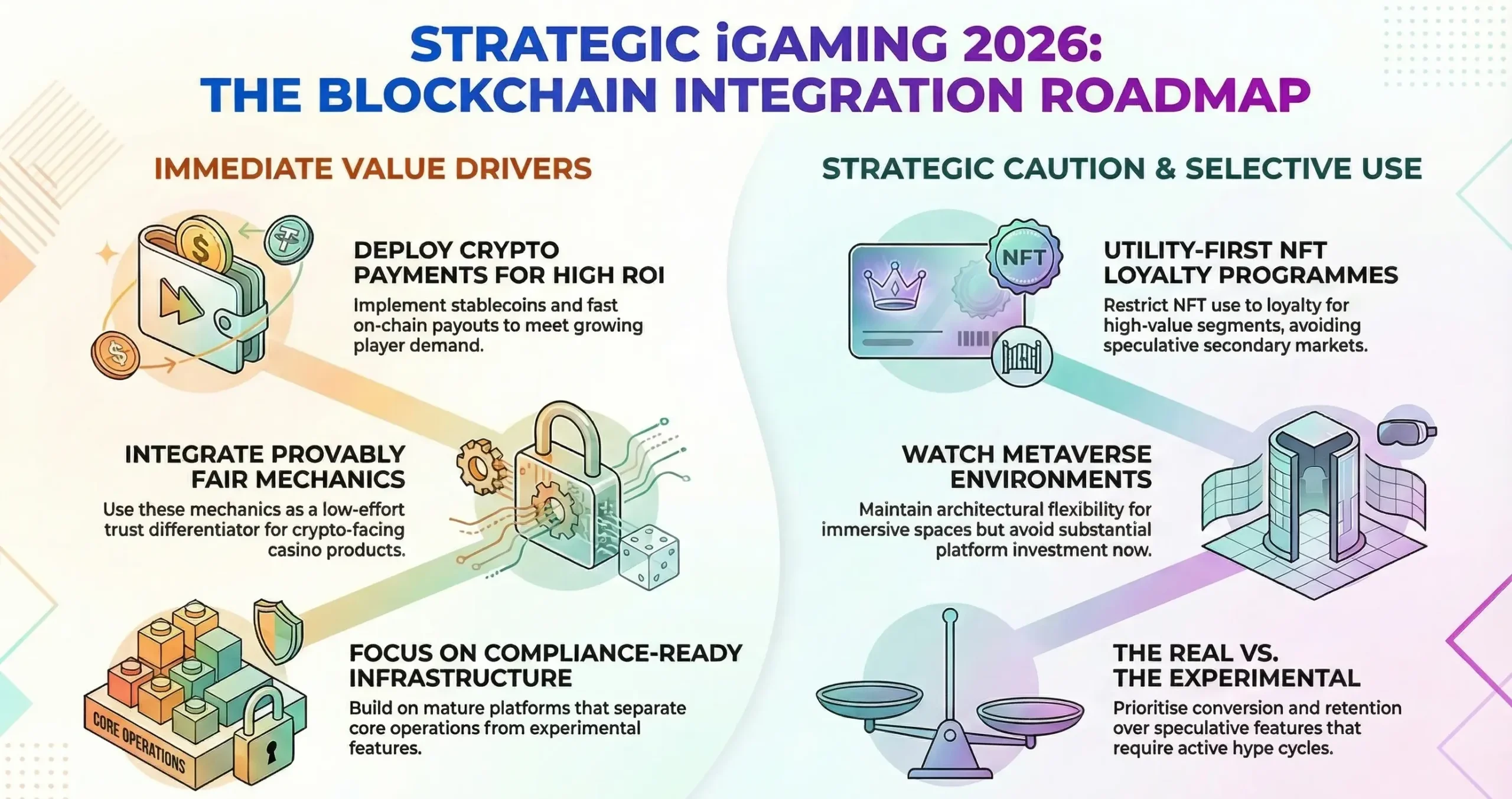
After stripping away the hype and the overcorrection — the breathless enthusiasm of 2021 and the cynical dismissal of 2024 — the reasonable 2026 position for a B2B iGaming operator looks something like this:
Deploy crypto payments now. Stablecoin support, multi-currency crypto deposits and withdrawals, and fast on-chain payouts are production-ready, operationally beneficial, and expected by a meaningful and growing player segment. The ROI case is clear.
Integrate provably fair for your crypto vertical. If you’re building or operating a crypto-facing casino product, provably fair mechanics are a trust differentiator that shows up in player acquisition. The implementation effort is low relative to the positioning benefit.
Be selective and honest about NFTs. NFT loyalty programmes have a narrow, legitimate application for crypto-native high-value player segments. Broad NFT gaming economies built around speculative token value are not a viable product strategy in the current environment. If you’re considering an NFT component, be clear about what utility you’re delivering and ensure it doesn’t depend on secondary market speculation to function.
Watch, don’t build, on metaverse environments. The immersive casino environment space is moving, but not at a pace that justifies substantial platform investment for operators outside the top tier of the market. Keep your platform architecture flexible enough to accommodate richer experiences as the technology matures, but focus your product investment on what converts and retains players today.
Build on infrastructure that separates the real from the experimental. The biggest risk in the blockchain iGaming space is an operator who builds on a platform that has conflated mature, deployable blockchain capabilities with speculative features that require active hype cycles to function. DSTGAMING’s position is straightforward: we deploy what works — crypto payments, provably fair, compliance-ready blockchain infrastructure — and we keep experimental capabilities as optional layers rather than core platform dependencies.
Should I accept Bitcoin specifically, or focus on stablecoins?
Both, ideally — but with different operational roles. Bitcoin acceptance is important for the player acquisition signal: "Bitcoin accepted" is the first filter many crypto players apply. But stablecoins (USDT, USDC) are often more practical as the primary transaction currency because they eliminate volatility risk for both players and operators. DSTGAMING's infrastructure supports both simultaneously.
Are NFT loyalty programmes compliant with MGA and UKGC standards?
This depends significantly on how the NFT programme is structured. NFTs used purely as access credentials or loyalty status markers — with no open secondary market trading — are generally lower risk from a regulatory standpoint. NFTs that function as financial instruments with speculative value components require careful legal review before implementation in regulated markets. Always engage your licensing jurisdiction's legal counsel before launching any token-based programme.
What happened to the major NFT casino platforms from 2021-2022?
Most either shut down, pivoted away from their NFT mechanics as token values collapsed, or significantly reduced the scale of their NFT-related features. The platforms that remained active generally survived by retaining their crypto payment infrastructure — which remained useful — while quietly discontinuing the play-to-earn and speculative token components that created the reputational risk.
How does DSTGAMING handle crypto KYC differently from a standard payment provider?
DSTGAMING's crypto infrastructure integrates wallet risk scoring alongside standard player identity verification. This means operators receive both the player's KYC status and a risk assessment of the depositing wallet — whether the funds have any association with high-risk on-chain activity. This dual-layer approach is more comprehensive than a standard fiat KYC process, and it's increasingly expected by AML auditors in regulated markets where crypto is accepted.
Is there a minimum scale at which crypto payments make operational sense?
No meaningful minimum threshold. The cost of adding DSTGAMING's native crypto payment infrastructure is not additive for operators already building on the platform. The question is whether your target player demographic includes a meaningful crypto-using segment — which it does in virtually every market where digital payments are common.
Ready to Build on Blockchain Infrastructure That Actually Works?
DSTGAMING’s platform offers crypto payment integration, provably fair game support, and compliance-ready blockchain infrastructure as part of our standard white label and turnkey offerings. No speculative add-ons. No technology theatre. Just the blockchain capabilities that are genuinely deployable and operationally beneficial for licensed iGaming operators in 2026.
Talk to the DSTGAMING team:
📧 enquiry@dstgaming.com 💬 Telegram: DSTGAMING Enquiry 🐦 Twitter: @DSTGAMING
Let’s build your iGaming platform on technology that works today — and scales with what works tomorrow.