
Crypto Payments for Online Casinos
A B2B Operator’s Guide to Integration, Compliance, and Risk Management
What every iGaming operator needs to know before adding crypto to their platform. These are the operational questions nobody warns you about until you are live.
Picture this.
You’ve just launched your online casino. Traffic is building, affiliate relationships are coming together, and your fiat payment stack is working reasonably well. Then you notice a pattern in your acquisition data. A steady group of high-intent visitors are dropping off. They found you through crypto casino review sites. They also came from Bitcoin gambling forums. Others arrived via crypto-affiliate channels. They reach your deposit screen, then leave.
They’re not leaving because your game selection is wrong, or because your bonus wasn’t compelling. They’re leaving because your payment page doesn’t show a single crypto option.
Those players didn’t go without gambling. They went to a competitor who had it sorted.
This scenario is playing out across the iGaming industry right now, and the operators who haven’t addressed it aren’t losing a niche audience — they’re losing a growing, high-value, and increasingly mainstream player segment. According to iGaming payment analysts, crypto now accounts for an estimated 20–30% of total deposit volume across platforms that support it, with the share trending upward in Southeast Asia, LatAm, and MENA markets where traditional banking access is inconsistent.
But here’s where most of the B2B conversation about crypto in iGaming goes wrong: it stays at the surface level. “Add Bitcoin, attract players.” The reality of integrating crypto payments into a licensed, compliant iGaming operation is considerably more involved — and the operators who get it right have thought carefully through four specific dimensions: wallet infrastructure, KYC and AML compliance for crypto deposits, volatility risk management, and platform-level crypto handling.
The Business Case First: Why Crypto Is a Revenue Decision, Not a Feature Toggle
Before investing in infrastructure, operators need to clearly understand what crypto payments offer commercially. They also need to understand what crypto payments do not offer.
What crypto payments genuinely do for your operation
- Open a player segment that is actively filtered out without it. Crypto-native players don’t browse from site to site hoping to find Bitcoin accepted. They filter from the start. Comparison sites, affiliate directories, and player communities have dedicated “crypto casino” categories. If you’re not listed there, you don’t exist for this segment.
- Eliminate chargebacks entirely. Blockchain transactions are irreversible by design. Once confirmed, a crypto deposit cannot be disputed through a payment processor or card network. For iGaming operators that often absorb 1–3% of payment volume in chargeback costs, this improves margins. This also helps avoid processor fee increases linked to high chargeback rates.
- Reduce processing costs on high-volume transactions. Traditional card processing for iGaming merchants typically runs 3–5% per transaction, often higher given the risk classification. Stablecoin transactions on networks like Tron (TRX) can settle for fractions of a cent. At scale — tens of thousands of deposits monthly — this difference is significant.
- Improve market access where traditional rails are restricted. In markets where iGaming merchant classification leads to high card decline rates — parts of Southeast Asia, LatAm, and emerging markets — crypto provides an alternative deposit path that bypasses the banking restriction entirely. An operator targeting the Brazilian market, for example, may find that a meaningful segment of players prefers USDT deposits even after PIX integration, simply because crypto is the payment method they’re most comfortable with for cross-border transactions.
- Accelerate withdrawal satisfaction. The most frequently cited player complaint across iGaming review platforms is withdrawal delay. Crypto withdrawals settle in minutes on fast networks, versus one to five business days for bank transfers. Fast withdrawal directly correlates with player trust and repeat deposit behavior.
What crypto payments don’t do
They don’t eliminate compliance obligations. They don’t replace the need for KYC. They don’t remove AML risk — in some ways they introduce new categories of it. And they don’t resolve regulatory issues in markets where online gambling itself is restricted. Crypto is a payment rail, not a regulatory workaround, and operators who approach it otherwise create compounding legal exposure.
Wallet Integration — The Infrastructure Questions That Actually Matter
Wallet integration sounds simple: make a wallet address for each player. Let them send crypto. Then credit the account. In practice, the architectural decisions you make at the wallet layer determine your security posture, your operational overhead, and your compliance tractability for years.
Hot wallet vs. cold wallet architecture — why this isn’t optional to think about
Every crypto casino uses hot wallets (online, for live transactions) and cold wallets (offline, to keep funds safe). Getting this balance wrong is how casino crypto operations get hacked.
The operational principle is straightforward— keep only the liquidity needed for day-to-day player withdrawals in hot wallets. Everything above that threshold moves to cold storage on a defined schedule. A platform processing 500 USDT in daily withdrawals doesn’t need 500,000 USDT in a hot wallet — it needs enough operational float to handle realistic withdrawal peaks, with the rest stored offline and inaccessible to a network-level attack.
In practice, this means your platform needs:
- A clear hot wallet liquidity policy — what is the maximum balance you keep in hot storage? What triggers a transfer to cold storage? For most mid-sized operators, this is somewhere between one to three days of average withdrawal volume.
- Moreover, an automated cold storage sweeps — manual transfers are operationally unreliable and create human error risk. The movement of funds from hot to cold should be automated and auditable.
- Multi-signature transaction requirements — for any transaction above a threshold amount, require multiple authorized signatories. This prevents a single compromised key from enabling a large unauthorized transfer.
- Key management procedures — Who holds the cold wallet keys? How are they stored? What is the recovery process if a key holder is unavailable? This sounds procedural until it isn’t, at 2am on a Sunday when your withdrawal processor needs access.
Additionally, wallet custody design, hot and cold balance management, and key management are managed by the platform. The operator configures their operational parameters; the platform handles the security architecture.
Player wallet assignment and transaction tracking
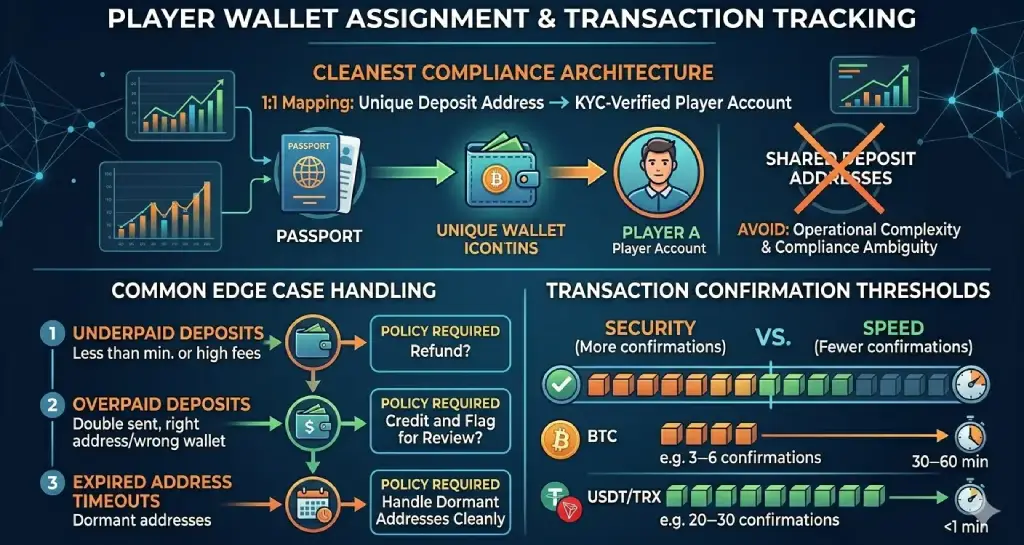
The cleanest compliance setup for crypto deposits gives each player a unique deposit address. It creates a 1:1 link between on-chain wallet addresses and KYC-verified player accounts. This means every deposit is immediately attributable to a specific verified identity, making transaction monitoring tractable and audit trails clean.
The alternative — shared deposit addresses with transaction amount matching — creates operational complexity and compliance ambiguity. Avoid it.
Unique address assignment also enables proper handling of the edge cases that every crypto-accepting platform encounters:
Underpaid deposits: a player sends less than the specified minimum, or a network fee deducted from the transfer amount means the received value is below the floor. What’s your handling policy? Credit the amount received? Hold until the player tops up? Refund? Each answer has implications, and it needs to be policy — not a case-by-case support decision.
Multi-currency support — which assets to prioritize and why
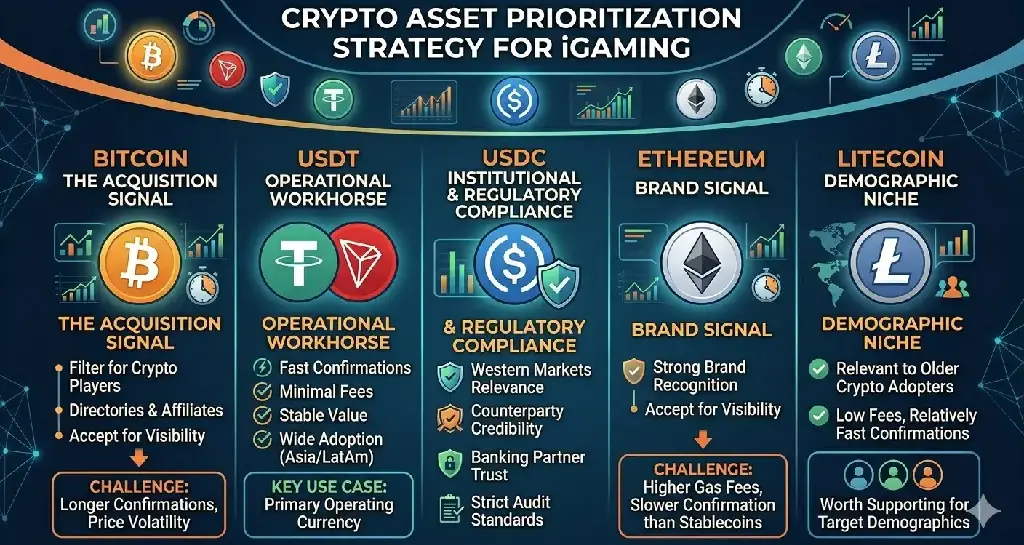
Not all crypto assets are equal in iGaming utility. Here’s the honest operator assessment:
- Bitcoin (BTC) is your acquisition signal. “We accept Bitcoin” is the filter most crypto players apply first. Accept it even if you mainly use stablecoins. Having BTC as a payment option decides if you appear in crypto casino directories and affiliate roundups. Be prepared for longer confirmation times and price volatility on the BTC balance.
- USDT (Tether) on Tron (TRX) is your operational workhorse. Fast confirmation, minimal fees, stable value, widely held by the iGaming crypto player demographic across Asia and LatAm. If you’re prioritising a single stablecoin, USDT/TRX is the right starting point.
- USDC is the institutional-grade stablecoin — more relevant for operators in regulated Western markets where counterparty credibility matters to compliance teams and banking partners.
- Ethereum (ETH) carries strong brand recognition but higher gas fees and slower confirmation times than alternatives. Accept it for the brand signal; price your gas fee handling into your operational model.
- Litecoin (LTC) remains relevant for a specific demographic of older crypto adopters. Low fees, relatively fast confirmation. Worth supporting if your player demographic skews toward established crypto users.
KYC for Crypto Deposits — The Compliance Reality in 2026
The most common misconception about crypto in iGaming is that it sidesteps the need for identity verification. It doesn’t. And operators who build their crypto integration on that premise are building a compliance liability that will surface — usually at the worst possible moment, typically during a licensing renewal or regulatory audit.
What FATF actually requires — and what regulators are enforcing
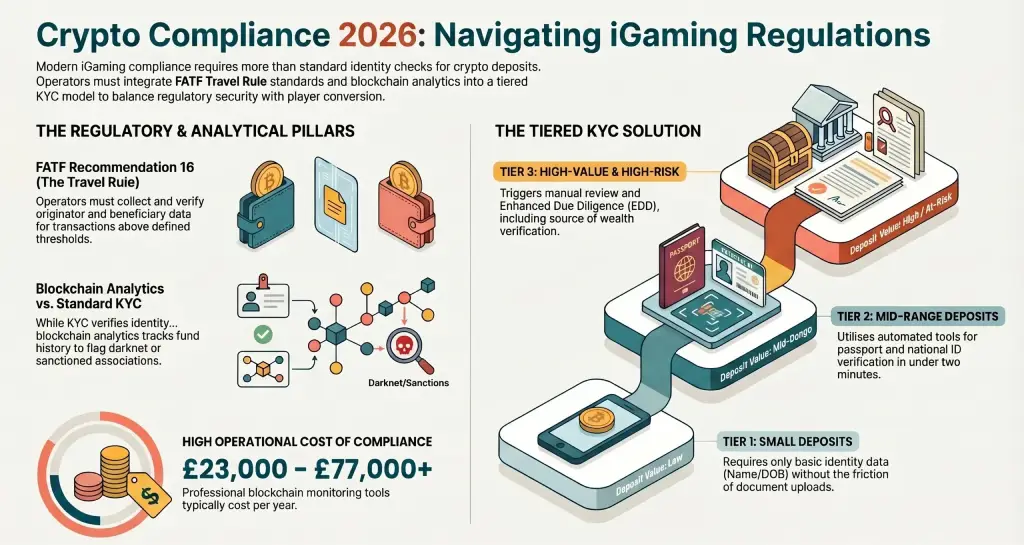
The Financial Action Task Force (FATF) Recommendation 16, commonly called the Travel Rule, requires Virtual Asset Service Providers (VASPs) — a category that includes licensed iGaming operators accepting crypto — to collect, verify, and transmit information about the originators and beneficiaries of crypto transactions above defined thresholds.
In practice, what this means for a licensed casino is:
Every player who deposits crypto must have a verified identity associated with their account before the deposit is credited. The specific documents required (passport, national ID, proof of address) align with your standard KYC framework — the crypto payment method doesn’t create a lower bar.
For high-value crypto deposits — the threshold varies by jurisdiction but is commonly around $1,000–$3,000 equivalent — enhanced due diligence applies. Source of funds documentation, PEP screening, and in some cases source of wealth verification are required before the funds are playable.
The wallet address from which a player deposits should be recorded and associated with their verified identity. This creates the audit trail that regulators require.
Blockchain analytics — the tool most operators underestimate
Standard KYC verifies who your player is. Blockchain analytics verifies where their crypto came from. These are different checks that serve different compliance purposes, and both are necessary for a defensible crypto AML programme.
Blockchain analytics tools — the major providers include Chainalysis, Elliptic, and TRM Labs — analyse the on-chain history of incoming deposits and assign a risk score based on whether the funds are associated with flagged wallets, sanctioned entities, darknet market activity, or mixer/tumbler services that are designed to obscure transaction history.
A practical example: a player passes your standard KYC — their identity is verified, they’re not on any sanctions list, and their risk profile looks clean. They deposit 1 BTC. Blockchain analytics flags that 40% of that BTC passed through a known darknet market wallet six transactions back. Standard KYC missed this entirely. Blockchain analytics caught it.
For licensed operators, the absence of blockchain analytics in your crypto compliance programme is increasingly treated as a gap by regulators rather than an acceptable minimum. MGA-licensed operators have received guidance that real-time transaction monitoring is expected. Blockchain analytics can enable this. This forms part of a compliant crypto AML framework.
The cost of these tools is high. Major providers use annual licence models. These can cost $30,000–$100,000+ each year. The price depends on transaction volume and feature tier. This is a genuine operational cost that needs to be factored into the business case for crypto integration.
Tiered KYC for crypto — balancing compliance and conversion
The tension between compliance rigour and player conversion is real. A player who wants to make a 50 USDT deposit and encounters a multi-step verification process involving document upload, facial recognition, and source of funds declaration will leave. And for a 50 USDT deposit, the compliance risk doesn’t warrant that friction.
Tier escalation based on risk signals: wallet risk scores from blockchain analytics, PEP or sanctions flags from screening tools, or behavioural patterns that suggest layering (multiple small deposits just below thresholds, rapid withdrawal following large deposits) trigger tier escalation regardless of deposit size.
DSTGAMING’s crypto infrastructure is built with this tiered model as the default compliance architecture. The risk thresholds are configurable by the operator based on their licensing jurisdiction’s requirements — MGA operators have different calibrations from Curaçao operators — but the framework is built in rather than requiring custom development.
Volatility Risk Management — Protecting Your Balance Sheet
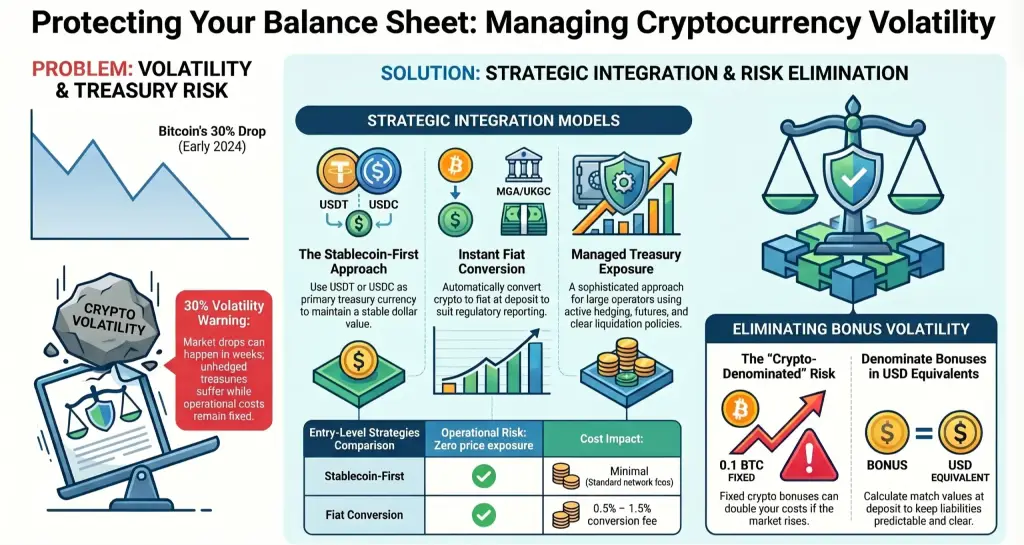
Bitcoin dropped 30% in three weeks in early 2024. An operator holding unhedged BTC on their balance sheet during that period saw the value of their crypto treasury fall materially — without any change in their operational costs. This is the volatility problem, and it’s the most practically significant objection most operators have to crypto integration.
It’s also entirely manageable, with the right architecture.
Strategy 1: Stablecoin-first operations — the cleanest solution
The most operationally straightforward approach to crypto volatility is to accept it as a deposit rail while eliminating it as a treasury risk. In practice, this means:
Your primary crypto currency is USDT or USDC — assets pegged to the US dollar whose value does not fluctuate with crypto markets. Players deposit USDT; your treasury holds USDT; players withdraw USDT. The value is stable throughout.
Bitcoin and Ethereum are accepted for the acquisition signal — “Bitcoin accepted” appears on your platform — but immediately converted to stablecoin at the point of deposit receipt. You capture the player segment, you capture the acquisition signal, and you carry zero BTC price exposure on your balance sheet.
This is the approach DSTGAMING recommends and supports for most operator profiles, particularly those entering crypto for the first time. It delivers the full commercial benefit of crypto integration with none of the treasury risk.
A realistic operator scenario: a Southeast Asia operator launches on DSTGAMING with USDT (TRX network) as the primary crypto currency and BTC as an additional accepted method. Within 90 days, USDT deposits represent 18% of total deposit volume. The operator’s treasury holds USDT at a known, stable dollar value. During a period where BTC drops 25%, the operator’s crypto treasury is completely unaffected — every BTC deposit converted at receipt, no exposure held.
Strategy 2: Instant fiat conversion — for operators who want crypto as a payment rail only
The next cleanest approach is to integrate a crypto payment processor that converts incoming crypto to fiat at the moment of deposit receipt. The player sends BTC; your treasury receives USD. The crypto amount, the exchange rate, and the conversion happen in the payment processor’s system, and your accounting sees only the fiat equivalent.
This approach works well for operators whose primary accounting, regulatory reporting, and banking relationships are all in fiat — particularly those with MGA or UKGC licenses where regulatory reporting is in EUR or GBP. The crypto integration becomes entirely transparent to your existing operational and financial infrastructure.
The trade-off is cost. Conversion services charge for this — typically 0.5–1.5% per conversion, depending on volume and the processor. For high-volume operators, this fee needs to be weighed against the alternative approaches.
Strategy 3: Managed treasury exposure — for operators with financial sophistication
Some operators choose to hold a portion of their crypto deposits as a deliberate treasury strategy, either because they believe in the long-term appreciation of BTC/ETH or because they’re building a crypto-native brand where holding the asset is part of the positioning.
This is a viable approach but requires active treasury management capability. Hedging through futures or options on major exchanges, setting defined exposure limits, and having a clear liquidation policy if price moves exceed a threshold are all necessary components. This is appropriate for large, financially sophisticated operators with dedicated treasury functions — not for most new entrants to crypto integration.
Bonus volatility: the operational edge case nobody warns you about
There’s a specific volatility risk that sits outside treasury management: crypto-denominated bonuses.
If your bonus offers players a “100% deposit match up to 0.1 BTC”, and BTC doubles in price, your costs double. This can happen between setting the bonus and a player claiming it, without changing the terms. Conversely, if BTC falls 40%, a player who matched based on an expected bonus value may feel misled.
The clean solution: denominate all bonus values in USD equivalents, calculated at the moment of deposit receipt. “100% match up to $5,000 equivalent in USDT” eliminates the volatility exposure entirely and sets clear player expectations.
How DSTGAMING Handles Crypto at the Platform Level
The preceding three sections cover what an operator needs to think through. This section covers what DSTGAMING has already built, so that operators launching on the platform don’t build it themselves.
Native multi-currency crypto integration — no third-party provider required
DSTGAMING’s platform integrates BTC, ETH, USDT, USDC, LTC, and TRX natively. Wallet address generation, confirmation threshold management, deposit crediting, withdrawal processing, and transaction record-keeping are all handled within the platform infrastructure.
Apart from that, this matters because the alternative adds cost and complexity. You would need a third-party crypto payment provider. You would also need a separate contract and an API integration. You would then manage that relationship alongside your main platform. This also adds another vendor dependency. On DSTGAMING, crypto is part of the platform, not an integration layer on top of it.
The specific configuration parameters that operators control include which currencies to accept, deposit minimum thresholds, confirmation requirements per currency, and stablecoin vs. conversion policy for non-stablecoin deposits. These are configuration choices, not development projects.
Stablecoin-first configuration — built in, not custom
DSTGAMING’s platform supports stablecoin-first operation as a standard configuration. Operators who want USDT or USDC as their primary crypto currency — with BTC and ETH accepted but immediately converted to stablecoin value — can configure this without custom development. The treasury implication is that the operator’s crypto balance is always in stable-value assets, regardless of what currency individual players chose to deposit in.
Compliance infrastructure — AML and KYC for crypto at the platform layer
DSTGAMINGs crypto system has an important parts. It can tag a player’s wallet address. This means it can link the player’s identity to the address they use to deposit money. It also keeps a record of all transactions in a way that makes sense to regulators.. It is set up to work with tools that analyze blockchain activity.
For people who run casinos in places where regulators require blockchain analytics, DSTGAMINGs system can connect to analytics firms. This means that when a player makes a deposit the system can immediately check the transaction, for any risks and use that information to decide what level of verification the player needs.
So what does this mean in practice?
If someone wants to start a casino that accepts cryptocurrency using DSTGAMING, they will already have a system. Regulators can review it. They will not have to build a system after they launch, which can be a big problem if they find out they need to make changes to follow the rules. DSTGAMINGs crypto system is set up to help with this from the start.
Provably fair integration for crypto-native game verticals
Operators who are building a dedicated crypto casino product need provably fair mechanics. It is not enough to simply add crypto payments to a standard casino. These mechanics help them compete credibly in the crypto casino player segment. Crypto-native players are disproportionately represented among the users who specifically filter for provably fair when evaluating casino options.
DSTGAMING’s platform supports provably fair game integration for dice, card game formats, and crash games — with the verification interface accessible natively within the game UI rather than requiring players to navigate to a separate technical documentation page most will never find.
The Practical Crypto Launch Checklist for Operators
If you’ve read this far, you’re likely planning a crypto integration. Or you’re checking a plan you’ve already started. Here’s the checklist that collapses the preceding sections into decisions:
Wallet infrastructure decisions:
- Hot/cold wallet split policy — what percentage stays in hot wallets, and what’s the sweep schedule to cold?
- Multi-signature requirements for above-threshold transactions
- Unique address-per-player assignment (not shared addresses)
- Underpaid/overpaid/timed-out deposit handling policies
- Confirmation threshold per currency
Currency selection:
- Which currencies will you accept? (Minimum: BTC for acquisition signal, USDT for operational volume)
- Which currencies convert to stablecoin at receipt vs. held as received?
- Bonus denomination policy — fiat equivalent at receipt, not crypto face value
Compliance:
- KYC tier framework — thresholds for standard, document, and enhanced verification
- Blockchain analytics provider selected and integrated
- AML policy documented to include crypto-specific scenarios
- FATF Travel Rule compliance mechanism in place for your jurisdiction
Volatility management:
- Stablecoin-first? Instant conversion? Managed exposure? Policy documented and operationalized
- Bonus terms denominated in fiat equivalents
- Treasury exposure limits defined if holding any non-stablecoin assets
Player experience:
- Confirmation time communication — what do players see while their deposit is confirming?
- Failed/delayed transaction communication workflow
- Withdrawal confirmation speed — how quickly do withdrawals process after player request?
If your current platform or platform provider can’t clearly answer how each of these is handled, that’s a meaningful gap.
The Honest Summary: Crypto Is Infrastructure, Not a Marketing Layer

The operators who built successful crypto verticals in iGaming shared one key trait. They treated crypto integration as essential infrastructure. They did not treat it as a marketing tool. They thought through the compliance architecture before launch, not after. They solved the volatility question at the treasury level before the first player deposited. They built the wallet infrastructure to handle edge cases, not just the standard flow.
Apart from that, operators who have struggled with crypto have often done the reverse. They added a crypto payment option to attract players. But they did not build the infrastructure needed to support it. They lacked compliant and operational support.
The result is a product that attracts players. It then loses them due to withdrawal delays. It may also lose them due to compliance failures. Or it may offer a worse experience than a well-built crypto competitor.
DSTGAMING aims to solve the hard infrastructure problems first. This includes wallet architecture, compliance integration, and stablecoin treasury management. It also includes provably fair game integration. This way, operators launching on the platform do not need to build these systems themselves.
The commercial case for adding crypto to your platform is clear. The question is whether your current infrastructure can support it properly. If the answer is no — or not yet — that’s a conversation worth having.
Talk to DSTGAMING About Your Crypto Integration
All in all, you might be adding crypto to an existing platform. You might be building a crypto-native casino vertical from scratch. Or you might be checking whether your crypto setup meets your regulator’s compliance standards. At every stage, DSTGAMING’s team works with operators.
The conversation starts with your situation: target markets, licensing framework, current payment stack, and how crypto supports growth. From there, we can show you exactly how the integration works on DSTGAMING’s infrastructure. This is not a generic demo. It is a setup that matches your market and operational needs.