
Why Stablecoins Became the Default Currency of Online Casinos
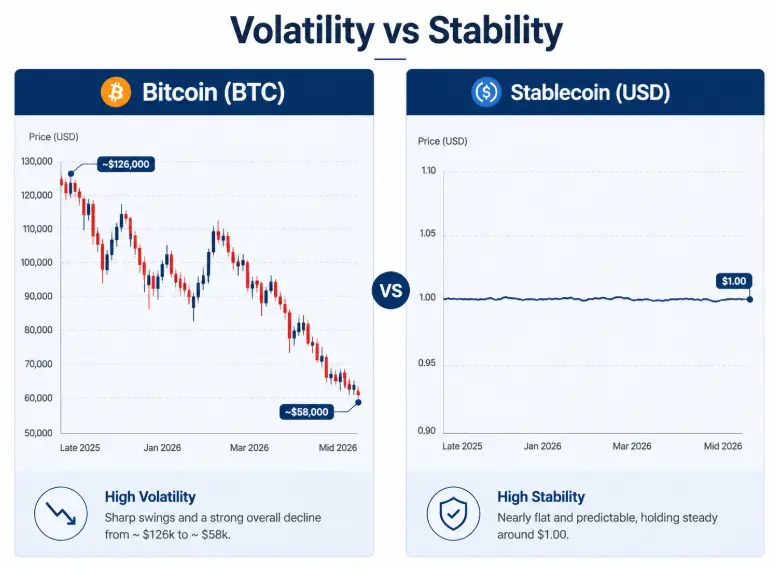
Between its peak of $126,210 on October 6, 2025, and its June 2026 low near $58,000, bitcoin lost roughly half its dollar value. An operator holding a bitcoin-denominated bankroll across those nine months watched its float halve for reasons unconnected to its house edge. That is the problem stablecoins address, and it explains much of how quickly stablecoin casino cashiers have spread.
The shift shows in operator data. SOFTSWISS, which processes wagers across more than 700 partner brands, reported bitcoin’s share of crypto bets falling by more than 17 percentage points across 2024, reinforcing the broader shift away from bitcoin-only casino payment models.
For most operators in 2026, the harder call is not whether to accept stablecoins but which one, on which chain, and under which regulator — because USDT and USDC now sit in different regulatory positions, and potentially in different places on your balance sheet.
What volatility actually costs an operator
A casino’s margin is thin. It accumulates slowly. Players wager the same deposit repeatedly, and the edge builds in small increments across many rounds. Because of this, the business cannot absorb a large move in its settlement asset.
Consider a simple case. A $1 million float held in bitcoin between October 2025 and June 2026 would have halved purely on price movement. A moderate drop in asset price can easily outweigh the gaming margin. No adjustment to RTP or bonus policy fixes this.
Viewing this backward causes confusion. Bitcoin’s volatility has dropped; ARK Invest noted a one-year realized volatility near 42% at the end of Q2 2026. Despite this, a 50% drawdown still happened. The true risk is not statistical volatility. The risk is denomination. Holding revenue in an asset driven by macro flows means the treasury result is decided outside the business.
Players face a smaller version of this problem. A player deposits in bitcoin and withdraws hours later. The dollar value might shift without a single round resolving. This generates support tickets and ruins bonus wagering math.
Understanding Stablecoin Deposit Settlement Costs
Tron carries a large share of high-value USDT movement, and understanding its fee model matters because people often describe it loosely.
Tron prices transactions using two resources instead of a single gas fee: bandwidth covers transaction size, and energy handles smart-contract execution. When the receiving address already holds USDT, a typical USDT TRC-20 transfer consumes about 64,000 energy, but creating a new token balance requires roughly twice that amount. Proposal #104, which the network ratified on August 29, 2025, adjusted the energy unit price to 0.0001 TRX. Because parameters change, you should check current values on Tronscan before modeling costs.
You can obtain energy through three methods, and the cost gap between them is significant:
- Burning TRX directly: If you lack staked or delegated energy, the network deducts and destroys TRX straight from your balance, making this route the costliest option and the default choice for most retail senders.
- Renting energy from a delegation service: This method lowers the per-transfer cost without locking up your capital.
- Staking TRX for a daily allowance: This approach yields the lowest marginal cost, though it locks up a substantial balance.
The Economics of Staking and Network Fees
“USDT on Tron is free” is therefore a staking artifact, not a property of the coin. Whether staking pays depends on transfer volume: poor economics for occasional senders, rational for a cashier clearing large payout batches. Payment cost at scale is an operational competence.
Network fees vary widely by chain, and exchange withdrawal charges frequently exceed the on-chain cost, so model the complete payment path rather than network fees alone. Card acquiring for gambling merchants can involve percentage-based fees, settlement delays and rolling reserves, depending on jurisdiction, merchant history and acquiring bank. Stablecoin payments use a different cost model — not a free one: wallet infrastructure, screening, custody and conversion all carry cost.
The Trade-Offs of Irreversibility and Risk Management
The structural trade-off is irreversibility. There are no chargebacks, which removes a cost card acquiring builds in — but there is no recall on a mistaken payout either. Wrong-network recovery depends on the receiving address, custodian and supported chains. That risk moves from the acquirer onto your operations team, which is why serious crypto casino software treats address validation, network checks, screening and multi-step payout approval as first-class controls.
BTC vs USDT vs USDC: what an operator is choosing
The decision is less about the coin than about what comes attached to it.
| Bitcoin (BTC) | Tether (USDT) | USD Coin (USDC) | |
| Effect on bankroll | Price-driven; treasury results are set outside the business | Pegged ~1:1 to USD; margin is the main variable | Pegged ~1:1 to USD; margin is the main variable |
| Settlement profile | Confirmation-based; L1 fees move with congestion | Fast finality on Tron; cost depends on how energy is sourced | Widely deployed across low-fee chains |
| Issuer and disclosure | No issuer | Tether International, S.A. de C.V.; quarterly BDO attestations; KPMG U.S. completed its first full audit of 2025 financial statements in August 2026 | Circle Internet Group (NYSE: CRCL); SEC-reporting public company |
| Supply (June 30, 2026) | n/a | ~$184.6B | $73.3B |
| Redemption terms | None | Verified customers; $100,000 minimum; fee is the greater of $1,000 or 0.1% | Business/institutional onboarding; tiered fees above defined monthly volumes |
| Accounting consideration | Intangible asset treatment | Turns on whether your entity holds an enforceable redemption right | Turns on whether your entity holds an enforceable redemption right |
| EEA position | Outside MiCA stablecoin rules | Delisted or restricted by several major EEA platforms | Retained on EU-regulated platforms |
| US direction | n/a | Offshore USDT plus GENIUS-track USAT via Anchorage Digital | GENIUS-track; final OCC approval to establish First National Digital Currency Bank, N.A. |
| Typical cashier role | Optional deposit method, often converted on receipt | Widely used in crypto-facing operations; particularly liquid on Tron | Often favored where MiCA-compliant infrastructure is required |
The accounting question most guides skip
For accounting purposes, what separates a stablecoin from a dollar is not the peg but whether the holder has an enforceable right to redeem at par from the issuer — and those rights are not uniform.
Under Tether’s published terms, direct redemption is available to verified customers subject to a $100,000 minimum and a fee of the greater of $1,000 or 0.1%. That floor, not the rate, sets the cost on anything below roughly $1 million: 1% at the $100,000 minimum, 0.5% at $200,000 — not the frictionless dollar the category implies. Circle Mint opens to businesses and institutions after full onboarding, with tiered fees above defined monthly volumes. Both issuers revise terms, so check current schedules.
Classification follows from those rights rather than from the ticker. With an enforceable cash redemption right, a stablecoin may fall within IFRS 9 as a financial asset; without one, it may sit under IAS 38 as an intangible, measured at cost less impairment and not presented as cash. Entities buying and selling in the ordinary course may face IAS 2 considerations, and the threshold for IAS 7 cash-equivalent treatment is higher than most operators assume. Under US GAAP, ASU 2023-08 measures many crypto intangibles at fair value through net income, while instruments carrying redemption rights may sit outside its scope.
Treatment may therefore differ depending on whether your entity qualifies for direct redemption and how your holding structure is documented — assess those rights with your auditor rather than assuming a treatment by coin. For a licensed operator, this is not academic: it affects how player funds are presented, what an auditor accepts as liquid, and what a regulator sees on capital adequacy.
Coin selection is now a licensing question
European regulators required crypto-asset service providers to stop offering services involving non-MiCA-compliant stablecoins, prompting several major platforms to delist or restrict USDT in the EEA. Tether did not seek e-money token authorization; Circle secured it through its French entity, and USDC and EURC retained EU listings. Defaulting to USDT therefore means a narrower liquidity and banking path in Europe.
In the United States, the GENIUS Act (Public Law 119-27, signed July 18, 2025) sets reserve, attestation and redemption requirements for payment stablecoins. Final implementing rules had not been issued by July 2026; the statute takes effect on the earlier of January 18, 2027 or 120 days after final rules. Both issuers have positioned accordingly — Tether launched USAT via Anchorage Digital, and Circle received final OCC approval to establish First National Digital Currency Bank, N.A.
Licensing bodies are moving too. The Curaçao Gaming Authority introduced phased crypto requirements in June 2026 covering wallet screening, transaction monitoring, and segregation of player, operational and treasury wallets. Some applied immediately; policy, risk-assessment and technical deadlines extend to June 2027. Segregation in particular changes how a stablecoin float may be pooled.
USDT casino or USDC: which default fits you
For a single-market brand under a Curaçao or Anjouan license serving Asia, the CIS, or Latin America, a USDT casino cashier can match established player liquidity — alongside a low-fee chain added for small, frequent depositors.
European-facing or EU-licensed operations benefit from USDC gambling deposits, which provide a clearer MiCA-compliant path while supporting USDT as an entry method converted immediately upon receipt instead of held in treasury.
Scaling multiple brands requires a written treasury policy rather than a single coin choice. Such a framework defines overnight holdings, conversion triggers on receipt, supported chains, payout authorization workflows, and position booking, all of which align with launch blueprints covered in our DSTGaming insights.
Where this decision actually sits
Stablecoins spread because they reduce the price volatility operators face in the settlement asset, allowing gaming margin and treasury exposure to be managed separately. Casino products carry a house edge and are entertainment rather than a source of income — and that edge only means something if its currency still means the same thing next quarter.
Treating coin selection as a cashier setting understates it. This is a treasury decision examined by your auditor, your banking partners and your regulator long before a player notices it.
See how DSTGAMING platforms support multi-currency and stablecoin payments out of the box.