The Definitive Guide to Starting an Online Casino Business in 2026

Key Takeaways
- The online casino industry is evolving with lower barriers to entry, allowing rapid setup through Turnkey Casino Solutions.
- Key components for launching an online casino include a robust platform, diverse game content, proper licensing, and effective payment processing.
- Choosing between building a custom platform or using a Turnkey Casino Platform can significantly impact your launch timeline and costs.
- A Turnkey Casino Platform provides ownership, dedicated support, and a comprehensive infrastructure for serious operators.
- Responsible gambling practices are critical and should be integrated into your operations from the start to build trust and compliance.
Turning Point for Online Casino Operators
First and foremost, launching an online casino required a development team, a seven-figure budget, and at least a year of runway before your first player ever logged in. The barrier was deliberately high — and most of the people who cleared it did so by throwing money at the problem rather than solving it intelligently.
That era is ending.
The iGaming market is projected to surpass $100 billion in gross gaming revenue by 2026, and the infrastructure that powers it has matured dramatically. What used to take 18 months of custom engineering can now be achieved in weeks, through a properly structured Turnkey Casino Solution. Regulations in established markets like Malta, Gibraltar, and Curaçao have become more navigable. Payment rails have expanded. Player acquisition channels have diversified.
But here’s the honest reality: the opportunity is real, and so is the noise around it. There are dozens of providers claiming to hand you a fully operational casino in a box. Most of them are selling you software. A genuine Turnkey Casino Platform is something different — it’s a living operational infrastructure that you own, configure, and grow.
This guide cuts through the marketing language. Whether you’re an entrepreneur exploring iGaming for the first time or an affiliate operator looking to move upstream, what follows is a grounded, practical roadmap for launching in 2026.
What You Actually Need to Start an Online Casino
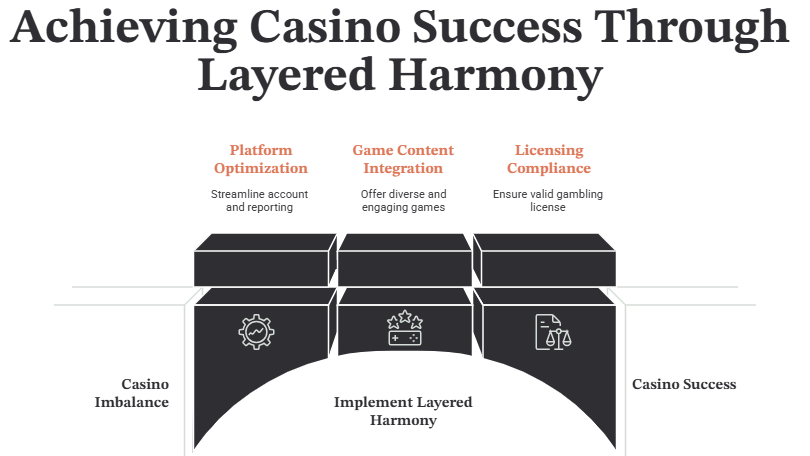
Besides, before you talk to any platform provider, it helps to understand what the component parts of an online casino actually are. There are more moving pieces than most new operators realise — and the quality of how they fit together determines whether your casino competes or stalls.
The six operational layers of an online casino:
- The Platform (Your Backbone) This is the software that runs everything — account management, wallet, bonusing engine, back-office reporting, affiliate tracking, and player lifecycle tools. The platform isn’t what players see; it’s what keeps everything working beneath the surface.
- Game Content (What Players Come For) No platform operates in a vacuum. You need integrated game content — slots, live dealers, table games, crash games, and sports betting if your strategy requires it. The quality and breadth of your game library is one of your first competitive differentiators.
- Licensing (Your Legal Foundation) You cannot legally accept real-money wagers without a valid gambling licence. Jurisdiction choice affects your tax rate, player eligibility, payment processor access, and advertising permissions. This decision deserves serious strategic thought.
- Payment Processing (Your Revenue Engine) Players deposit in dozens of currencies and through dozens of methods — cards, e-wallets, bank transfers, and increasingly, cryptocurrency. Your payment stack must be fast, frictionless, and fraud-resistant. A slow withdrawal kills player loyalty faster than almost anything else.
- KYC & Compliance (Your Risk Firewall) Anti-money laundering (AML) checks, Know Your Customer (KYC) verification, responsible gambling tools, and geolocation filtering aren’t optional. They are legal requirements that carry real consequences when ignored. Modern platforms handle most of this programmatically.
- CRM & Marketing Stack (Your Growth Engine) Bonuses, loyalty programmes, personalized promotions, email and SMS campaigns, affiliate tracking — these are the tools that turn first-time depositors into retained players. The best platforms bake these directly into the operator dashboard.
Understanding these six layers helps you evaluate any Casino Online Solution on the market with clear eyes. The right partner doesn’t just hand you a product — they help you configure each of these layers intelligently.
Build vs. Buy: The Decision That Defines Your Timeline
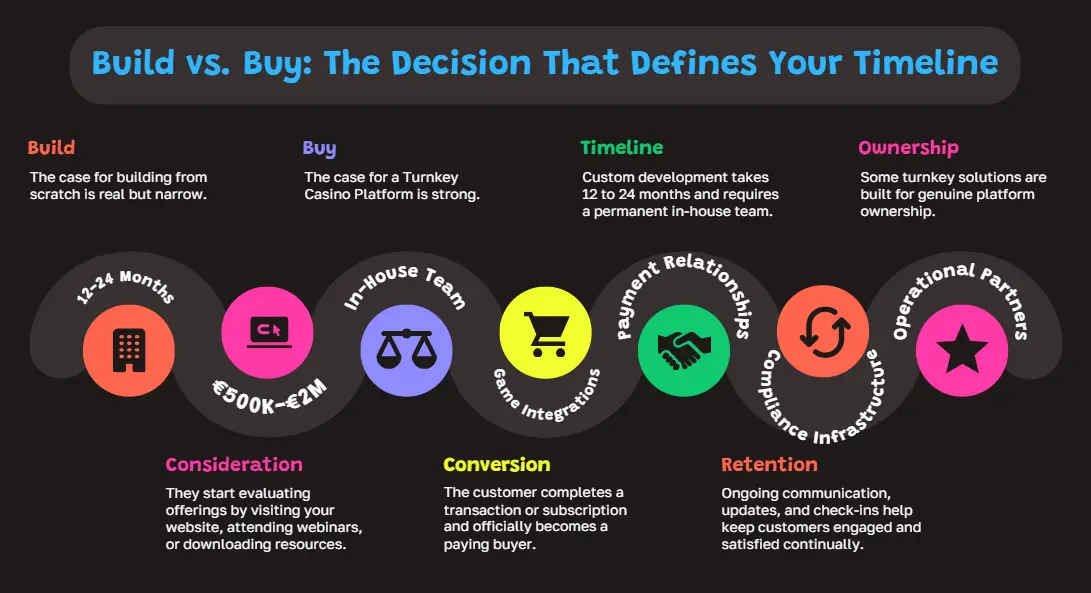
Moreover, every serious operator faces this question. Let’s address it honestly.
The case for building from scratch is real but narrow. If you have a genuinely novel product concept — a mechanic, a market segment, or a regulatory angle that existing platforms simply cannot accommodate — custom development gives you the freedom to build exactly what you envision. But custom development at this scale takes 12 to 24 months, costs between €500,000 and €2 million in initial build, and requires a permanent in-house engineering team to maintain it. You’re also starting from zero on game integrations, payment relationships, and compliance infrastructure.
The case for a Turnkey Casino Platform is strong for the vast majority of operators entering or scaling in 2026. You leverage infrastructure that has already been built, tested, and refined through live player traffic. You get to market faster, cheaper, and with less operational risk. The best turnkey providers aren’t just software vendors — they’re operational partners who have solved the problems you haven’t encountered yet.
The honest nuance: not all turnkey solutions are equal. Some are white-label setups where dozens of operators share the same codebase with a different skin. Others — like the approach DSTGAMING takes — are built for genuine platform ownership, where your data, your player relationships, and your configurations belong to you.
Comparison: Casino Platform Options in 2026
Here is a straightforward breakdown of the primary routes to market and what each realistically delivers:
| Custom Build | White-Label Shared Platform | Turnkey Casino Platform (DSTGAMING) | |
| Time to Launch | 12–24 months | 2–6 weeks | 4–8 weeks |
| Initial Investment | €500K–€2M+ | €15K–€50K (rev-share) | Competitive, transparent pricing |
| Platform Ownership | Full | None — you’re a tenant | Full — your data, your brand |
| Game Library | Must integrate individually | Fixed catalogue | 10,000+ titles across 100+ providers |
| Back-Office Control | Full (you build it) | Limited | Full operator dashboard |
| Compliance Tools | Must build/procure | Basic, shared | Built-in KYC, AML, RG tools |
| Scalability | High (but costly) | Constrained | High — cloud-native infrastructure |
| Payment Methods | Must negotiate individually | Limited | Multi-currency, crypto-ready |
| Ongoing Tech Support | In-house team required | Basic SLA | Dedicated account management |
| Revenue Share Model | N/A | Typically 20–40% GGR | Flexible, operator-friendly |
| Recommended For | Funded operators with unique IP | Testing a concept quickly | Serious operators scaling for growth |
The table above reflects the real operational reality of each route. White-label platforms are useful proof-of-concept tools, but they’re not businesses in the fullest sense — you’re renting infrastructure and building on someone else’s foundation. A genuine Turnkey Casino Solution gives you a real operational asset.
DSTGAMING Casino Online Solution: What’s Under the Hood
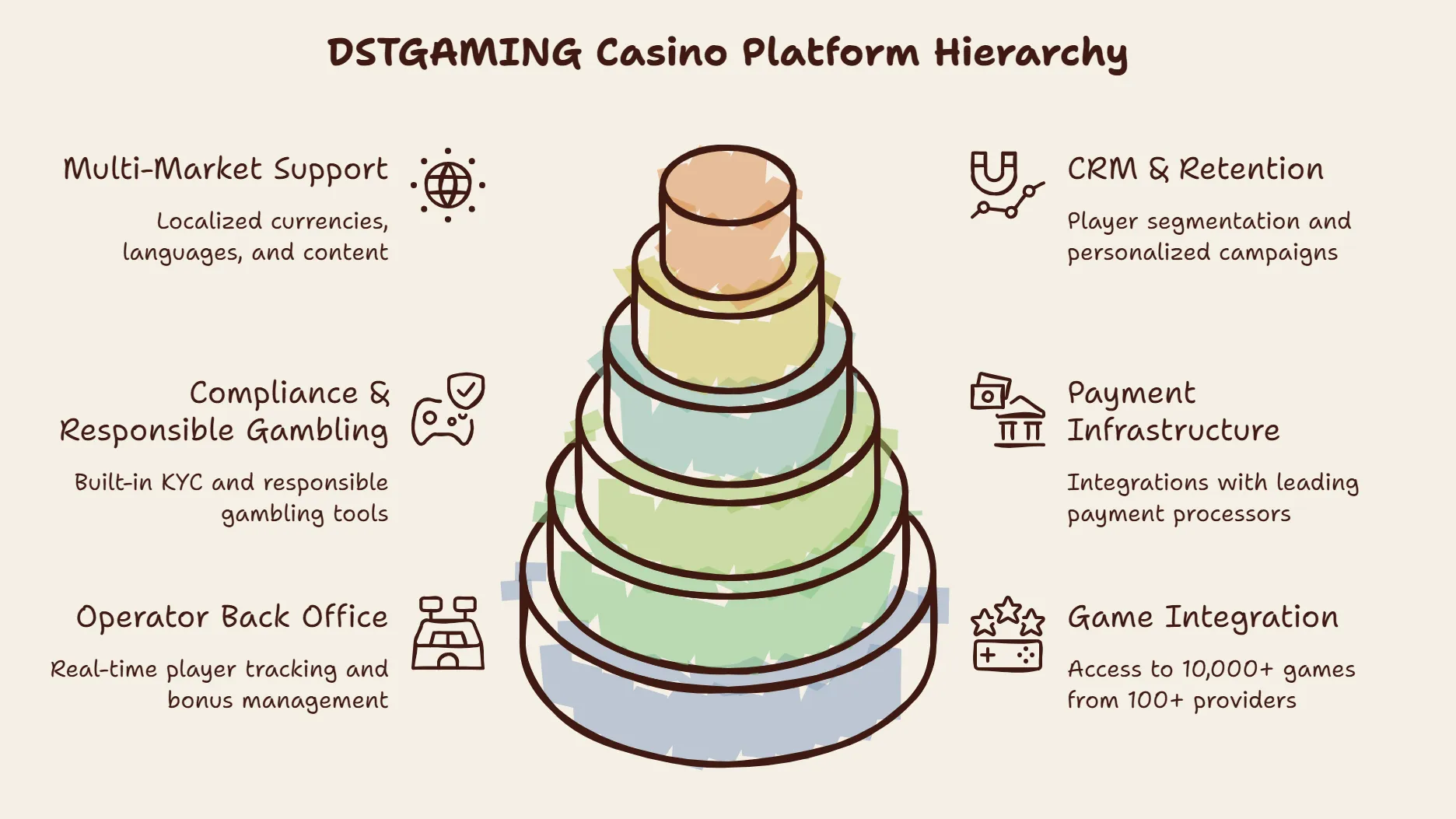
DSTGAMING built its platform specifically for operators who take the business of running a casino seriously. Not a cosmetic reskin of someone else’s software — a purpose-built Turnkey Casino Platform designed around the commercial and operational realities of growing a sustainable iGaming brand.
Here’s what the platform actually delivers:
Game Integration at Scale
With access to over 10,000 game titles from more than 100 certified game providers — including Evolution, Pragmatic Play, Playtech, NetEnt, and dozens of specialist studios — your players have genuine breadth and quality from day one. New provider integrations don’t require engineering sprints on your end.
Operator-Grade Back Office
The DSTGAMING back office isn’t a reporting dashboard bolted onto a retail product. It’s an operator command centre — real-time player tracking, bonus engine configuration, affiliate performance management, risk flagging, and game performance analytics, all from a single interface. You run your casino from here.
Payment Infrastructure, Ready to Go
Integrations with leading payment processors, e-wallets, local payment methods, and crypto gateways mean your players can deposit and withdraw in the way they prefer. For emerging markets especially, localised payment options aren’t a nice-to-have — they’re a conversion requirement.
Built-In Compliance & Responsible Gambling
KYC verification workflows, AML transaction monitoring, player self-exclusion tools, deposit limits, and session time alerts are built into the platform architecture — not patched on afterward. This matters both for regulatory compliance and for building player trust.
CRM & Retention Engine
Segment your players, automate bonus triggering, run personalised campaigns, and track lifecycle metrics. The retention engine works alongside your affiliate tracking system so you can see the full commercial picture — acquisition cost vs. lifetime value — without stitching together separate tools.
Multi-Language, Multi-Currency, Multi-Market
Whether you’re launching in a single regulated market or building a multi-brand operation across jurisdictions, the platform is built to support localisation at scale — currencies, languages, payment methods, and content libraries adapted to market requirements.
Want to see the platform in action? Book a personalized demo with the DSTGAMING team →
Licensing 101: Where to Register and Why It Matters
Choosing your licensing jurisdiction is one of the most consequential early decisions in building an online casino. It affects your legal operating authority, your tax obligations, the payment processors willing to work with you, and the markets your players can come from.
Here’s a practical overview of the most relevant jurisdictions for 2026:
| Jurisdiction | Licence Cost (Approx.) | Processing Time | Reputation | Best For |
| Malta (MGA) | €25,000 annual | 4–6 months | Tier 1 | EU-facing operators |
| Gibraltar | £35,000+ | 3–6 months | Tier 1 | UK & European brands |
| Curaçao | $30,000–$50,000 | 4–8 weeks | Tier 2 | Emerging market entry |
| Isle of Man | £5,000–£35,000 | 3–6 months | Tier 1 | International brands |
| Kahnawake | Varies | 2–4 months | Tier 2 | Americas-facing operators |
| UK Gambling Commission | £4,000–£81,000 | 4–16 weeks | Tier 1 | UK market access |
A few practical notes on licence selection:
Don’t optimize only for speed or cost. A Curaçao licence is fast and affordable — it’s a legitimate starting point for operators targeting markets where it’s accepted. But Tier 1 licences from Malta or the UK open doors that a Curaçao licence doesn’t, particularly with payment processors and game providers who have their own compliance requirements.
Player geography determines your licence requirement. Each jurisdiction limits where you can market and accept players from. If your target audience is primarily EU-based, an MGA licence is the most operationally practical choice. Build your licence strategy around your player acquisition strategy, not the other way around.
Licence renewal and ongoing compliance have real costs. Budget not just for application fees but for the ongoing compliance infrastructure — responsible gambling reporting, AML audits, player fund segregation, and regulatory submissions. Modern platforms automate significant portions of this, but it’s never zero overhead.
DSTGAMING’s team works alongside operators on licence applications and can connect you with specialist legal counsel for jurisdictions that require it.
Payment Infrastructure: The Silent Backbone of Your Revenue
Ask any experienced operator where player churn actually happens, and a significant portion of the answer comes back to payments. A declined deposit is a lost player. A delayed withdrawal is a complaint. A friction-heavy checkout flow is an abandoned session.
Getting your payment stack right isn’t glamorous — but it’s foundational.
What a mature payment infrastructure looks like in 2026:
- Card processing via major acquirers with 3DS2 fraud protection
- E-wallet integrations — Skrill, Neteller, PayPal (jurisdiction-dependent), and regional equivalents
- Local payment methods tailored to your target markets (iDEAL for Netherlands, MBway for Portugal, PIX for Brazil, and so on)
- Cryptocurrency rails for Bitcoin, Ethereum, USDT, and increasingly stablecoins — important for markets with banking friction
- Instant withdrawal capability — increasingly a player expectation, not a premium feature
In addition, the DSTGAMING platform comes with pre-negotiated integrations across this stack. You’re not starting payment conversations from a standing start — the relationships and technical integrations are already in place.
Fraud and chargeback management is the other side of this coin. A good payment stack isn’t just about accepting money — it’s about accepting it safely. Risk scoring, velocity checks, and automated flagging are built into the payment layer so your risk team can focus on genuine anomalies rather than manual transaction review.
Responsible Gambling: Building It In, Not Bolting It On

This section is shorter than the others, but it matters more than most.
Responsible gambling tools aren’t just a regulatory checkbox — they’re core to building a business that doesn’t generate the kind of player harm that invites regulatory crackdowns, payment processor pullbacks, and reputational damage.
The DSTGAMING platform includes:
- Deposit and loss limits set at player or operator level
- Session time reminders and automatic session limits
- Self-exclusion and cooling-off tools with cross-operator flagging where required
- Affordability and behavioural pattern monitoring linked to automatic intervention triggers
- Reality check overlays during extended play sessions
These tools run alongside the commercial operation — they don’t diminish revenue when implemented properly. In fact, operators with robust responsible gambling frameworks tend to maintain healthier player bases with higher lifetime value, because they’re not burning through high-risk players who churn quickly.
Build it in from the start. It’s cheaper, smarter, and the right thing to do.
Case Study: From Contract to Live Casino in 6 Weeks
The Operator: A sports media group based in Eastern Europe with an established affiliate business and a database of engaged sports bettors. They had explored building a proprietary platform but found the 18-month timeline and upfront cost incompatible with their growth ambitions.
The Brief: Launch a fully branded online casino with sports betting integration, targeting their existing audience of sports bettors while building a slots and live casino offering in parallel.
What Happened:
In week one, the DSTGAMING team conducted a discovery session covering brand guidelines, target market requirements, preferred game providers, and payment processor priorities. A dedicated implementation manager was assigned.
By week three, a staging environment was live with the operator’s branding applied across the platform. Game content was loaded from an agreed initial library of 3,000 titles. Payment integrations were tested against the operator’s preferred processors.
By week five, licensing documentation was in order (the operator had previously initiated a Curaçao application), KYC workflows were configured, and the affiliate tracking module was connected to their existing affiliate partner network.
Week six: first live players.
Six months post-launch:
- Monthly Active Users exceeded 4,200
- Average Deposit Value: €87
- Player Retention (30-day): 41%
- Sports Betting accounted for 28% of GGR; Slots and Live Casino made up the remainder
What made the difference: The operator came prepared. They had clear answers on brand, target market, payment preferences, and licensing. Operators who arrive with ambiguity in those areas tend to extend timelines. Those who come organised get live faster.
The DSTGAMING team didn’t just hand us software. They worked through every operational question with us — from how to structure the welcome bonus to how to set up the affiliate programme. That support in the first months is what made the difference.
— Operator, Eastern Europe
The full cost depends on three main variables: your platform choice, your licensing jurisdiction, and your initial marketing budget. Using a Turnkey Casino Platform like DSTGAMING’s solution significantly reduces the upfront technology cost compared to custom builds. Licensing fees vary from approximately $30,000 for Curaçao to €25,000+ annually for an MGA licence. A realistic total budget for a well-resourced launch — including platform, licensing, payment deposits, compliance tools, and initial marketing — typically ranges from €150,000 to €500,000 depending on ambition and market scope.
With DSTGAMING’s Turnkey Casino Solution, operators have gone live in as few as four to six weeks from contract signature. The primary variable is how prepared the operator is at the point of engagement — brand assets, licensing status, payment processor relationships, and market decisions. Operators who come to the table with clear answers on those questions launch fastest.
Not necessarily. DSTGAMING works with operators at all stages of the licensing process and can help guide licence strategy as part of the onboarding process. However, you cannot legally accept real-money players without a valid licence, so the licensing timeline will ultimately determine your go-live date. Starting the licence application early — ideally in parallel with platform setup — minimises delay.
A white-label casino is typically a shared platform where your brand is applied as a “skin” on top of infrastructure controlled by the provider. You share back-office systems, often share player databases, and have limited control over platform evolution. A Turnkey Casino Platform gives you a dedicated, fully controlled environment — your data, your player relationships, your configurations — with the technical infrastructure handled by the provider. The key difference is ownership: turnkey means you’re building a real business asset, not renting space on someone else’s.
Yes. The DSTGAMING platform supports cryptocurrency payment rails including Bitcoin, Ethereum, USDT, and others. Crypto acceptance is increasingly important in markets with limited traditional banking access and among player segments who prefer the speed and privacy of on-chain transactions. Regulatory compliance for crypto is jurisdiction-dependent and requires appropriate AML monitoring regardless.
DSTGAMING integrates content from more than 100 certified game providers, including Evolution Gaming (live dealer), Pragmatic Play, Playtech, NetEnt, Microgaming, Hacksaw Gaming, Push Gaming, and many more. With over 10,000 titles available at launch, operators have genuine content depth from day one — without needing to negotiate individual provider contracts.
Yes. DSTGAMING’s platform includes a comprehensive responsible gambling module covering deposit limits, loss limits, session controls, self-exclusion, cooling-off periods, and behavioural monitoring. These tools are configurable by operators and are designed to meet the compliance requirements of major regulated jurisdictions including the UK, Malta, and others.
DSTGAMING provides dedicated account management, technical support, platform updates, and strategic consultation on an ongoing basis. You’re not handed software and left to figure it out — the team remains engaged through the growth phase, including assistance with new market launches, bonus strategy, and payment optimisation.
Your Next Step
You now have the map. What you do with it depends on where you are in your journey.
If you’re at the research stage, start with the licensing decision — it has the longest lead time and the most downstream implications. Work through the questions in this guide and get clear on your target market before anything else.
If you’re ready to evaluate platform options, the best thing you can do is see a real demo of the back office, the game library, and the player-facing product. Not a slide deck. An actual working environment that reflects what your players would experience.
If you’re ready to move, the DSTGAMING team is built for operators who want to move with purpose.
Whether you’re at the idea stage or ready to sign, we’ll give you a straight conversation about what launching with DSTGAMING looks like — timeline, structure, investment, and commercial model.