
White Label Casino Software: The Complete 2026 Operator Guide
Estimated reading time: 18 minutes
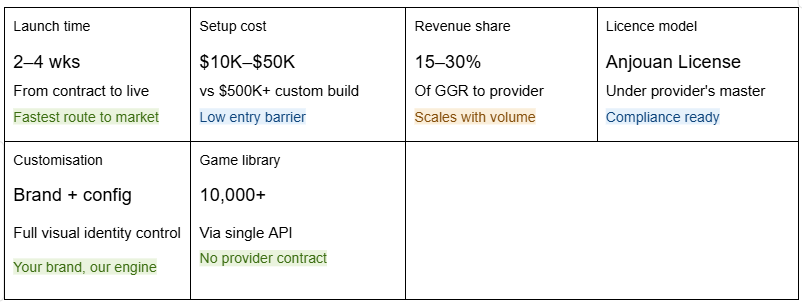
A white label casino is a ready-to-launch online gambling platform where a B2B provider handles the software, gaming licence, and game integrations while the operator brands and markets the casino under their own name. Operators typically go live in 2–4 weeks without writing a single line of code.
The global online gambling market is projected to reach $153.6 billion by 2030, growing at a CAGR of 11.7% (Mordor Intelligence, 2024). White label casino software has become the dominant entry model for operators who want a stake in that growth without the 12–24 month build cycles and seven-figure development costs that custom platforms require.
This guide covers everything a B2B operator needs to make an informed platform decision in 2026 — from what’s actually included in a white label package to real costs, licensing considerations, and the step-by-step launch process.
What is a white label casino?
A white label casino is a fully operational online gambling platform that a B2B software provider builds, maintains, and licences — while the operator applies their own brand, acquires players, and runs the marketing. Think of it as a franchise model for iGaming: the infrastructure, compliance framework, and technology are shared; the brand, the customer relationships, and the revenue are yours.
The “white label” terminology comes from manufacturing, where a product is made by one company and sold under another’s branding. In iGaming, the product is the casino platform itself: the game library, payment processing, back-office, KYC workflows, and responsible gambling tools. All of it is pre-built and pre-tested. You configure it for your market, apply your brand, and launch.
This model exists because building a competitive online casino from scratch is genuinely complex — game provider negotiations alone can take months, and payment integration for multiple markets is a project in itself. White label software consolidates years of infrastructure development into a platform you can access in weeks.
How does a white label casino work?
Understanding the operational model helps operators make better decisions about which provider to choose and which configuration suits their business.
At the core, the white label provider operates a master licence from a recognised jurisdiction — Curaçao, Malta, Isle of Man, or others — and extends sublicence rights to operators who launch under that framework. The operator runs their branded platform under the provider’s regulatory umbrella until they’re ready to pursue their own standalone licence.
The technical flow works like this: when a player deposits, the transaction routes through the provider’s payment infrastructure. When they play a game, it loads from the provider’s aggregated game library. Player data is stored in the provider’s back-office, accessible to the operator through a management dashboard. The operator sees everything they need to run the business; the provider manages everything underneath.
Revenue typically flows as follows: the operator collects gross gaming revenue (GGR) from players, remits the agreed revenue share to the provider (usually 15–30%), and retains the remainder. Some providers charge a flat monthly platform fee instead of, or in addition to, the revenue share.
The diagram below shows how the layers sit relative to each other:
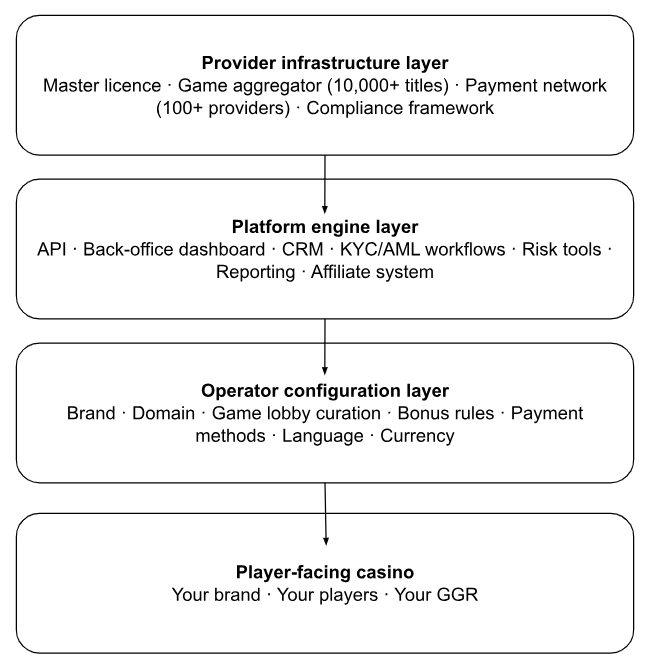
The key insight from this structure: the operator controls the revenue layer (brand, player relationships, marketing). The provider takes on the operational complexity below it.
White label vs. turnkey vs. custom casino
These three terms appear frequently in B2B iGaming discussions and are often confused. The distinctions matter — they represent meaningfully different commercial models, not just different names for the same thing.
| Criteria | White Label | Turnkey Casino | Custom Build |
| Launch Timeline | 2 – 4 Weeks | 2 – 8 weeks | 8 –18 months |
| DSTGAMING Setup Cost | 2K – 12K USD | 10K – 20K USD | 20K – 30K USD |
| Platform Ownership | Provider owns infrastructure | Operator owns post-delivery | Operator owns from build |
| License | Provider’s sublicence | Typically operator’s own | Operator’s own |
| Revenue Share | 15–30% GGR | Low/none | None |
| Customization | Branding and configuration | Deeper product customisation | Complete |
| Technical Team Needed | None | Minimal | Large dev team required |
| Ongoing Maintenance | Provider responsibility | Shared or operator | Operator responsibility |
| Best For | Fast market entry, limited capital | Operators seeking ownership | Established operations, unique IP |
| Market Access | Immediate via provider licence | Requires own licence | Requires own licence |
The white label model trades some long-term revenue (the GGR share) for dramatically lower entry cost and risk. The turnkey model sits in the middle: you receive a fully delivered product that becomes yours, but you carry more of the cost and compliance responsibility upfront. Custom builds make economic sense only when your competitive advantage genuinely requires proprietary technology — which is rarely the case for new market entrants.
For operators evaluating the turnkey route, DSTGAMING’s turnkey casino solutions offer a middle path with operator-owned outcomes and provider-supported build processes.
What is included in the package?
A properly specified white label casino package should include all of the following. If a provider’s offering is missing components from this list, those gaps become the operator’s problem post-launch — usually at the worst possible moment.
Game library via aggregator API — access to 10,000+ titles from major studios (Evolution, Pragmatic Play, Play’n GO, NetEnt, and hundreds more) through a single API connection. This eliminates the need to negotiate and maintain separate contracts with individual game providers. The library typically includes slots, live dealer games, table games, crash games, and progressive jackpots. See DSTGAMING’s game aggregator infrastructure for full provider coverage.
Gaming licence (master or sublicence) — operating legally requires a valid licence from a recognised jurisdiction. White label providers extend sublicence rights to operators under their master licence, which covers the compliance, reporting, and regulatory obligations while the operator builds their player base. Licence jurisdiction options and their implications are covered in the licensing section below. For a full jurisdiction guide, DSTGAMING’s licensing resources cover the current landscape in detail.
Payment gateway integration — the ability to accept deposits and process withdrawals via credit and debit cards, e-wallets (Skrill, Neteller), local payment methods (UPI, PIX, M-Pesa, SEPA), and cryptocurrencies (USDT, BTC, ETH). Payment coverage is one of the most commercially significant variables in platform selection — the right local payment methods directly affect your deposit conversion rate in target markets. DSTGAMING’s payment solutions infrastructure covers 100+ providers across global and regional methods.
Back-office management system — a dashboard through which the operator manages player accounts, views real-time GGR and session data, configures bonuses, monitors KYC status, reviews risk flags, and generates regulatory reports. The quality of the back-office determines how effectively operators can run their business day-to-day.
CRM and bonus engine — player segmentation, personalised bonus configuration (welcome bonuses, cashback, free spins, reload offers), loyalty tier management, and automated trigger campaigns based on player behaviour. A native CRM eliminates the need for a separate third-party CRM platform and integration.
KYC and AML tools — identity verification workflows, document upload and review processes, politically exposed person (PEP) screening, sanctions list checking, and suspicious activity flagging. These are regulatory requirements, not optional features — and they need to be embedded in the platform from day one.
Risk management tools — fraud detection, unusual betting pattern flagging, velocity checks on deposits and withdrawals, and manual review queues for high-risk transactions. These protect the operator from financial fraud and protect the licence holder from AML exposure.
Customer support framework — live chat integration, ticketing system, escalation workflows, and the ability to customize support language and availability settings. Some providers include outsourced support staffing as an optional component.
Affiliate management system — tracking links, commission models (CPA, revenue share, hybrid), affiliate dashboard access, and payment processing for affiliate partners. Affiliate channels typically drive 40–60% of player acquisition for new casino brands, making this infrastructure commercially critical from launch.
Regular software updates — security patches, regulatory compliance updates (as licensing requirements evolve), game library additions, and payment method integrations. These are the provider’s ongoing obligation and should be contractually specified.
How to launch a white label casino in 8 steps
This is the process as it actually runs for operators launching on a well-structured white label platform — not a theoretical framework but the sequence that consistently produces live casinos within the 4–6 week window.
| 1 | Define your target market and player demographics Identify your primary geography, preferred player segment (mass market vs. high-value), and game verticals. This informs every downstream decision — from licence jurisdiction to payment methods and game library curation. Strategic |
| 2 | Choose a white label provider with relevant licensing Evaluate providers on jurisdiction coverage, game library breadth, payment method availability for your target market, and support model. Ensure their master licence covers your intended player geography. Week 1 |
| 3 | Select your game library and preferred providers Configure your game lobby from the aggregated library — prioritise titles that over-index in your target market. Evolution live dealer content performs differently across demographics than, say, Pragmatic Play slots; curation matters. Week 1 |
| 4 | Configure payment methods for your target market Match payment methods to your player geography. A Brazilian-focused casino needs PIX. An Indian operator needs UPI and Paytm. A crypto-native brand needs USDT and BTC. Mismatched payment options are one of the most common causes of deposit abandonment. Week 1–2 |
| 5 | Design your branding — domain, logo, colour scheme Apply your visual identity to the platform: logo, colour palette, typography, and game lobby layout. Configure your domain, SSL, and any regional URL structures. Most providers offer design templates to accelerate this stage. Week 2 |
| 6 | Set up back-office, bonuses, and KYC parameters Configure your welcome bonus structure, wagering requirements, player tier system, and loyalty programme in the CRM. Set KYC thresholds, risk flags, and AML monitoring parameters aligned to your licence jurisdiction’s requirements. Week 2–3 |
| 7 | Complete staging and user acceptance testing Test the full player journey end-to-end: registration, KYC, deposit, gameplay, withdrawal, bonus activation. Test across device types — mobile is the primary surface for most markets. Validate payment flows for every configured method. Week 3–4 |
| 8 | Launch and activate marketing campaigns Go live and activate affiliate partnerships, paid acquisition campaigns, and SEO-driven content. Monitor first-week KPIs closely: registration-to-deposit conversion, first deposit average, and bonus claim rate. Optimise weekly from real data. Week 4–6 |
For a detailed breakdown of post-launch player acquisition, DSTGAMING’s casino marketing strategies guide covers affiliate strategy, SEO, and retention frameworks for new casino brands.
How much does a white label casino cost?
Cost is the question every operator asks first, and the honest answer is: it depends significantly on which provider you choose, which markets you’re targeting, and how much configuration your launch requires. Here’s the real breakdown.
Upfront setup costs
Setup fees cover platform configuration, onboarding, and any custom branding or payment integrations specific to your market. For a standard white label launch, expect €10,000–€50,000. At the lower end, you’re launching in a well-supported market with standard payment methods and minimal customisation. At the higher end, you’re building a multi-market operation with regional payment integrations, extensive custom UI work, and additional compliance requirements.
Ongoing operational costs
Once live, your cost structure shifts to revenue-based: the GGR revenue share (15–30% depending on your provider agreement and volume) is the primary ongoing cost. Some providers also charge a flat platform fee of €1,500–€5,000 per month. The better deals at scale often reduce the revenue share percentage as your GGR grows — this is worth negotiating before signing.
Licensing costs
If you’re operating under the provider’s sublicence, the direct licensing cost to you is typically zero or a small annual sublicence fee (€2,000–€10,000). If you’re pursuing your own licence, Curaçao starts at approximately €25,000–€50,000 total setup, while MGA requires €170,000–€205,000 before launch.
Payment processing costs
Traditional card processing for iGaming merchants runs 3–5% per transaction. Crypto processing via stablecoins can be significantly lower. Chargeback losses (if any) are an additional variable cost.
| Cost category | Low estimate | High estimate | Notes |
| Setup / onboarding | €10,000 | €50,000 | Increases with customisation complexity |
| Monthly platform fee | €1,500 | €5,000 | Some providers waive with higher GGR share |
| GGR revenue share | 15% | 30% | Negotiable at scale; reduces with volume |
| Sublicence fee | €0 | €10,000/yr | Included in many packages |
| Payment processing | 2% | 5% | Per transaction; lower for crypto |
| Marketing / acquisition | €5,000/mo | €50,000+/mo | Operator controlled; scales with ambition |
| Own licence (if pursuing) | €25,000 (Curaçao) | €205,000 (MGA) | Optional; recommended at scale |
The total cost of ownership comparison that matters most: a white label launch at €30,000 setup and 20% GGR share, generating €100,000 monthly GGR, costs €20,000/month in revenue share. A custom build at €800,000 upfront generating the same GGR has zero revenue share — but it’s carrying €800,000 in capital cost that takes 40 months of revenue share savings to recover, and it launched 18 months later.
What jurisdiction is best for your operation?
Licensing is the most consequential decision in the white label operator’s journey — and it’s one where many new operators make choices they later regret, either by under-investing (choosing the cheapest option without considering market access implications) or over-investing (pursuing an MGA licence before they have the operational scale to justify it).
The fundamental question is: which market are you targeting, and which licence do players and payment processors in that market recognise and trust?
The three practical tiers for white label operators
Tier 1 jurisdictions — Malta (MGA) and UK (UKGC) — carry the highest player trust and the best payment processor acceptance rates (85%+). They also carry the highest cost and compliance burden. According to the Malta Gaming Authority’s published requirements, MGA licensees must maintain segregated player funds, submit monthly financial reports, and comply with detailed responsible gaming obligations. These licences are appropriate for operators who are specifically targeting European markets and have the compliance infrastructure to support them.
Tier 2 jurisdictions — Curaçao (CGA), Isle of Man, Gibraltar — offer a practical middle ground. Curaçao in particular is the most common choice for white label operators entering Southeast Asia, LatAm, and emerging markets, with setup costs of €25,000–€50,000 and a 4–8 week approval timeline. The reformed Curaçao Gaming Control Board framework introduced since 2023 has tightened compliance standards while maintaining relative accessibility.
Tier 3 jurisdictions — Anjouan, Nevis, Kahnawake — offer the fastest and cheapest entry. Appropriate for MVP launches and market testing. Payment processor acceptance is more limited, and tier-1 affiliates increasingly prefer MGA or UKGC-licensed operators.
The sublicence starting point
Most white label operators launch under their provider’s sublicence rather than applying for their own immediately. This is a rational starting strategy: it eliminates the upfront licensing cost, gets you to market faster, and gives you time to build the revenue base that justifies a standalone application.
The timeline most operators follow: sublicence for the first 12–24 months while building GGR, then apply for their own Curaçao or MGA licence once they have the operational history and revenue to support the application costs.
For a comprehensive current breakdown of licensing options and costs, see our full iGaming legal requirements and licensing guide. For jurisdiction-specific guidance including the newly regulated Brazil and UAE markets, DSTGAMING’s team can provide market-specific recommendations.
Advantages of white label casino software
Furthermore, the case for white label is well established, but the following benefits are worth understanding in their commercial specificity — not just as headline features.
Speed to revenue is the most significant commercial advantage. Every week your casino isn’t live is a week competitors are acquiring the players you were targeting. An operator who launches in week 5 rather than month 18 has 13 months of player data, affiliate relationships, and GGR to reinvest. That compounding advantage is difficult to overstate in competitive markets.
No technology risk before your first player deposits. Custom platforms encounter integration bugs, payment processing failures, and security vulnerabilities in production — often weeks after launch when you thought everything was stable. White label platforms have been tested across hundreds of live operators. The edge cases have been found and resolved before your launch.
Immediate access to a full compliance infrastructure. KYC workflows, AML monitoring, responsible gambling tools, and audit-ready reporting are operational from day one. For operators who have never run a licensed gambling business, this alone is worth the revenue share.
Lower capital requirement allows faster market validation. Testing whether a casino brand works in a specific market costs €30,000 on a white label and 4 weeks. Testing the same hypothesis on a custom platform costs €800,000 and 18 months. The white label model lets operators validate before committing to full-scale infrastructure investment.
Access to negotiated game provider relationships. The provider’s game aggregator delivers content from 100+ studios via a single contract. Getting those same agreements independently would take months and require legal resources that most new operators don’t have.
Ongoing technical maintenance is the provider’s responsibility. Security patches, regulatory compliance updates, payment method integrations — all of this happens under the hood without operator intervention.
Limitations of white label casino software
Building genuine operator trust requires honest assessment of trade-offs. White label software has real limitations that operators should understand before committing.
Revenue share is the structural constraint. A 20% GGR share is manageable at low volume; at scale it becomes a meaningful cost. An operator generating €1 million monthly GGR is paying €200,000/month in revenue share. At that point, a standalone licence and turnkey platform begins to pay for itself — typically around the 18–24 month mark for successful operations.
Customization has ceilings. You can brand, configure, and personalize extensively, but you cannot modify the underlying platform architecture. If your competitive strategy requires a genuinely proprietary player experience — a unique game mechanic, a deeply custom loyalty system, a proprietary data architecture — a white label cannot deliver it.
You’re dependent on the provider’s uptime and reliability. If the provider’s platform has an outage, your casino is offline. Evaluating a provider’s historical uptime record and SLA commitments is non-negotiable due diligence.
Platform differentiation is harder when competitors use the same infrastructure. Players who have used multiple white label casinos from the same provider may notice similar game lobbies, similar bonus mechanics, and similar UX patterns. Brand differentiation above the platform layer — in content, marketing voice, and customer service quality — becomes more important.
Sublicence means operating under the provider’s regulatory umbrella. If the provider has compliance issues or their licence is challenged, this can affect your operation. Transitioning to your own licence as early as commercially viable reduces this dependency risk.
Case Study: Southeast Asia multi-market launch
In early 2024, a first-time operator group with deep marketing expertise but no technical iGaming background evaluated their options for entering the Southeast Asian market. A custom build had been scoped at 14 months and €600,000. They chose DSTGAMING’s white label solution instead.
The configuration they deployed covered a full mobile-first white label casino with the DSTGAMING game aggregator, regional payment methods (local e-wallets alongside USDT and TRX), a CRM configured for SEA player behaviour patterns, and multi-language support for their target markets.
The results at 90 days post-launch were direct and measurable: the casino went live 5 weeks after contract signing; average deposit values came in 31% higher than their initial projections, attributed directly to local payment method availability; and the returning player rate reached 40% through personalised CRM automation — versus an industry baseline of 25–30% for new casino brands.
“DSTGAMING’s White Label solution platform allowed us to launch quickly and scale confidently. Their support and integration team made the process seamless — it felt like having an in-house tech partner who’d already solved the problems we hadn’t encountered yet.” — Managing Director, Southeast Asia Casino Brand (internal client performance report, Q1 2025)
By month six, the operator had expanded to three markets using the same platform infrastructure with minimal additional overhead. The 14-month custom build alternative would have still been in development.
How DSTGAMING’s white label solution works
DSTGAMING operates as a full-spectrum B2B iGaming solutions provider with 200+ active operators across 18+ countries. The white label solution sits at the core of the platform offering, supported by the infrastructure depth that comes from operating at that scale.
What operators get from DSTGAMING beyond the platform fundamentals:
The game library covers 10,000+ titles accessible via a single API, including live dealer content from Evolution, slots from Pragmatic Play and Play’n GO, and regional game content curated for SEA and LatAm player preferences — markets where DSTGAMING has specific operational depth.
Payment infrastructure spans 100+ providers including credit cards, major e-wallets, regional local payment methods (PIX, UPI, M-Pesa, SEPA), and full crypto support (BTC, ETH, USDT, LTC, TRX) with stablecoin-first configurations available for operators managing volatility risk.
The compliance layer includes built-in KYC workflows, AML transaction monitoring, responsible gambling tools (deposit limits, loss limits, self-exclusion, session timers), and audit-ready reporting — operational from launch without additional vendor sourcing.
Launch support includes a dedicated onboarding manager, 24/7 technical support post-launch, and ongoing regulatory monitoring so operators don’t need a full-time compliance team to stay current.
Game content is sourced from providers certified by Gaming Laboratories International (GLI) and eCOGRA, ensuring RTP accuracy and fair play certification is documentable — a requirement for licensed operations and a trust signal for players.
The typical DSTGAMING white label timeline: contract signed on day one; platform configured, branded, and payment-tested by the end of week three; soft launch and final UAT in week four; full live operation by week five or six.
Ready to launch your white label casino?
The operators who are winning in the markets opening right now — Brazil, the UAE, and the continued growth of regulated European and Asian markets — launched quickly, on proven infrastructure, with compliance built in from the start.
DSTGAMING’s white label platform puts you live in 4–6 weeks: 10,000+ games, 100+ payment providers, built-in KYC/AML, and the regional market depth to serve SEA, LatAm, Europe, and MENA from a single platform.
Get a free white label casino consultation — see the platform configured for your specific market, with a realistic timeline and commercial structure.
A white label casino operates under the provider’s infrastructure and licence throughout — you brand it and run marketing while the provider manages the technology and compliance. A turnkey casino is delivered as a complete product that transfers to the operator’s ownership after delivery. Turnkey requires your own licence and carries higher upfront cost, but gives you full platform ownership. For a detailed comparison, DSTGAMING’s turnkey solution guide covers the trade-offs in full.
With a well-structured provider, 2–6 weeks from contract signing to live operation is realistic. The lower end (2–3 weeks) is achievable for operators launching in a single market with standard payment methods. The upper end (5–6 weeks) reflects multi-market configurations with additional payment integrations and more extensive branding work. DSTGAMING’s documented average across 200+ operator launches is approximately 5 weeks.
Not immediately. White label providers extend sublicence rights to operators, allowing you to launch legally under the provider’s master licence. Most operators begin on a sublicence and pursue their own standalone licence at the 12–24 month mark, once their operation is generating sufficient GGR to justify the application cost. See our full licensing guide for jurisdiction-specific requirements.
Revenue share ranges from 15% to 30% of GGR, depending on the provider, the expected volume, and what’s negotiated at contract stage. Higher-volume commitments typically unlock lower revenue share rates. Some providers offer flat monthly fees at higher upfront cost as an alternative to revenue share — the right structure depends on your volume projections and cash flow profile.
Yes, and this is a common path. Operators who demonstrate commercial viability on a white label foundation often graduate to a turnkey or custom solution once they have the GGR, player data, and capital to support it. The player data and brand equity you build on the white label transfers to your new platform — the infrastructure changes, the business asset remains yours.
The most important variables are: payment method coverage for your target market (this directly affects deposit conversion); game library depth and regional content curation; the licensing jurisdiction of the master licence and its acceptance in your player geography; the provider’s uptime SLA and support response model; and the commercial terms (setup cost, revenue share, and volume-based adjustments). DSTGAMING offers a market-specific platform consultation to work through exactly these variables for your situation.