How Gamification Boosts Player Retention in iGaming
Registration is done. The first deposit lands, and the new player tries a handful of games. Then the next evening arrives. Why should that player return to your platform instead of opening one of the many alternatives already on their phone? That second visit is where retention starts, and a welcome bonus alone rarely gives a lasting answer.
At DSTGAMING, we use gamification to give every return visit a purpose. A mission offers a next step. A loyalty level makes progress visible. A tournament adds a social reason to participate. Rewards recognise meaningful activity instead of sending the same promotion to every account. Together, these mechanics turn separate casino sessions into a connected player journey.
Our gamification solutions bring loyalty systems, jackpots, mini-games, missions, tournaments and rewards into the wider platform and CRM environment. Operators can build stronger engagement without assembling a patchwork of separate tools. The result is not simply more activity. It is a retention programme that can be measured, adjusted and governed from one place.
What Gamification Means in iGaming
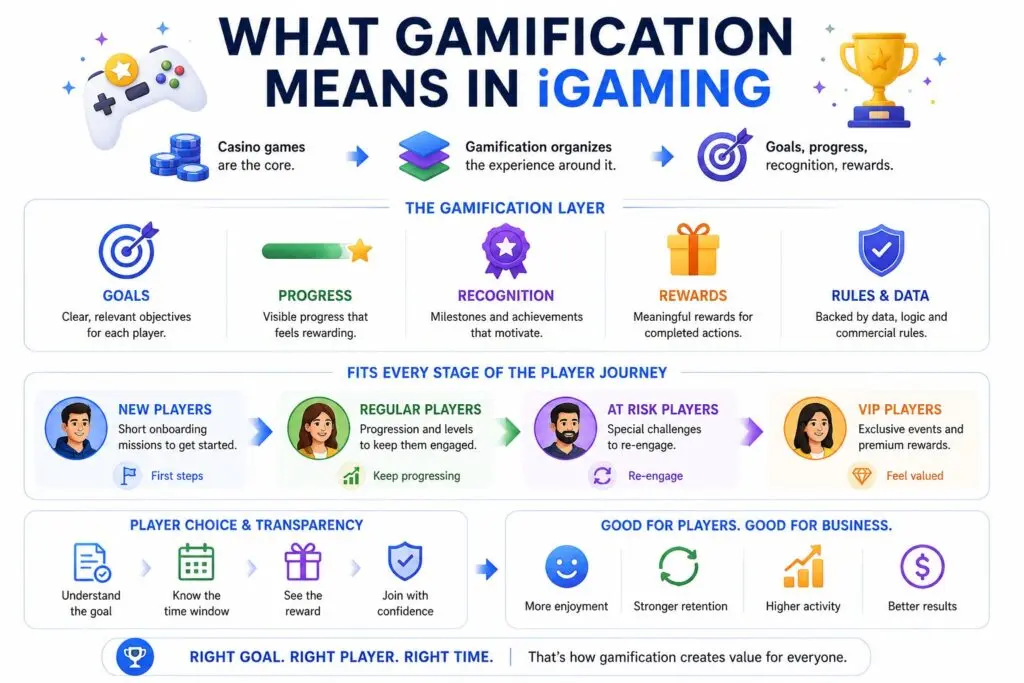
Gamification applies familiar game mechanics to the experience around casino play. The casino games remain the core product. The gamification layer organises the wider journey: what a player can work towards, how progress is shown, when recognition appears and which reward follows a completed action.
That distinction matters. A badge is the easy bit. The real work is choosing a goal that makes sense for this player, at this point in the relationship, and supporting it with sound data and commercial rules. The mechanic must fit the audience and the lifecycle stage. New players may need a short onboarding mission. Regular players may value progression, while lapsed players may respond better to a limited tournament or a fresh challenge.
The best programmes also leave room for choice. Players should understand the goal, the time window and the reward before they join. When the experience is transparent, progress feels earned rather than manufactured. That makes gamification useful to the player and commercially accountable for the operator.
Why Gamification Can Improve Player Retention
Retention grows when a platform creates reasons to return beyond a single outcome. Progress is one reason. A partially completed mission leaves a clear next step. Recognition is another. Points, levels and milestones show that a player’s history on the platform has value. Competition adds a different pull by giving tournaments and rankings a defined beginning, middle and end.
The broader research supports a careful version of this logic. A systematic review of digital consumer settings found that most of the empirical studies it examined reported a meaningful influence from game elements on engagement or online decisions. A randomised field experiment also studied how badges and leaderboards affect consumer behaviour. Neither source says that every point system works. They show why mechanics, motivation and context have to be designed together.
For an iGaming operator, this means testing the behaviour that sits between registration and long-term loyalty. Do players return to finish a mission? Do they move through loyalty levels? Does tournament participation improve seven-day activity without producing unhealthy play patterns? Gamification becomes a retention tool when those questions can be answered with evidence.
Six Mechanics, Six Different Retention Jobs
DSTGAMING does not treat gamification as one generic feature. Each mechanic creates a different type of player experience and should be tied to a different operator signal.
| Mechanic | Player experience | Useful operator signal |
| Loyalty levels | Progress and status | Repeat visits and tier movement |
| Missions | A clear next action | Completion and return frequency |
| Tournaments | Competition and urgency | Participation and reactivation |
| Mini-games | Short moments of variety | Feature engagement |
| Jackpots | Anticipation around a shared prize | Qualified participation |
| Reward system | Recognition for useful actions | Redemption and repeat activity |
Turn Separate Sessions into a Player Lifecycle
A strong programme follows the player lifecycle instead of repeating the same campaign forever. Keep onboarding simple. One modest mission might introduce the lobby, a payment method or a selected feature, then get out of the way. The reward should be easy to understand and proportionate to the action.
Once a player becomes active, progression can take over. Loyalty points, visible levels and milestones create continuity between sessions. Missions can rotate by game category or campaign theme. A well-timed tournament gives the month a focal point, provided the entry rules and prizes are plain to see. A mini-game can break up the journey for a minute without competing with the main lobby.
When activity drops, simply making the bonus larger misses the point. A relevant challenge, a new tournament or recognition of earlier progress may offer a cleaner reason to return. DSTGAMING’s player retention strategy looks beyond one promotion and brings gamification, personalisation, CRM activity and the mobile experience into the same conversation.
Look Past Campaign Participation
A campaign can attract clicks and still fail to improve retention. That is why participation is only the first metric. Operators need a baseline, a comparison group where practical and a clear observation window. Day-one, day-seven and day-thirty activity tell different stories. So do mission completion, tier progression, reward redemption and reactivation after a period of inactivity.
Start with one commercial question. For example: can a seven-day onboarding mission increase the share of new depositors who return during their second week? That question determines the eligible audience, the mechanic, the reward and the KPI. It also stops the campaign from becoming a collection of features with no agreed purpose.
Look beyond averages. A tournament may work well for experienced slot players but add little value for a new live-casino audience. Loyalty levels may improve long-term engagement while producing almost no immediate uplift. Segment results by lifecycle stage, product preference, market and device. The useful insight is not that gamification worked. It is where, for whom and under which rules it worked.
Commercial measures belong in the same review, but they need context. Compare reward cost, net gaming revenue and player value over a sensible period rather than judging a campaign on deposits made during the event. Watch for cannibalisation too. If players would have returned without the reward, the campaign may be paying for behaviour the platform already had. Incremental retention is the real target.
Personalisation Needs Rules and Restraint
Personalisation makes gamification more relevant, but relevance should not become pressure. Use CRM data to match the challenge to a player’s demonstrated preferences and recent activity. Avoid placing every player into the same high-frequency tournament or sending a reward simply because an account has been quiet for a few days.
A practical decision model considers eligibility, preferred content, activity level, reward history and responsible-gaming status before a campaign is shown. Frequency caps prevent fatigue. Budget limits keep reward exposure under control. Suppression rules ensure excluded or at-risk players do not receive retention prompts that conflict with player-protection requirements.
DSTGAMING connects gamification with the broader CRM environment so operators can manage these conditions alongside the campaign itself. That makes personalisation operational rather than cosmetic. It also gives marketing, compliance and product teams a shared view of why a player received a particular mission or reward.
Responsible Gamification Is Better Gamification
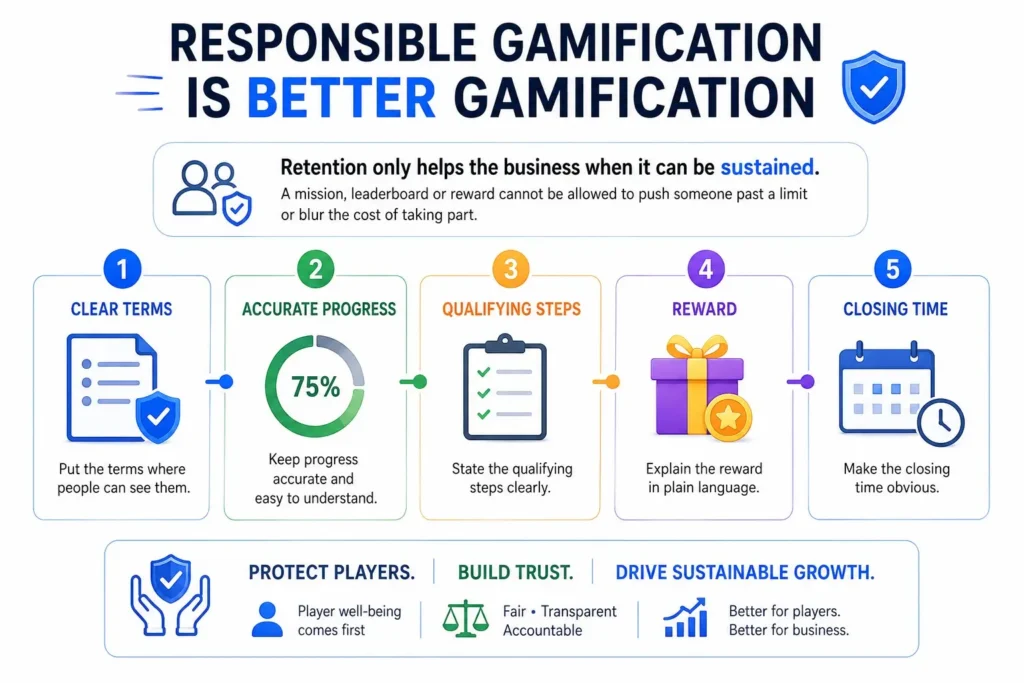
Retention only helps the business when it can be sustained. A mission, leaderboard or reward cannot be allowed to push someone past a limit or blur the cost of taking part. Put the terms where people can see them, keep progress accurate and state the qualifying steps, reward and closing time in ordinary language.
A campaign that is fine in one market may not be fine in another. Great Britain’s updated Gambling Commission requirements for rewards and bonuses have applied since 19 January 2026; among other points, they tighten the way incentive terms and structures are handled. Check the target jurisdiction each time instead of copying a mechanic across borders.
DSTGAMING’s compliance-ready approach supports the wider controls that responsible retention depends on, including limits, self-exclusion workflows and session management. Gamification should respect those controls by design. A player-protection trigger must always take priority over a marketing trigger.
Why Platform Integration Changes the Result
Gamification loses much of its value when it sits in a separate tool with delayed data. Missions need reliable event tracking. Loyalty points need accurate settlement information. Tournament rankings need timely game activity. CRM messages need to know whether a player has already completed the goal. A fragmented stack creates gaps between all four.
DSTGAMING’s white label online casino platform brings gamification together with CRM, game content, payments, reporting and compliance tools. The scale matters here: DSTGAMING’s casino game aggregator covers 10,000-plus games from more than 100 providers, all reached through a single integration. A player may leave a slot for a live table, but the mission does not vanish at the lobby door. The progress stays with them.
Integration also speeds up learning. Product teams can see which mechanics attract participation, CRM teams can refine segments and compliance teams can review the same campaign rules. Instead of moving reports between vendors, the operator can focus on the decisions that improve the next cycle.
A Practical Rollout Plan
Begin with one audience and one retention problem. Define the behaviour you want to support, then select the mechanic. A mission suits a sequence of actions. A loyalty level suits long-term progression. A tournament suits time-bound competition. A reward system can recognise a completed action, but the value and conditions must remain proportionate.
Write the rules before building the campaign. Set eligibility, start and end times, progress logic, reward limits, exclusions and failure handling. Then pick up a phone and try the whole route, not just the desktop version. Join late. Drop the connection. Complete the last step twice. Make an account ineligible halfway through. Awkward cases are much cheaper to find before launch.
Launch to a controlled segment, measure the agreed KPI and review the result by cohort. Keep what improved the player journey. Change what caused confusion. Stop what created activity without meaningful retention. This measured cycle is slower than switching on every feature at once, but it produces a system the business can trust.
Build a Retention Engine with DSTGAMING
Gamification boosts player retention when it creates a clear reason to return, recognises progress and stays connected to the rest of the platform. Loyalty systems, missions, tournaments, mini-games, jackpots and rewards each play a different role. The operator’s job is to combine them around a defined audience, measurable outcome and responsible set of rules.
DSTGAMING provides that connected foundation. Our gamification tools work alongside CRM, game aggregation, payments, reporting and compliance-ready controls in the wider iGaming stack. That leaves you free to run a focused retention journey without calling a different vendor whenever one part needs changing.
Talk to DSTGAMING about your current retention challenge. We will help you map the player lifecycle, choose the right mechanics and build a programme that your product, marketing and compliance teams can operate with confidence.