
Online Casino License : Launch in 4 Weeks
Ask most new casino operators about their biggest hurdle at launch, and they will likely cite tough competition. They may also mention rising player acquisition costs or finding top-tier game content. But ask anyone who has been through the process, and the answer is almost always the same. It is about securing the right licensing.
Apart from that, the endless paperwork, changing jurisdiction choices, compliance audits, and uncertain timelines make a regulatory minefield. Many promising casino projects quietly fail long before any player places a bet. Application timelines often run from eight weeks to twelve months. Meanwhile, legal fees, system audits, and local substance requirements add up fast. A single missed document or compliance oversight can instantly push a launch back by an entire quarter.
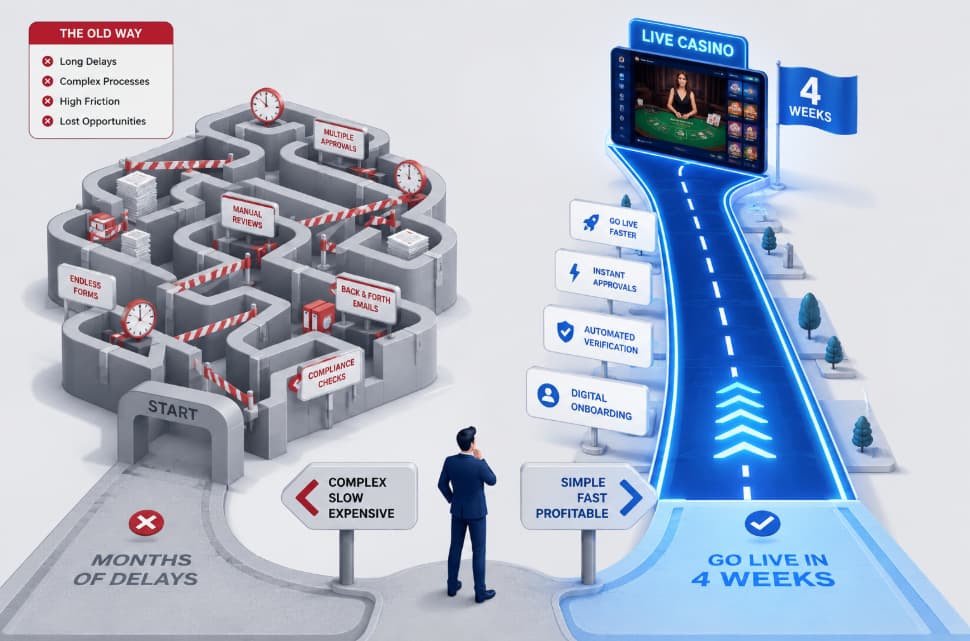
What if that bottleneck could be removed entirely? With the right launch partner, an operator can move from concept to a fully licensed, live online casino in as little as four weeks.
This article explains the global licensing landscape in 2026. It shows the hidden costs of managing the process alone. It also explains how DSTGAMING’s licence-inclusive ecosystem helps operators avoid regulatory delays. Operators can launch fully compliant platforms from day one.
Why Operating Without a License Is a Non-Starter
For some early-stage operators, the question is not which license to pursue but whether a license is needed at all. The honest answer is yes — in every market worth entering.
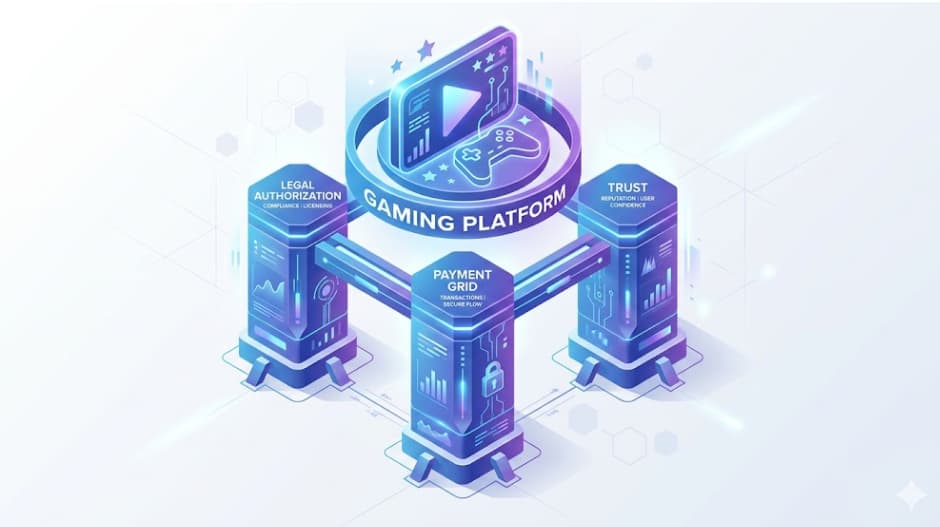
A gaming license does three things that no workaround can replicate. First, it grants legal authorization to offer real-money gambling services. Without it, an operator is not running a casino; they are running a liability. Second, it unlocks the payment infrastructure that makes the business viable. Mainstream payment service providers, acquiring banks, and even most crypto on-ramps will not onboard an unlicensed gambling operator. Third, it builds the player trust that drives retention. Modern players check license footers before they deposit, and affiliate networks tier their traffic based on regulatory standing.
The consequences of skipping this step are severe and well-documented. Banks freeze merchant accounts. Payment processors refuse settlements. Regulators in target markets issue public warnings. The Curaçao Gaming Authority did this in early 2026. It publicly flagged an unlicensed site. The site was using a fake authorization seal.
Apart from that, going live without authorization is not a shortcut. It is a dead end. The real strategic question, which drives long-term profit, is which licence to pursue and where to get it.
Global iGaming Licensing Matrix
Besides, in the global iGaming market, getting a licence is not a prestige marker. It is a basic infrastructure decision. Selecting an online gambling jurisdiction sets an operator’s target market, banking set-up, and payment provider onboarding. It also affects overall time to revenue.
As we navigate the 2026 regulatory environment, the global licensing landscape is distinctly segmented across four key regulatory tiers.
Curaçao (CGA / LOK Framework)
- Strategic Position: Mid-Tier Global / Hybrid Crypto-Fiat Infrastructure
- Time-to-Market: 8 to 16 weeks
Curaçao remains the world’s most widely adopted international iGaming license, but its operational framework has transformed. The full enactment of the National Ordinance for Games of Chance (LOK) permanently dismantled the legacy “Master License and Sublicense” hierarchy. All operators must now interface directly with the centralized Curaçao Gaming Authority (CGA) under a unified B2C or B2B model.
Financial Commitments & Local Substance
- Application & Setup Fees: Initial administrative and phase-one processing fees start at approximately €4,600, with an annual statutory supervisory fee (Green Seal activation) of roughly €24,600 (NAf 120,000).
- Local Substance Requirements: Operators face strict localized physical substance rules. This includes establishing a physical office presence in Curaçao and appointing a certified local Key Person.
- Corporate Tax & Crypto Framework: Platforms with multi-currency setups benefit from comprehensive cryptocurrency integration (requiring explicit player wallet and on-chain transaction monitoring). While corporate income tax is subject to the 15% OECD global minimum tax for large multinationals, mid-market startups and standard operators leverage a optimized 2% E-Zone profit tax rate with 0% tax on Gross Gaming Revenue (GGR).
Malta (MGA)
- Strategic Position: Premium European Tier / Onshore Tier-1 Standard
- Time-to-Market: 6 to 12 months
The Malta Gaming Authority (MGA) license represents the onshore EU gold standard. An MGA license provides immediate corporate legitimacy, offering unparalleled acceptance among Tier-1 merchant banks, premium payment processors, and global game studios. For operators seeking automated EU passporting rights and an enterprise-grade corporate posture, the MGA remains the definitive choice.
Capital & Auditing Costs
- Fee Structure: A non-refundable €5,000 application fee is paired with tiered annual license fees ranging between €10,000 and €25,000 depending on the license class (Type 1–4).
- Capitalization Thresholds: Minimum paid-up share capital requirements range from €40,000 to €100,000.
- Compliance Rigor: The lengthy onboarding runway requires extensive personal due diligence, three-year financial forecasting, rigorous technical infrastructure system audits, and a mandatory physical or cloud-mirrored data footprint within the EU. It is designed for highly capitalized enterprises rather than boot-strapped startups.
United Kingdom (UKGC)
- Strategic Position: Hyper-Targeted Onshore / Elite High-Volume Market
- Time-to-Market: 6 to 9+ months
The UK Gambling Commission (UKGC) oversees one of the most stringent and heavily policed remote gambling markets in the world. The UKGC prioritizes player protection, strict anti-money laundering (AML) controls, localized alternative dispute resolution (ADR) setups, and real-time social responsibility audits.
Fiscal Realities
- Licensing Costs: Initial application fees scale dynamically based on Gross Gambling Yield (GGY), starting at £4,224 for boutique operations and exceeding £91,000 for enterprise-level brands. Annual regulatory fees mirror this structure, running deep into six figures for high-volume operators.
- Taxation Burden: The commercial viability of a UKGC footprint is governed by the UK’s Remote Gaming Duty, which sits at a steep 40%. This environment makes independent entry sustainable only for tier-one operators with massive balance sheets or highly strategic reasons to target British consumers directly.
Anjouan (ABGB / AOFA)
- Strategic Position: High-Velocity Entry / Cost-Effective Startups & Crypto Platforms
- Time-to-Market: 2 to 6 weeks
Anjouan is an autonomous region of the Union of the Comoros. In 2026, it has become the fastest and easiest place to launch a company. Administered under the Anjouan Betting and Gaming Board (ABGB) and the Anjouan Offshore Finance Authority (AOFA), this jurisdiction provides a flexible, single-permit solution that covers all iGaming verticals—including online casino, sportsbook, poker, and web3/crypto gambling.
Cost Optimization Core Metrics
- All-Inclusive Costs: Capital requirements are exceptionally lean, with an all-in initial license application and compliance fee sitting at approximately €17,000 per year. Annual renewals run at a stabilized rate of roughly €13,300, alongside a flat €2,000 fee for mandatory Key Person/Compliance Officer authorization.
- Fiscal Benefits: Operators benefit from a 0% Gross Gaming Revenue (GGR) tax, 0% corporate profit tax on offshore income, and zero local office hiring mandates.
- Target Audience: Because it circumvents the lengthy administrative drag of older jurisdictions while still providing clean, legal international banking and crypto-gate integration, it has become the default choice for platforms targeting rapidly growing emerging markets across Asia, Africa, and Latin America.
License Comparison Snapshot — 2026
| Jurisdiction | Application Cost | Annual Fee | Timeline | GGR Tax | Best Suited For |
| Curaçao (LOK) | ~€4,600 | ~€24,600+ | 8–16 weeks | Varies | Mid-tier global operations |
| Malta (MGA) | €5,000 | €10K–€25K | 6–12 months | 5% | EU market entry |
| United Kingdom (UKGC) | £4,224+ | £4,199–£793K+ | 16+ weeks | 40% RGD | UK consumer market at scale |
| Anjouan (ABGB) | ~€17,000 all-in | ~€17,828 | 2–6 weeks | 0% | Fast launch, emerging markets |
Figures reflect publicly available regulatory data as of 2026 and may vary based on operator profile and license category.
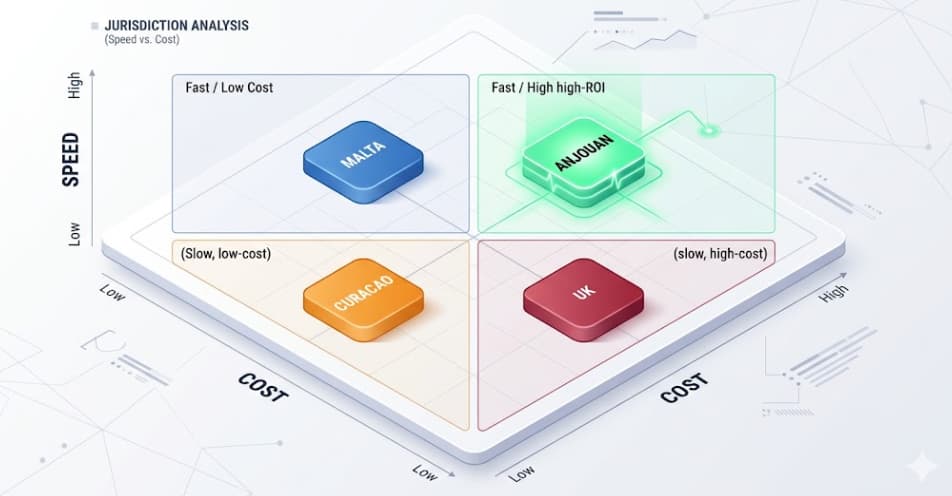
The right licence matches where the operator wants to compete, not the one with the biggest name on paper.
The True Cost of Going It Alone:
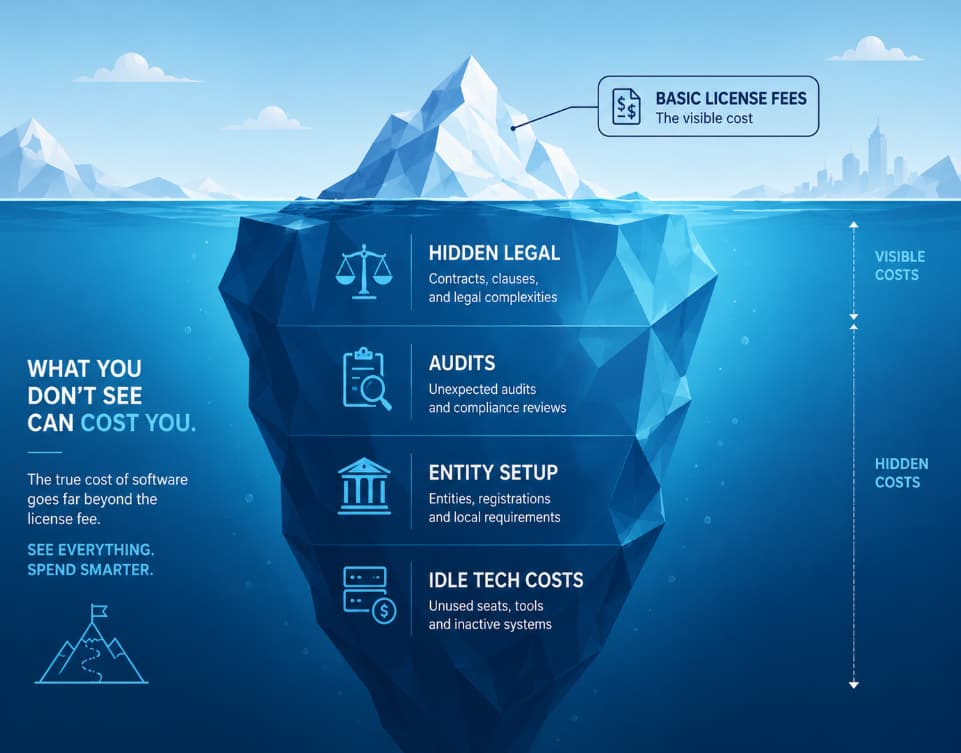
The headline license fees published by each regulator are only the beginning of what an independent application actually costs. The real budget — and the real timeline — looks very different once the full scope of work is accounted for.
Besides, on the financial side, legal and consultancy fees typically run €10,000 to €25,000 for a credible application. System certification by an approved testing lab adds another €15,000 to €30,000. Jurisdictions like Curaçao and Malta require a local entity, office space, and at least one resident key person. These costs can add up to €20,000 to €40,000 per year, before the platform goes live. Then come the AML and KYC framework build-out, responsible gaming policies, and ongoing compliance reporting infrastructure, each of which carries its own development and audit overhead.
Apart from that, the timeline is where most projects underestimate the damage. Official processing times rarely include the pre-application phase: company formation, director appointments, banking setup, and policy drafting typically take 4 to 8 weeks before the application is even submitted. Bank account opening alone can take 2 to 3 months in tier-one jurisdictions. System audits run another 6 to 8 weeks. None of this is optional, and almost none of it can be parallelized effectively without experienced project management.
The compounding cost is opportunity cost. Every month spent in regulatory limbo is a month of unrecovered marketing readiness, idle technology contracts, and lost first-mover positioning in target markets. For operators with a finite runway, the licensing process itself can become the reason a viable project fails.
A License-Inclusive Launch Ecosystem
This is the gap DSTGAMING was built to close. Rather than positioning itself as a software vendor that hands off licensing to a third party, DSTGAMING operates as a fully integrated launch partner — one where the regulatory framework is part of the package, not an external dependency.
The foundation of this model is straightforward:
Furthermore, DSTGAMING already holds an Anjouan gaming license. For operators targeting fast-growing markets across Asia, Latin America, and Africa, this changes the equation entirely.
Instead of spending months setting up a legal entity, drafting policies, and waiting for regulator approval. An operator can launch sooner. They can use DSTGAMING’s existing licence framework. This covers casino games, sports betting, poker, and crypto-enabled products under one authorisation.
As part of onboarding, DSTGAMING provides a detailed guide to Anjouan licensing. It walks new operators through the regulatory scope and restricted jurisdictions. It also explains AML and KYC duties, plus key compliance touchpoints. These points matter, even when operating under an existing framework. The goal is not to abstract away regulation — it is to make compliance operational from day one.
The license, however, is only one component. The DSTGAMING White Label setup includes the casino engine, back office, payment infrastructure, risk management tools, and license framework in one connected package. Operators bring the concept, branding, and marketing.
Nevertheless, DSTGAMING provides the technology, integrations, and regulatory support you need. Building this on your own could take 18 months. It could also cost a seven-figure budget.
This is what a true online casino with built-in compliance looks like in practice. It offers 10,000+ games from 100+ providers. It supports multiple currencies and languages. It includes integrated KYC and fraud controls. It also has a payment stack built for the iGaming sector. All of this runs under a licence that is already active. The operator’s launch timeline is no longer dictated by a regulator’s queue.
White Label vs Turnkey: Which Path Fits Your Business?
Moreover, within the DSTGAMING ecosystem, operators choose between two launch routes. The choice usually comes down to one question. How much of the licensing and operational burden do you want to carry?
A White Label Casino with License is the quicker answer. The operator will go live under DSTGAMING’s current Anjouan licence. It will use the same back-end stack as DSTGAMING’s other partners. There is no separate licence application to submit. You do not need to set up a local entity. You do not need to hire a compliance team on day one. Upfront capital requirements are lower, and four weeks from kickoff is a realistic launch target. This route suits first-time operators, established brands testing a new region, and teams seeking revenue before committing.
In addition, a Turnkey Casino is the heavier route, and it is built for operators who want the licence on their own books. DSTGAMING still does the technical heavy lifting. This includes platform deployment, game integration, payments, and risk tools. The operator holds the licence and owns the player data outright. The operator also has more room to customize the product. Timelines are longer, costs are higher, and ongoing compliance is shared. DSTGAMING no longer handles it end-to-end.
The two paths are not locked. A common pattern is to launch on a White Label setup. Use the first 12 to 18 months to build revenue. Use this time to prove the brand. Then move to a Turnkey structure once the business is big enough. This can justify holding its own licence. All this can happen without changing the technology provider.
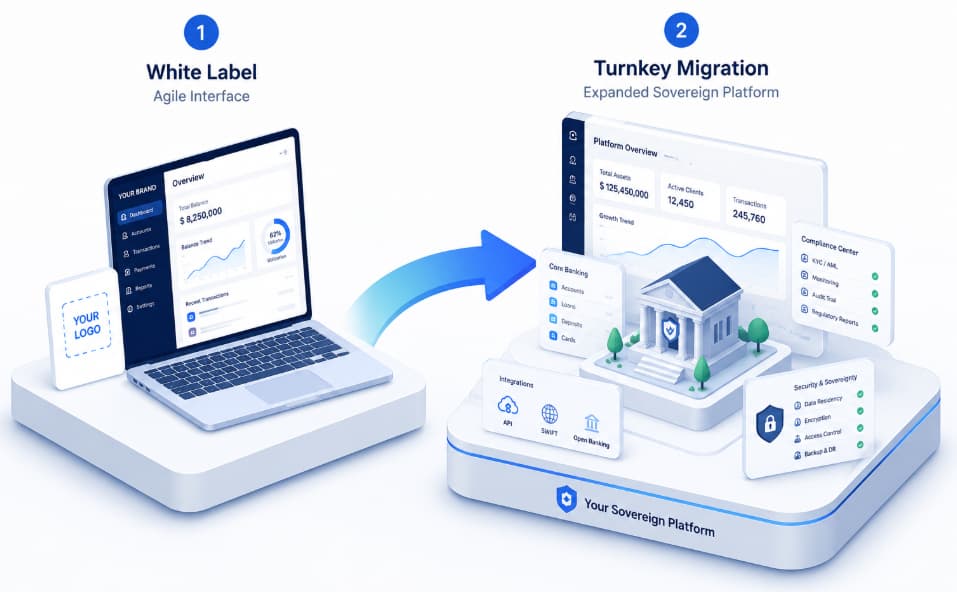
| Feature | White Label (Anjouan License Included) | Turnkey (Operator’s Own License) |
| Time to Launch | ~4 weeks | 8–16+ weeks |
| License Ownership | DSTGAMING’s | Operator’s own |
| Upfront Investment | Lower | Higher |
| Customization | Standard package | Fully customizable |
| Ongoing Compliance | Handled by DSTGAMING | Shared / operator-led |
| Best Suited For | Fast launch, market entry | Long-term independent brand |
4-Week Launch Roadmap with DSTGAMING
In addition, the four-week timeline is not a marketing figure. It is what becomes possible once the licensing dependency is removed from the critical path. Here is how that compresses into four working weeks under the White Label model.
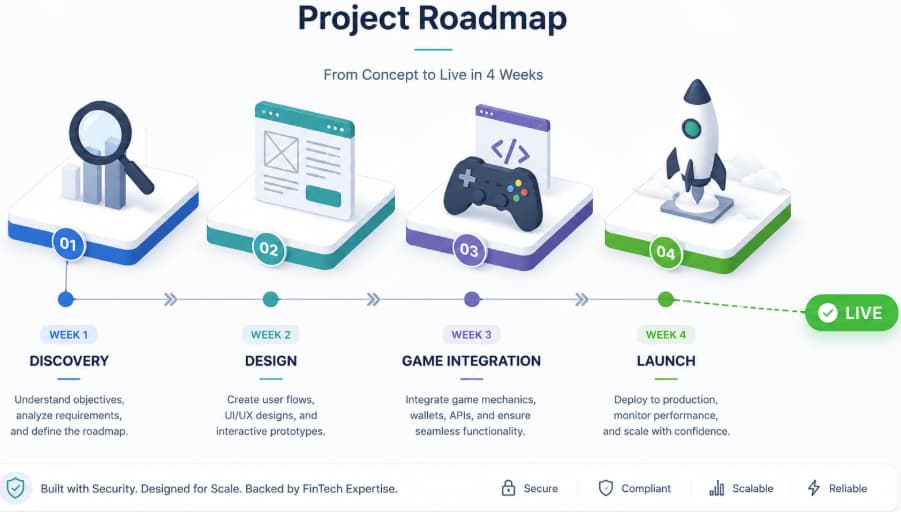
- First Week — Discovery and Setup. The DSTGAMING team aligns on business objectives, target markets, and brand direction. Domain registration, corporate structuring, and license framework alignment happen in parallel. By the end of the week, the project has a clear scope and a confirmed configuration plan.
- Second Week — Build and Customize. The operator’s visual identity is applied to the front end, with mobile-first design as standard. The back office is configured for the operator’s chosen markets, currencies, and languages. Payment gateways are connected, including credit card, e-wallet, bank transfer, and crypto options where relevant.
- Third Week — Game Library and Compliance Integration. Games are selected from the 10,000+ title library across 100+ providers and integrated into the platform. KYC, AML, and responsible gaming tools are activated. Risk management and fraud controls are tested against live conditions.
- Fourth Week — Testing and Go-Live. Full end-to-end QA covers player flows, payment processing, and back-office reporting. Compliance verification confirms the platform operates within the active license framework. Soft launch follows, then public launch.
Overall, in four weeks, the operator has a fully licensed, revenue-ready casino.
Your Casino, Live in Four Weeks
Last but not least, licensing should not be the reason a viable casino concept never reaches the market. For too many operators, it still is: a regulatory bottleneck. It drains capital, momentum, and competitive timing. This happens long before the first player signs up.
DSTGAMING’s license-inclusive model removes that bottleneck. With an active Anjouan gaming licence, an integrated technology stack, and built-in compliance tools, operators can launch fast. They can go from concept to a live, fully licensed casino in as little as four weeks. This works for rapid market entry with White Label. It also supports long-term independent growth with Turnkey.
The licensing maze is solved. What is left is the part that actually builds the business: the brand, the players, the growth.
Your License. Your Platform. Your Casino — Ready in Weeks.