
RNG vs RTP: Understanding Fair Play in iGaming
Trust serves as the currency of the online casino industry. Players will not deposit funds if they suspect the games are rigged. For a solopreneur entering the market, understanding the technical backbone of fairness is non-negotiable. The core of this trust relies on RNG iGaming technology and Return to Player (RTP) percentages.
These two concepts work in tandem to create a transparent gaming environment. While they sound technical, they are essentially business metrics that define user retention. Operators who grasp the nuance of RTP understanding can better market their platforms and manage player expectations. Ignoring them leads to disputes, chargebacks, and a tarnished brand reputation.
This guide demystifies the relationship between randomness and statistical return. We will explore how these elements function independently and together. By the end, you will view game mathematics not as code, but as a business lever.
What is RNG in iGaming?
RNG stands for Random Number Generator. It is the digital engine that determines the outcome of every spin, card draw, or dice roll. In the physical world, gravity and physics dictate these results. Online, software must simulate this natural chaos perfectly.
The primary function of an RNG is to ensure that every result is statistically independent. The previous spin has zero influence on the next one. This lack of pattern prevents players from predicting outcomes. It ensures that the “luck” factor remains pure and unmanipulated.
The Mechanics of Pseudo-Random Number Generators
Most online casinos use Pseudo-Random Number Generators (PRNGs). These algorithms generate long sequences of random numbers based on a shorter initial value, known as a seed. The seed changes constantly, often using the server’s milliseconds clock.
While deterministic in theory, a high-quality PRNG is virtually impossible to reverse-engineer. For a solopreneur, the quality of the casino software solution determines the reliability of this generator. Poor implementation can lead to predictable patterns, which skilled players might exploit.
Why RNG is Non-Negotiable for Trust
Imagine a slot machine that never pays out a jackpot. Players would leave immediately. Conversely, imagine a machine that pays out too frequently; the casino would go bankrupt. The RNG balances these extremes by ensuring volatility matches the game’s design.
Without a certified RNG, an operator is essentially running a scam. Licensing bodies like the Malta Gaming Authority or the UK Gambling Commission mandate rigorous testing. Independent labs such as iTech Labs or eCOGRA audit the code to verify fairness.
An online casino is only as good as its last audit. Certification is the bridge between software code and player confidence.
How RNG Works (Operator Lens)
Most disputes start here. Players feel a streak and suspect control. Your job is to show that each event stands alone and that certified builds lock math in place. Keep version IDs, hashes, and certificates handy so support can respond with facts, not opinions.
From Entropy to Outcome
The engine collects randomness (OS entropy or hardware sources) and builds a seed. A cryptographically secure PRNG expands that seed into a stream of numbers. The game maps those numbers to events—reels, cards, or wheel pockets—using range-safe methods that avoid bias. Each call stands alone. Streaks appear, but they don’t predict.
Labs validate unpredictability and distribution, then issue certificates tied to specific versions and RTP profiles. Your job: run the certified build, keep hashes and change logs, and expose the right facts in the UI. DSTGAMING’s aggregation stack preserves version integrity for the builds received from game studios. While we strive to deliver the correct certified versions, all fairness elements — including RNG, RTP, and math models — continue to be managed by the game providers and their accredited testing labs.
RTP Understanding: The Player’s Perspective
While RNG handles the immediate result, RTP handles the long-term promise. RTP stands for Return to Player. It is a percentage indicating how much wagered money a game will pay back to players over time. For example, a slot with 96% RTP will theoretically return $96 for every $100 wagered.
This metric is calculated over millions of spins. It does not mean a player will get back 96% of their money in a single session. Short-term variance can result in massive wins or total losses. However, over the lifespan of the game, the math converges toward the stated RTP.
RTP as a Marketing Tool
Solopreneurs should view RTP as a key marketing metric. Games with higher RTPs are naturally more attractive to savvy players. A library of high-RTP games can serve as a Unique Selling Proposition (USP). It signals that your platform offers better “value” than competitors.
However, higher RTP means lower house edge. The house edge is the casino’s profit margin. A game with 98% RTP has a 2% house edge. Operators must balance the desire for attractive games with the need for sustainable revenue. Finding this equilibrium is a core component of successful casino game mathematics.
How RTP is Calculated
Developers set the RTP during the game design phase. They run complex simulations—often billions of spins—to verify the percentage. Once set, the RTP is usually fixed, though some modern games allow operators to choose from a range of settings. Regulatory bodies often require this range to be transparent to the player.
- Theoretical RTP: The statistical calculation based on infinite play.
- Actual RTP: The real return calculated over a specific period (e.g., one month).
- Volatility: The risk level associated with the RTP. High volatility means rare but large wins.
The Interplay: How RNG and RTP Work Together
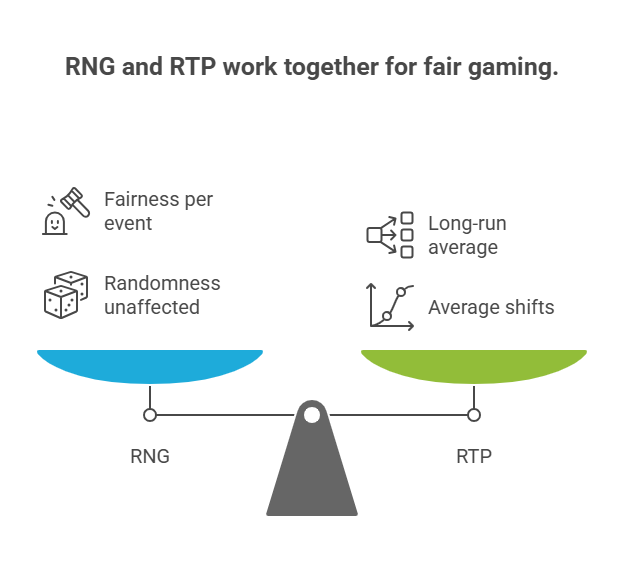
Many new operators confuse RNG and RTP as competing concepts. In reality, they are dependent mechanisms. The RNG ensures each spin is random. The RTP ensures the game pays out according to its mathematical design over time.
Think of the RNG as the engine and the RTP as the fuel efficiency rating. The engine decides how the car moves moment-to-moment. The efficiency rating tells you how far the car will go on average with a tank of gas. You cannot have a functioning vehicle without both components working in harmony.
The “Bucket” Analogy
Imagine a bucket filled with 100,000 marbles. 96,000 are white (wins) and 4,000 are black (losses). The RTP is the ratio of white to black marbles (96%). The RNG is the blindfolded person reaching into the bucket to pick a marble. They pick randomly (RNG), but the ratio ensures the overall result (RTP) holds true eventually.
Ensuring Statistical Convergence
The RNG dictates that any marble can be picked at any time. It prevents the machine from “saving up” for a win. This randomness can lead to streaks where the casino loses money in the short term. Over thousands of players, however, the results always align with the RTP percentage. This convergence is what guarantees the casino’s profit.
For operators, this highlights the importance of liquidity. You need enough capital to survive short-term variance (bad luck streaks). A robust casino bankroll management strategy accounts for these statistical fluctuations.
RTP Understanding: The House Edge Variable
Understanding the house edge is vital for revenue projection. The House Edge is simply 100% minus the RTP. If a slot has an RTP of 94%, the House Edge is 6%. This percentage represents the mathematical advantage the casino holds over the player.
This advantage ensures the casino generates profit over the long run. It is not a guarantee for every session. Players can and do win big. But for every winner, there are many more losers whose losses cover the payout and the house edge.
Game Types and Their Typical RTPs
Different games offer different margins. Choosing the right mix of games affects your bottom line. Slots generally have higher house edges than table games. However, they are easier to scale and require less player skill.
- Online Slots: Usually 94% to 98% RTP. High volume, low skill barrier.
- Blackjack: Can be as high as 99.5% RTP with optimal strategy. Low house edge but requires player skill.
- Roulette: European Roulette offers 97.3% RTP. American Roulette drops to 94.7% due to the double zero.
Operators must decide if they want high turnover with lower margins (Table Games) or high margins with lower turnover (Slots). Most successful casinos offer a mix of both to cater to different player psychologies.
Common Myths Regarding RNG iGaming
Players often harbor misconceptions about how online slots work. These myths can lead to complaints and distrust. As an operator, your support team must be educated to debunk these myths politely. Failing to do so can damage your brand’s credibility.
Myth 1: “The Machine is Due for a Win”
This is the Gambler’s Fallacy. Players believe that after a losing streak, a win is statistically imminent. The RNG makes every spin independent. The odds remain exactly the same on every spin, regardless of history. A machine that hasn’t paid out in hours is no more likely to pay out now than one that just hit a jackpot.
Myth 2: “Casinos Flip a Switch to Lower RTP”
In regulated markets, changing RTP requires a software update and often regulatory approval. It is not a “dial” that the operator can turn in real-time. Furthermore, doing so would violate the terms of the gaming license. Transparency logs and third-party audits prevent this type of manipulation.
Myth 3: “Auto-Play Has Lower RTP”
Players often believe that hitting the spin button manually yields better results. The RNG does not know who is spinning the reel. Whether it is a human or an automated script, the result is generated the moment the spin initiates. The method of initiation is irrelevant to the math.
The Role of Volatility in Player Retention
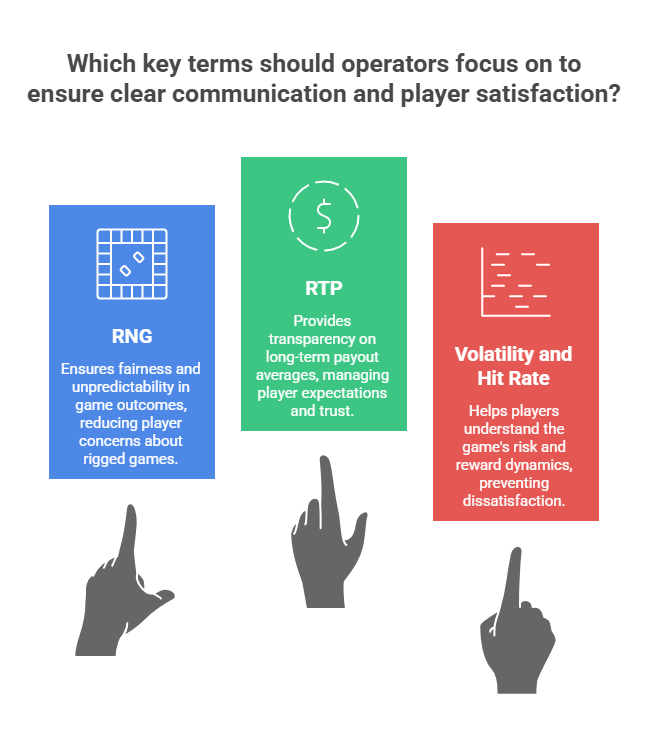
While RTP explains the long-term return, volatility explains the short-term experience. Also known as variance, it dictates how often and how much a game pays out. This is a critical concept for game selection on your platform.
Low vs. High Volatility
Low volatility games pay small amounts frequently. These are excellent for keeping casual players engaged. They offer longer play sessions for smaller budgets. This builds loyalty and habit formation.
High volatility games feature long dry spells punctuated by massive wins. These attract “high rollers” and streamers. The excitement of a big win drives viral marketing. However, they can frustrate casual players who deplete their bankroll quickly.
A balanced portfolio includes both types. You can guide players to the right games through categories like “Frequent Wins” or “Big Wins.” This level of RTP understanding helps you curate a superior user experience.
Regulatory Compliance and Certification
Operating without certified software is a recipe for disaster. Regulatory bodies exist to protect both the player and the operator. They ensure the RNG iGaming software functions as advertised. They also verify that the RTP claims are mathematically accurate.
The Certification Process
Before launching, the software undergoes a rigorous audit. Testing agencies inspect the source code. They run millions of simulations to check for bias. Once passed, the game receives a certificate of fairness.
Solopreneurs should always request these certificates from their software providers. Displaying the seals of iTech Labs or eCOGRA on your homepage instantly boosts credibility. It proves you are running a legitimate operation.
Transparent Reporting
Many jurisdictions require operators to publish RTP percentages. Hiding this information breeds suspicion. Make the RTP accessible within the game info or help section. This transparency reduces friction and support tickets regarding “unfair” losses.
For more information on maintaining standards, see our guide on maintaining regulatory compliance in iGaming.
Choosing the Right Software Partner
For a solopreneur, building custom RNG software is rarely feasible. The cost and regulatory hurdles are too high. Therefore, partnering with a reputable aggregator or platform provider is essential. You are effectively renting their fairness and certification.
Questions to Ask Providers
Do not assume all software is equal. You must vet your partners thoroughly. Ask specific questions about the underlying technology.
- Which independent labs certify your RNG?
- Can you provide RTP certificates for the games in the package?
- How often is the software audited?
- Do you offer a variety of volatility levels in your game portfolio?
The answers to these questions determine the quality of your business foundation. A platform with poor RNG will eventually fail. A platform with unattractive RTP will struggle to retain players.
Conclusion: Mathematics as a Business Strategy
RNG and RTP are more than just industry acronyms. They are the pillars of the online casino economy. RNG iGaming technology ensures the games are fair and unpredictable. RTP understanding ensures the games are marketable and profitable.
For the solopreneur, mastering these concepts provides a competitive edge. It allows for better game selection, smarter marketing, and efficient bankroll management. By prioritizing transparency and certified fairness, you build a brand that survives the test of time. In an industry built on luck, math remains the only constant you can rely on.
How DSTGAMING Helps — Tools You Can Use Today
Fair play isn’t a slogan. It’s a system of data, controls, and clear UI. DSTGAMING provides the plumbing to launch certified content, monitor live performance, and back it with banking that players trust.
Certified Content, One Integration
Aggregate top studios through Casino Game Aggregators and ship with the right RTP profile from day one. You get version-locked builds, certificate references, and metadata (RTP, volatility) through a single feed. That reduces integration drift and speeds compliance checks.
Live Telemetry that Mirrors Audit Practice
Our hooks track running RTP by game and version, win-size distributions, and drift alerts at sample-size gates. When a player questions fairness, support answers with evidence—active profile, certificate number, build hash, and a recent window of live results.
Payments that Reinforce Trust
Smooth withdrawals and clean KYC complete the picture. Casino Payment Solutions connects risk controls with fast payout orchestration, so the fairness message carries through the banking journey.
Content that Educates
For a clear primer, keep a Fair Play page with short, plain definitions, and guide readers to Why RNG Matters and Casino API Explained, which outline the technical specifics—version control, live RTP data, and the player-facing signals that prove fairness—so staff learn faster, players can go deeper, and the combination of certified builds, live data, and clear reading cuts ticket volume and speeds ADR outcomes.
Make Fairness a Feature with DSTGAMING
Fair play isn’t a claim on a banner; it’s daily practice. RNG protects each round. RTP sets the long-run average. Volatility and hit rate describe the journey players feel along the way. Operators who show these ideas on the screen win trust and keep it. DSTGAMING turns that approach into a system. With Casino Game Aggregators and Casino Payment Solutions, you ship certified content, surface RTP and version data, monitor results like a regulator, and back fair gameplay with fast payouts. Build the trust engine your brand deserves—build it with DSTGAMING.
For additional details about DSTGAMING’s products and services, please visit DSTGAMING.