
Web3 Gaming vs Crypto Casinos: Two Markets People Keep Confusing
Search for web3 gaming vs crypto casino and you will usually find the two lumped together. They should not be. A regulated crypto casino offers online gambling under an authorization and accepts digital assets for payment or settlement. A Web3 game uses blockchain technology, often to support tokens or player-held digital assets. Not every Web3 game issues tradable assets. Not every crypto casino is licensed.
The confusion comes from shared vocabulary: wallets, tokens, on-chain transactions. A pharmacy and a cocktail bar both measure liquids carefully and serve customers across a counter. Nobody confuses their licences.
These 2 markets differ in who their users are, how they make money and who regulates them. Treat them as one category and you risk the wrong authorization, the wrong benchmarks and the wrong product assumptions. Usually all 3 at once.
Different players: GameFi vs iGaming audiences
A casino player pays for entertainment inside a game designed to produce a negative expected return over time. Individual sessions vary. The rules still create a house edge. Gross gaming revenue (GGR), meaning stakes minus winnings paid, is not profit either. Bonuses, taxes, supplier fees, payment costs and operating expenses all come out before anyone sees a margin.
Web3 gaming draws a wider mix of motives. Some users play for fun or for digital ownership. Others trade assets or expect financial upside. During the 2021 play-to-earn boom, some Axie Infinity players in the Philippines treated in-game rewards as income.
That expectation does not exist in every blockchain game. Where it does, it changes acquisition, retention and risk. A player who treats a game as a job tends to leave when the job stops paying.
Counting wallets is not counting players
DappRadar, a widely used analytics and discovery platform for decentralized applications (dApps), reported that blockchain gaming averaged 5.8 million daily unique active wallets (dUAW) in Q1 2025. That fell to 4.8 million in Q2 and 4.66 million in Q3, a drop of roughly 20% across the 3 quarters.
Read those numbers with care. They count wallet addresses interacting with dApp smart contracts, not verified individual players. One person can run several wallets, and off-chain activity may not show up at all. Counting wallets to measure players is like counting keys to measure residents.
So do not set a dUAW figure beside an iGaming metric and compare the two. It shows on-chain interaction. It cannot stand in for active depositing customers, stakes, GGR or player retention.
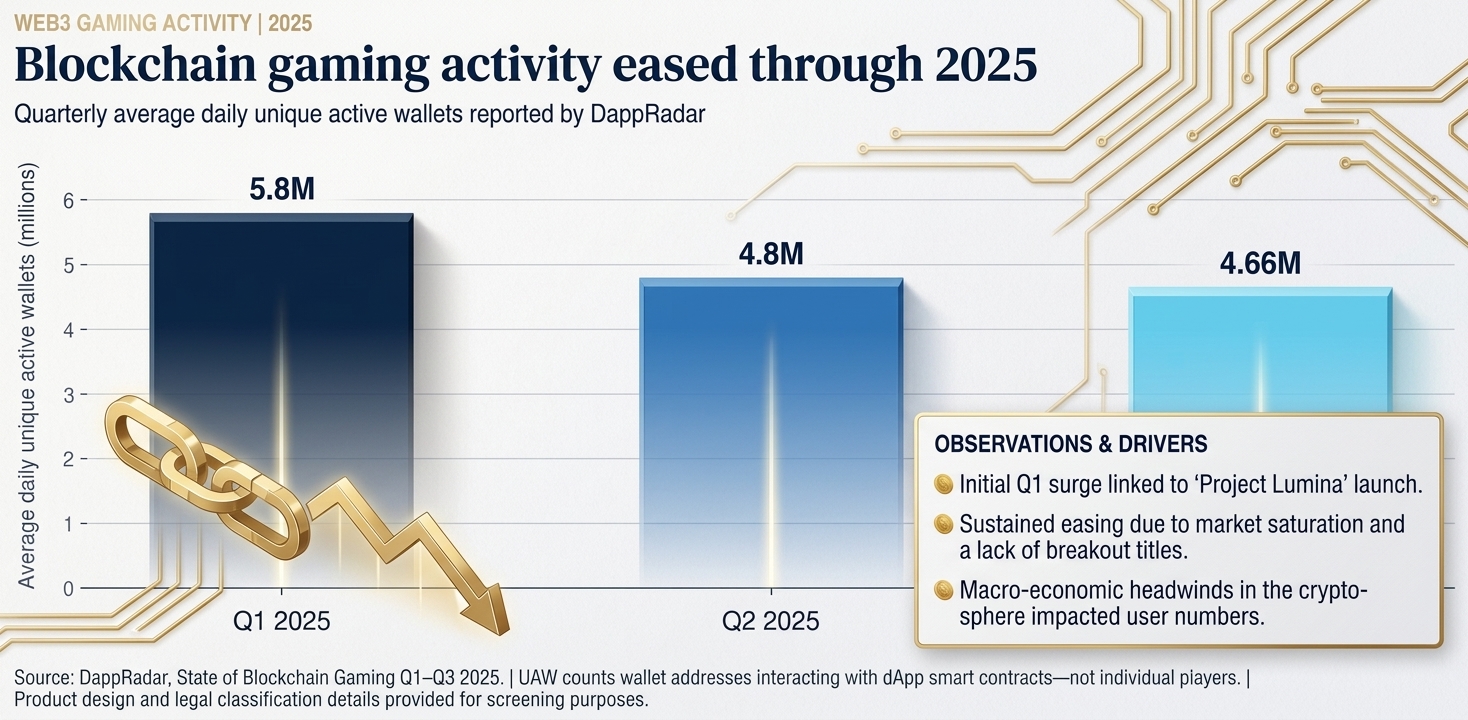
Figure 1. Average daily unique active wallets in blockchain gaming, Q1 to Q3 2025. Source: DappRadar.
Different economics: what each business actually sells
A casino earns GGR from wagering. Its economics depend on game configuration, player volume and retention, minus bonuses, taxes, supplier charges, payment costs and operating expenses.
Accepting crypto changes the payment rail, not the wagering model. Paying a taxi fare in bitcoin does not turn the taxi into an airline. Casino revenue does not depend on the resale price of a token or NFT.
For a crypto casino, the commercial questions sit in the cashier and the treasury. How do deposits, withdrawals, conversion, treasury exposure and source-of-funds controls work within the licence? Liquidity, volatility, network costs and payment partner terms all shape cost and player experience, even when the games themselves stay unchanged.
A Web3 game earns differently. Asset sales, marketplaces, in-app purchases, subscriptions and other services. The value of its digital assets rests on utility, player demand, liquidity, token supply and sinks, retention and content quality. New launches alone cannot hold it up.
What the 2025 and 2026 numbers say
The recent market shows that risk plainly. DappRadar counted more than US$1.8 billion in blockchain-gaming funding in 2024, against US$293 million through Q3 2025. With 3 quarters gone, 2025 had raised about 16% of the prior year’s total. And only 53% of Q3 funding went directly to games.
In April 2026, Decrypt highlighted steep declines in many popular gaming tokens, alongside closures including Forgotten Runiverse and Xociety. These point to funding and valuation risk. They do not necessarily mean the whole market has crashed.
They do show a variable that a Web3 studio carries and a casino does not. The price of the thing it sells can fall sharply for reasons that have nothing to do with the game.
Side-by-side comparison
| Dimension | Crypto casino | Web3 gaming |
|---|---|---|
| Core product | Regulated wagering using digital assets as a payment or settlement method | A game using blockchain technology, sometimes with tokens or player-held assets |
| Typical motivation | Paid entertainment and the chance of a payout | Entertainment, ownership, participation and sometimes asset trading |
| Main revenue sources | GGR, less the costs of bonuses, taxes, suppliers, payments and operations | Asset sales, marketplace fees, in-app purchases, subscriptions and related services |
| What supports the economics | Wagering volume, retention, game margin and cost control | Player demand, utility, liquidity, token design, retention and content quality |
| Primary legal review | Gambling licence, AML, payments, responsible gambling and local operating rules | Crypto-asset classification, consumer protection, game publishing and age rating |
| When gambling law matters | From the outset, when the product offers wagering | When product mechanics satisfy the local test for gambling |
| 2026 watch item | Curaçao local-substance and crypto-wallet controls | MiCA scope, national transition dates and PEGI’s revised criteria |
| Best suited for | Operators building an iGaming business under a defined licensing framework | Studios building a games product with blockchain-based features |
Table 1. Structural differences between crypto casinos and Web3 gaming. Product classification still depends on design and jurisdiction.
Different regulation: who reviews the product
Crypto casinos start with the gambling regulator
For a crypto casino, the starting point is the gambling authority in each target market. Curaçao’s National Ordinance on Games of Chance (LOK) took effect on 24 December 2024 and replaced the old master and sub-licence system. Existing NOOGH licences became provisional LOK licences rather than lapsing automatically on 1 January 2025.
Under the published statutory schedule, a Curaçao B2C licence carries an annual fee of €47,450. That splits into €24,490 to the treasury and €22,960 in supervisory fees. Add the €4,592 application fee plus applicable suitability-review fees, and year 1 starts above €52,000 before anything else gets paid.
That is the small number. From 1 January 2026, the local-substance framework generally expects an office, a resident managing director and at least 1 locally based, full-time Key Person during the first 4 years, subject to exemptions. Staff that properly and the payroll will likely outrun the licence fee.
Crypto-payment controls add their own list. Entity or group wallets. No personal wallets. Blockchain analytics.
Web3 games start with the feature
For Web3 gaming, the answer depends on which feature you are looking at. MiCA applies to crypto-asset issuers and crypto-asset service providers within its scope. A game does not become a crypto-asset service provider just because it contains tokens.
Timing adds a wrinkle. 2026 marks the outer limit for MiCA’s transitional grandfathering, but several member states set shorter transition periods. So which rules apply to you today depends on the member state.
Unique NFTs can fall under an exclusion. Issuing them in large series or collections, though, could indicate a fungible token, which brings MiCA back into play. And where an asset qualifies as a financial instrument, financial-services law takes precedence, assessed case by case.
Two more points close common gaps. Gambling remains mainly a national competence, so MiCA authorization is no substitute for a gambling licence. And PEGI does not regulate gambling at all. It rates content by age.
For games submitted from June 2026, PEGI’s revised criteria generally place paid random items at PEGI 16, or PEGI 18 in certain circumstances. Blockchain and NFT features go to PEGI 18. For a studio courting a teenage audience, that single rule can decide the whole product.
Where web3 gambling actually blurs
The overlap appears when a game combines 3 elements. A payment or other form of consideration. An outcome materially affected by chance. And a prize or reward that converts to cash or another asset.
That makes a useful screening trigger. It is not a legal test. Definitions differ between regimes, and no single formula applies everywhere.
In the UK, most loot boxes with non-cashable prizes fall outside the statutory definition of gambling. In January 2026, the government reaffirmed that approach while keeping the option of further legislation open. Belgium’s Gaming Commission went the other way back in 2018, finding the paid elements in the 3 games it reviewed to be illegal games of chance. That ruling does not make similar loot boxes unlawful everywhere else.
South Korea offers a blockchain-specific case. In January 2023, the Seoul Administrative Court upheld the refusal to rate Five Stars for Klaytn, because its NFT prizes counted as prohibited prizes under the Game Industry Promotion Act. The reasoning turned on prize restrictions and speculative elements, not on anything borrowed from Belgian gambling law. Different legal route, same practical result: no rating, and no lawful path to Korean players as designed.
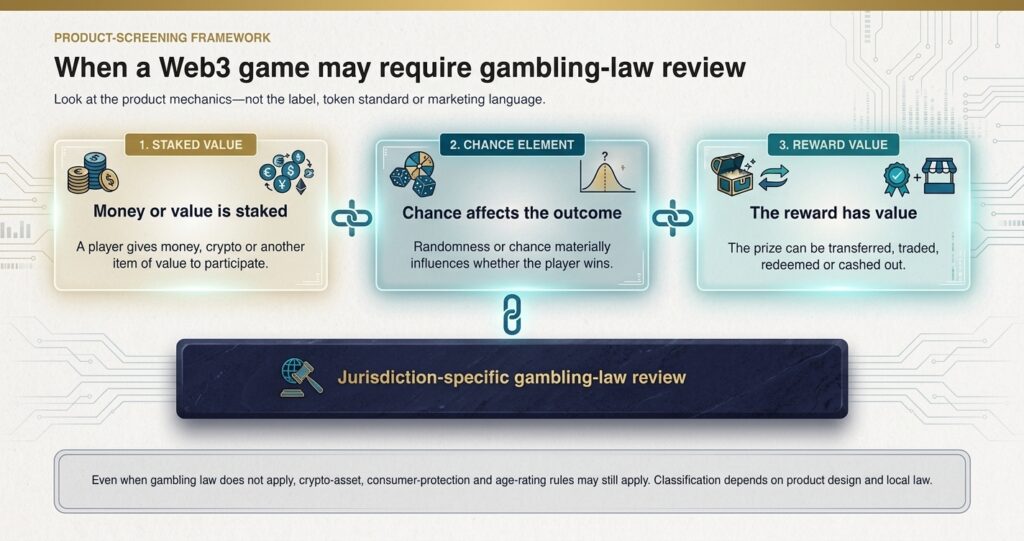
Figure 2. A practical screening framework for identifying when a Web3 game may require gambling-law review.
Which market are you building for?
If your product accepts stakes and resolves outcomes for a prize, start with the gambling framework in every target market. The licence decides which game suppliers, payment providers and commercial partners will onboard you at all. Settle the licensing structure before you choose crypto casino software, and ask any platform provider, us at DSTGAMING included, which licences it already supports.
If your product is mainly a game with blockchain assets, start with feature-level analysis. Token or asset classification, consumer disclosures, game-publishing rules, age ratings and marketplace design.
If it combines wagering with cashable assets, get jurisdiction-specific gambling advice early. Calling it a game changes nothing. Neither does wrapping the prize in an NFT. Regulators look at what the product does, and a wager in a costume is still a wager.
The category decision comes first
The decisive question is not which chain or which wallet. It is what the customer is buying, how value moves through the product, and which authority has jurisdiction.
Answer that first and licensing, payments, suppliers and product design line up behind it. Answer it last and you learn which regulator you belong to from the regulator.
The operator stays responsible for obtaining and keeping the authorization each target market requires. For more operator guidance, see DSTGAMING’s iGaming education hub.
DSTGAMING builds licensed crypto casino platforms. See how it works.